Best tap tempo delay pedals
The feature that turns a delay from a setting into an instrument, and the subdivision switch that decides whether it is any use to you.
Fret & Fuzz earns a commission when you buy through the links on this page. It costs you nothing and it does not decide what we rank. How we’re funded.
We have not played this gear. Every pick below is chosen from published manufacturer specifications and the arithmetic set out in how we research, which you can re-run yourself.
Tap tempo is only useful if the pedal also lets you choose the subdivision, because the sound almost everyone wants from it is a dotted eighth rather than a quarter note. Buy the BOSS DD-3T for subdivisions on a front-panel knob at 70 mA, the DD-8 if the delay slot has to cover everything else too, and the MXR Carbon Copy Deluxe if you want analog repeats with a tap switch. Check before you buy: several famous delays have no tap tempo at all.
This is a narrow page on purpose. Plenty of delays sound good; far fewer let you set the time with your foot, and fewer still let you choose what the tap means.
01The criteria, before any product
| Criterion | Why it matters | What to look for |
|---|---|---|
| Does it actually have tap tempo | Several well-known delays do not, including one named almost the same as one that does | A tap switch or a published TEMPO jack |
| Subdivision control | The sound people want is usually a dotted eighth, not a quarter note | A front-panel division switch, not a menu |
| Where you tap | Tapping on the pedal itself saves a box and a cable | Onboard switch, external jack, or ideally both |
| Maximum delay time in tap mode | A short ceiling limits how slow a tempo you can lock to | 800 ms on the DD-3T; up to 10 s on the DD-8 |
| Current draw | Digital delays are among the hungriest pedals on a board | 70 mA to 100 mA here — and one maker publishes nothing |
| Repeat character | Digital stays bright; analog darkens as it decays | Published signal path, analog or digital |
| Trails and bypass | A tail cut off mid-decay is an audible edit | A carryover switch, or published true bypass |
Notice that the first row is a criterion at all. In most categories you do not have to check whether the pedal has the feature the page is about — here you do, and the skip pick below exists for exactly that reason.
Best tap tempo delay pedals
| # | Product | Best for | Price |
|---|---|---|---|
| 01 | 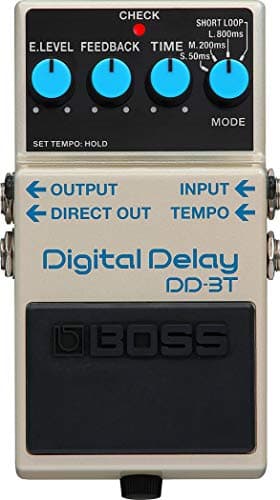 BOSS DD-3T Digital Delay Three subdivisions on the MODE knob, tap from the onboard switch or an external one, and a Direct Out. | Tap tempo done properly, at the lowest draw here | |
| 02 | 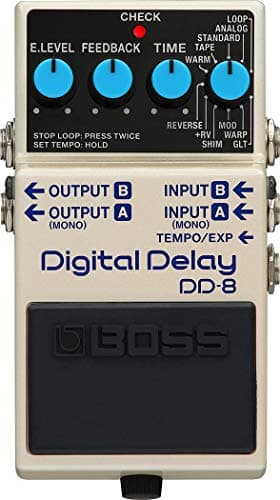 BOSS DD-8 Digital Delay Eleven modes and up to 10 seconds with tap, true stereo and carryover — at the highest draw on this page. | One delay slot that has to do everything, tap included | |
| 03 | 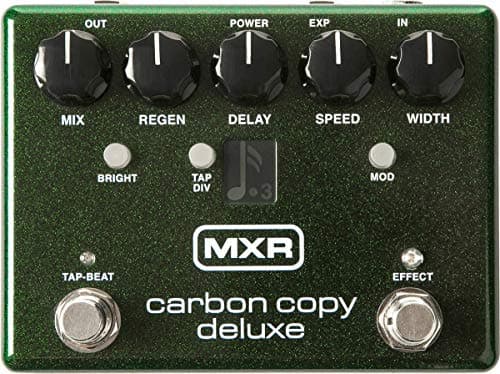 MXR Carbon Copy Deluxe Analog Delay Four tap divisions, 1.2 seconds, true bypass and a Dry Kill switch — on an all-analog bucket-brigade path. | Analog repeats with tap, and the most subdivisions | $245.99 · Check price #ad How we’re funded · price as of October 18, 2026 |
| ! | 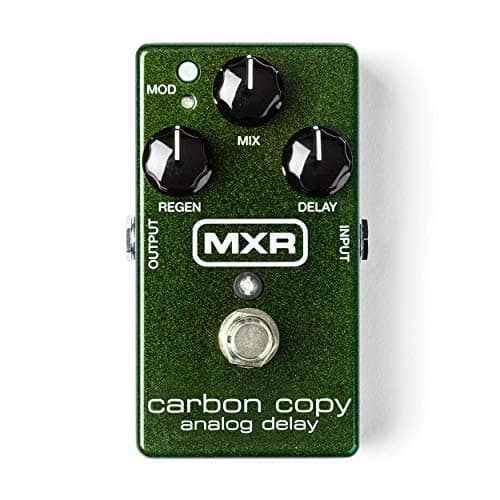 MXR Carbon Copy Analog Delay The standard Carbon Copy has no tap tempo at all — the Deluxe above is the one that does. Skip this one — see why below | Not this list, and it is the delay people buy by mistake | $159.99 · Check price #ad How we’re funded · price as of October 18, 2026 |
Rows link to the full write-up further down this page. Prices come from the live price layer only — where there is no live figure the button reads “Check price” rather than showing a remembered number.
03Why the subdivision switch is the whole feature
Tap tempo on its own sets the delay to the tempo you tapped, which gives you a repeat on every quarter note. That is a usable sound and it is rarely the one people are chasing.
The sound that made tap tempo famous is the dotted eighth: a repeat three quarters of a beat after the note, which interleaves with a straight eighth-note part so the two together produce a running pattern neither hand is playing. Without a subdivision control you cannot get there by tapping — you would have to tap a tempo that is not the song's tempo, which defeats the point. That is why the DD-3T puts the division on the MODE knob and the Carbon Copy Deluxe gives it a dedicated switch.
BOSS DD-3T Digital Delay
Tap tempo done properly, at the lowest draw here
The number70 mA, 12.5 to 800 ms, 1 M ohm in, 1 k ohm out. All published by BOSS.
This is the pedal that exists specifically to answer this question, and it is the one to buy for most people. BOSS publishes tap tempo from the onboard pedal switch or an external footswitch, which matters more than it sounds: tapping on the pedal itself means no second box and no extra cable, and the TEMPO jack is there when you would rather not bend down.
The MODE knob selects the subdivision — quarter-note triplet, dotted-eighth or quarter note — so the division is a front-panel control rather than a menu. There is also a Direct Out for running a parallel rig, and at 70 mA it is the least demanding pedal here by a clear margin.
The cons are the ceiling and the character. Delay time tops out at 800 ms, so the long ambient washes people use a 10-second delay for are simply not available. The repeats are digital and stay bright rather than darkening as they decay, which is the opposite of what a slapback usually wants. No presets, and no adaptor in the box.
| Delay time | 12.5 to 800 ms, divided into three ranges, plus a Short Loop setting for phrase capture |
|---|---|
| Tap tempo | Tap in tempos with the onboard pedal switch or an external footswitch |
| Subdivisions | The MODE knob selects quarter-note triplet, dotted-eighth note or quarter note |
| Controls | MODE, TIME, FEEDBACK and E.LEVEL knobs, pedal switch, and a CHECK battery indicator |
| Impedance | 1 M ohm input, 1 k ohm output; recommended load 10 k ohm or greater |
| Current draw | 70 mA |
| Battery life | Approximately 5 hours on an alkaline 9 V |
| Connectors | Input, Output, Direct Out, Tempo and DC In |
| Size / weight | 73 x 129 x 59 mm, 420 g including battery |
| What it does not do | 800 ms is the ceiling, so the long ambient washes a 10-second delay allows are not available here. There are no presets, the repeats are digital rather than analog, and no adaptor is included. |
Specs from BOSS DD-3T specifications. We have not used this unit.
BOSS DD-8 Digital Delay
One delay slot that has to do everything, tap included
The number100 mA, up to 10 seconds with tap tempo input, 440 g.
If the tap tempo is one requirement among several, this is the pedal. BOSS publishes eleven modes — Analog, Standard, Tape, Warm, Reverse, +RV, Shimmer, Mod, Warp, GLT and Loop — with up to 10 seconds of delay available through the tap tempo input, plus true stereo in and out.
The Carryover switch is the feature that pairs best with tap tempo in a live set: repeats can ring out past bypass instead of being cut off, so a tempo-locked part can hand over to a clean one without an audible edit.
The cons: it draws 100 mA, the most on this page and enough to break a modest supply budget on its own. Tap tempo runs through the TEMPO/EXP jack rather than a dedicated front-panel division switch, so the subdivision is not the one-knob affair it is on the DD-3T. And there are no presets, so every change is a knob move. Our full DD-8 review covers it in depth.
| Modes | 11 — Analog, Standard, Tape, Warm, Reverse, +RV, Shimmer, Mod, Warp, GLT, plus Loop |
|---|---|
| Maximum delay | Up to 10 seconds, with tap tempo |
| Controls | Mode, Time, Feedback, E.Level, Carryover switch, pedal switch |
| Current draw | 100 mA |
| Battery life | Approx. 3.5 hours on alkaline |
| I/O | True stereo in and out, with three selectable output modes |
| Weight | 440 g including battery |
| What it does not do | No adaptor included. At 100 mA it is not a pedal you daisy-chain casually, and the 3.5-hour battery figure means battery power is a backup, not a plan. |
Specs from BOSS DD-8 specifications. We have not used this unit.
MXR Carbon Copy Deluxe Analog Delay
Analog repeats with tap, and the most subdivisions
The numberUp to 1.2 s; four tap divisions; true bypass.
The analog answer, and the only one here that does not make you choose between bucket-brigade character and a tap switch. MXR publishes a Tap Division switch with four subdivisions — dotted eighths, eighths, triplets and sixteenths — which is the widest set on this page, with a status display to show what you have selected.
It also carries Speed and Width modulation controls that MXR describes as chorusing, a Bright/Warm tone switch, and a Dry Kill switch for running it in a parallel loop or into a wet-dry rig. Up to 1.2 seconds and true bypass.
The cons are documentation and money. MXR publishes no current-draw figure and no dimensions, so you can budget neither a supply output nor a board slot for it without measuring — an awkward gap on a pedal at this price. It is also comfortably the most expensive pedal here, and no power supply is included.
| Delay time | Up to 1.2 seconds |
|---|---|
| Tap tempo | Yes, with what MXR describes as an easy-to-read status display |
| Tap divisions | A Tap Division switch offering dotted eighths, eighths, triplets and sixteenths |
| Modulation | Speed and Width controls, which MXR describes as chorusing |
| Switches | Bright/Warm tone switch, Mod switch, Line/Instrument level switch and a Dry Kill switch |
| Signal path | All-analog bucket-brigade delay |
| Bypass | True bypass |
| Power | 9 V battery, Dunlop ECB003 adapter, or a DC Brick / Iso-Brick supply |
| Electrical data | MXR publishes no current-draw figure and no dimensions for it |
| What it does not do | MXR publishes neither a current draw nor dimensions, so you cannot budget a supply output or a board slot for it without measuring. It is also the most expensive pedal on this page by a clear margin, and no power supply is included. |
Specs from MXR Carbon Copy Deluxe M292 product page. We have not used this unit.
#ad How we’re funded · price as of October 18, 2026
MXR Carbon Copy Analog Delay
Not this list, and it is the delay people buy by mistake
We are not picking this one on a tap tempo page, and it is on the page because it is the single most likely mistake a reader of this page can make. The standard MXR Carbon Copy is a genuinely good analog delay that appears on our delay roundup for what it does do.
What it does not do is tap tempo. MXR publishes a 600 ms ceiling, Delay, Mix and Regen controls and a modulation footswitch — and no tap switch and no tap division anywhere in the specification. The name is one word away from the pedal that does have it, they sit next to each other on the same shelf, and the difference is roughly a hundred dollars.
If you want analog repeats and a tap switch, you want the Deluxe. If you do not need tap tempo, the standard version is the cheaper and smaller pedal and there is no reason to pay for the other — best delay pedals covers it properly.
| Maximum delay | 600 ms |
|---|---|
| Controls | Delay, Mix, Regen, plus a modulation footswitch |
| Modulation | Two internal trim pots set modulation width and rate |
| Signal path | All-analog bucket-brigade delay |
| Bypass | True bypass |
| Power | 9 V battery, Dunlop ECB003 adapter, or a DC Brick / Iso-Brick supply |
| Current draw | Not published by Dunlop |
| What it does not do | 600 ms is the ceiling — there is no tap tempo, no presets, and no way to get a long ambient wash out of it. Repeats darken by design and cannot be made bright. |
Specs from MXR Carbon Copy product page. We have not used this unit.
04Where you tap, and why it matters more than it sounds
There are two ways to tap: on the pedal's own footswitch, or through a jack into a separate external switch. BOSS publishes both for the DD-3T, which is the arrangement worth having.
Tapping on the pedal itself costs nothing and works everywhere, but on a pedal whose switch also toggles bypass it means holding or double-tapping to get into tap mode — fine in a rehearsal, fiddly in a song. An external switch gives you a dedicated tap you can leave your foot near, at the cost of a board slot and a cable. If a set involves genuine tempo changes between songs, the external switch stops being a luxury.
05Analog or digital, when tap tempo is a requirement
This is where the category narrows sharply. A bucket-brigade delay line is an analog circuit whose time is set by a clock, and adding tap tempo to that is more work than bolting it onto a digital delay — which is why most analog delays, including the standard Carbon Copy, simply do not have it.
So if you want darkening, progressively duller repeats and a tap switch, your options are few and the Carbon Copy Deluxe is the obvious one. If you are happy with digital repeats that stay bright, you have the whole BOSS range and a much lower price. Analog vs digital delay covers what each mechanism actually does to the sound.
06The power budget, since two of these are hungry
The DD-3T draws 70 mA and the DD-8 draws 100 mA, both published. MXR publishes nothing for the Carbon Copy Deluxe, which means you either measure it or leave headroom for it.
On a board that already has a tuner, a couple of drives and a reverb, adding a 100 mA delay is frequently the purchase that forces a new power supply — a hidden cost worth adding to the price before you decide. Power requirements explained has the method, and best power supplies compares bricks on published per-output current.
07Where it goes in the chain
After your drives, and in the effects loop if your amp has one. A delay in front of a distorting preamp gets distorted along with everything else, which turns distinct repeats into a wash — the single most common reason a delay sounds worse on a board than it did in the shop.
The Dry Kill switch on the Carbon Copy Deluxe and the Direct Out on the DD-3T both exist for players running parallel or wet-dry rigs, where the delay feeds its own amp and the dry signal stays clean. That is a more advanced setup than most boards need, and worth knowing the pedals support it. Pedal order covers the whole chain.
Frequently asked questions
+ What is the best tap tempo delay pedal?
+ Does the MXR Carbon Copy have tap tempo?
+ Why does my tap tempo delay not sound like the records?
+ Do I need an external footswitch to tap tempo?
Sources
Related on Fret & Fuzz
Best delay pedals
Maximum delay time and current draw settle most of this category. Four delays on their published figures.
Best Delay pick: BOSS DD-8 Digital Delay
Delay time and tempo: the arithmetic
60,000 divided by the tempo. The full table for quarter, eighth, dotted-eighth and sixteenth notes.
Top pick: BOSS DD-8 Digital Delay
Analog vs digital delay
Why analog repeats darken, what the published time ceilings are, and which format your parts need.
Top pick: MXR Carbon Copy Analog Delay
#ad How we’re funded · price as of October 18, 2026
BOSS DD-8 review
Eleven modes, 10 seconds and carryover, against 100 mA and no presets. Both of those numbers are published.
Top pick: BOSS DD-8 Digital Delay
Pedalboard power requirements explained
Two sums decide your power supply, and almost everyone only does the first. A worked example with real published figures.
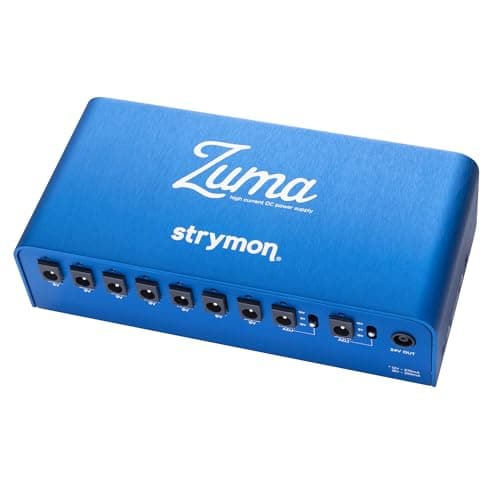
Top pick: Strymon Zuma
#ad How we’re funded · price as of October 18, 2026