Guitar pedal types explained
Five families, defined by what they do to the waveform. Once you have that map, the hundred-brand problem shrinks to a five-choice one.
Fret & Fuzz earns a commission when you buy through the links on this page. It costs you nothing and it does not decide what we rank. How we’re funded.
We have not played this gear. Every pick below is chosen from published manufacturer specifications and the arithmetic set out in how we research, which you can re-run yourself.
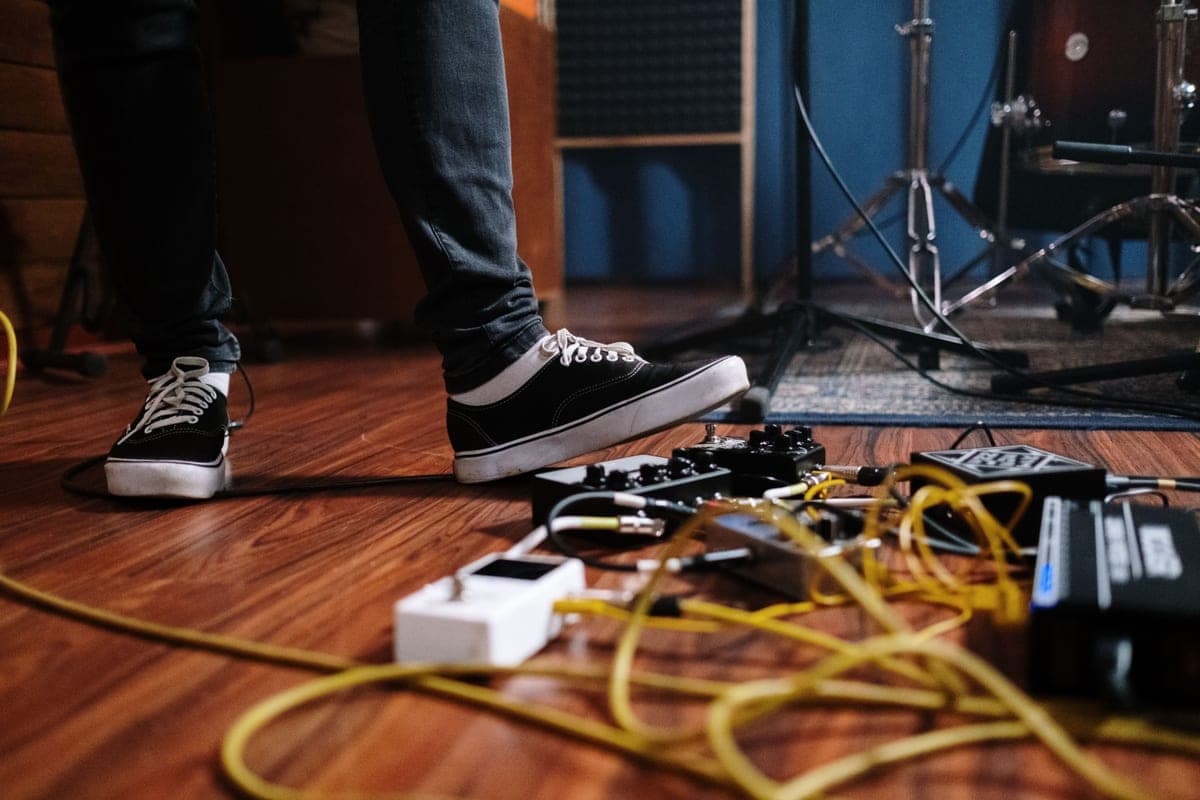
Every guitar pedal belongs to one of five families: gain (clips the waveform), time (stores and replays the signal), modulation (alters a copy in a time-varying way and recombines), filter (changes the frequency response), and utility (fixes a specific problem). Knowing which family you want narrows a market of hundreds of pedals to a handful of real decisions.
Brand-first shopping does not work in this category because the same circuits appear across dozens of brands. Family-first shopping does.
01The five families
| Family | What it does to the signal | Examples | Typical draw |
|---|---|---|---|
| Gain | Clips the waveform, adding harmonic content | Overdrive, distortion, fuzz, boost | 3-25 mA |
| Time | Stores the signal and replays it later | Delay, reverb, looper | 95-300 mA |
| Modulation | Alters a copy over time and recombines it | Chorus, phaser, flanger, tremolo | Varies |
| Filter | Changes the frequency response | EQ, wah, envelope filter | Varies |
| Utility | Fixes a named problem | Tuner, compressor, noise gate, buffer | 20-100 mA |
Draw figures are from the manufacturers' published specifications where they publish one.
02Gain: the biggest family and the most confused
Every gain pedal clips the waveform. What separates them is how hard, how symmetrically, and what EQ is applied on the way. Overdrive clips softly and usually leaves more of the amp's character; distortion clips harder and imposes more of its own; fuzz clips hardest of all and, in classic circuits, depends on being loaded by your pickup.
The labels are unreliable. The Fulltone OCD is sold as an overdrive and behaves like a distortion past halfway. Overdrive vs distortion vs fuzz works through where the boundaries actually sit.
03Time: the family that costs you a power supply
Delay and reverb are the same mechanism at different scales. Delay produces repeats you can count; reverb produces thousands of overlapping short reflections your ear reads as a space. Below about 30 ms of delay you stop hearing repeats and start hearing comb filtering, which is where modulation lives.
Practically, this is the family that changes your power situation. A BOSS DD-8 draws 100 mA and an EHX Big Muff draws about 3 mA. Adding one digital time effect to an analog board can multiply the total current several times over.
One pedal from each family, to start with
| # | Product | Best for | Price |
|---|---|---|---|
| 01 | 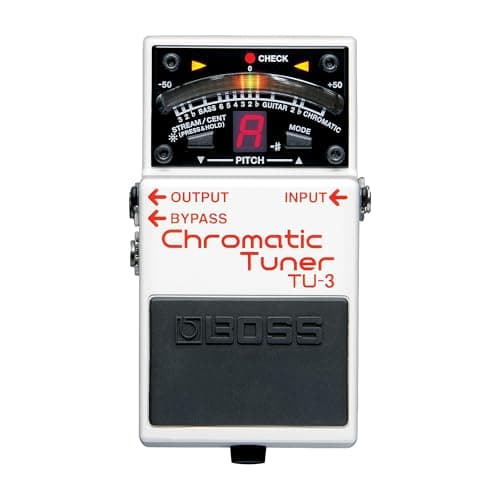 BOSS TU-3 Chromatic Tuner Mutes your output for silent tuning, and buffers a long cable run. | Utility — the first pedal anyone should own | |
| 02 | 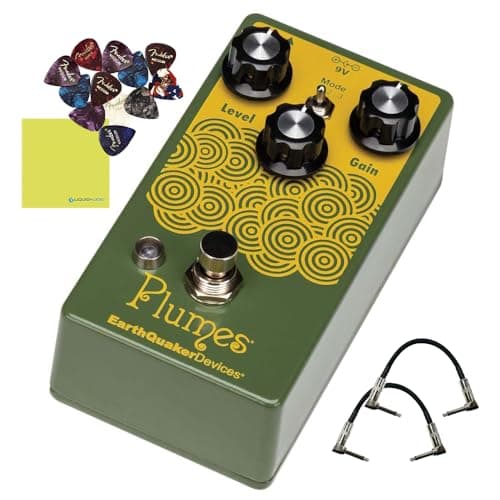 EarthQuaker Devices Plumes Symmetrical LED clipping, no clipping, or asymmetrical silicon clipping, on a three-way toggle. | Gain — three circuits in one pedal | |
| 03 | 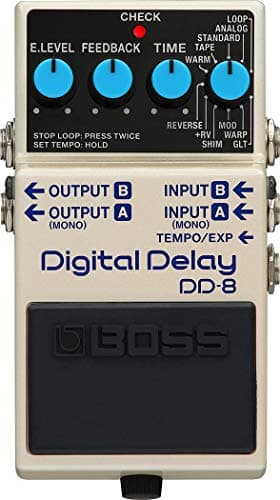 BOSS DD-8 Digital Delay Eleven delay modes and up to 10 seconds, with true stereo I/O. | Time — the family that makes a part sound finished | |
| 04 | 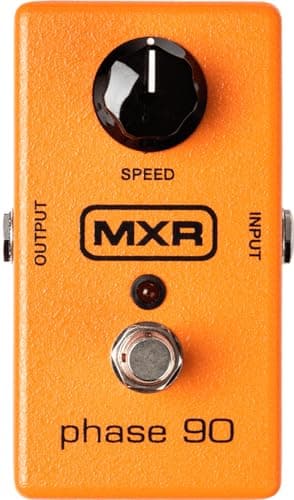 MXR Phase 90 Four all-pass stages sweeping notches through the signal, controlled by one knob. | Modulation — movement without gain | $99.99 · Check price #ad How we’re funded · price as of October 17, 2026 |
Rows link to the full write-up further down this page. Prices come from the live price layer only — where there is no live figure the button reads “Check price” rather than showing a remembered number.
05Modulation: four mechanisms that get shelved together
Chorus mixes a pitch-modulated short delay with the dry signal, which thickens the note. Flanger does the same with a much shorter delay and feedback, which produces a metallic sweep. Phaser sweeps notches using all-pass filters. Tremolo modulates volume only.
They are grouped by where they sit in the chain rather than by what they do. The modulation roundup separates them properly.
06Filter and utility
Filter pedals change frequency response without adding gain or time. An EQ does it statically; a wah does it under your foot; an envelope filter does it in response to how hard you play. An EQ is the most underrated pedal on most boards — it can fix a problem no gain pedal will.
Utility pedals solve named problems: a tuner for tuning, a compressor for uneven dynamics, a gate for noise, a buffer for a long cable run. Because the problem is specific, the spec sheet answers the question. The utility hub covers all four.
BOSS TU-3 Chromatic Tuner
Utility — the first pedal anyone should own
The number+/- 1 cent, 20 mA (80 mA with High Brightness on).
Utility pedals fix a named problem rather than adding a sound, and a tuner fixes the most universal one. The mute function is why a pedal tuner beats a clip-on for anyone who plays with other people.
BOSS publishes a C0 to C8 range at +/- 1 cent, buffered bypass, and a DC OUT jack that will power a small number of other pedals.
One cent is a stage tuner's accuracy. For setting intonation you want strobe accuracy — the tuner roundup covers the difference.
| Tuning range | C0 (16.35 Hz) to C8 (4,186 Hz) |
|---|---|
| Accuracy | +/- 1 cent |
| Modes | Chromatic, Chromatic flat x2, Guitar, Guitar flat x2, Bass, Bass flat x3 |
| Bypass | Buffered bypass |
| Current draw | 20 mA; 80 mA with High Brightness mode on |
| Jacks | Output, Bypass, DC IN, DC OUT (powers other pedals) |
| Weight | 390 g including battery |
| What it does not do | +/- 1 cent is fine for a stage tuner and not enough for setting intonation — that is strobe territory. Turning on High Brightness quadruples the current draw, which matters on a shared supply. |
Specs from BOSS TU-3 specifications. We have not used this unit.
EarthQuaker Devices Plumes
Gain — three circuits in one pedal
The number10 M ohm in, 100 ohm out, 25 mA. All published by EarthQuaker.
Gain pedals clip the waveform. Which diodes do the clipping, where they sit in the circuit, and what EQ is applied around them is what separates a hundred pedals into four or five families.
This one lets you switch between three of those behaviors, including a no-clipping mode that is a clean boost. For learning what the differences actually sound like, that is more useful than three separate pedals.
It also publishes everything: input and output impedance, current draw, and the bypass mechanism.
| Controls | Level, Gain, Tone (bass left, midrange center, treble right), 3-way clipping toggle |
|---|---|
| Clipping modes | Mode 1 symmetrical LED clipping, which EarthQuaker describes as more crunch and compression; mode 2 no clipping, a wide-open op-amp clean boost; mode 3 asymmetrical silicon diode clipping, described as more transparency with a looser feel |
| Circuit | EarthQuaker states it uses JFET op-amps rather than the traditional 4558 IC, with the 9 V supply internally converted to +/- 9 V for more headroom |
| Current draw | 25 mA |
| Input impedance | 10 M ohm |
| Output impedance | 100 ohm |
| Bypass | Flexi-Switch relay-based true bypass, momentary or latching |
| Size | 4.75 x 2.50 x 2.25 in (121 x 64 x 57 mm) with knobs |
| Power | 9 V DC, 2.1 mm center-negative barrel |
| What it does not do | No power supply included and no battery compartment. Mode 2 is a clean boost, not a second drive voicing — if you expected three flavors of dirt, one of them is not dirt. |
Specs from EarthQuaker Devices Plumes product page. We have not used this unit.
BOSS DD-8 Digital Delay
Time — the family that makes a part sound finished
The number100 mA — thirty times an analog fuzz, and the reason boards need power supplies.
Time-based pedals store your signal and play it back later. Delay does it with countable repeats; reverb does it with thousands of overlapping short ones. Same mechanism, different scale.
Eleven modes covers analog-style darkening repeats, clean digital ones, reverse, shimmer and a looper mode.
The 100 mA draw is the number to plan around. This is the pedal that usually forces a board off a daisy chain — see the power arithmetic.
| Modes | 11 — Analog, Standard, Tape, Warm, Reverse, +RV, Shimmer, Mod, Warp, GLT, plus Loop |
|---|---|
| Maximum delay | Up to 10 seconds, with tap tempo |
| Controls | Mode, Time, Feedback, E.Level, Carryover switch, pedal switch |
| Current draw | 100 mA |
| Battery life | Approx. 3.5 hours on alkaline |
| I/O | True stereo in and out, with three selectable output modes |
| Weight | 440 g including battery |
| What it does not do | No adaptor included. At 100 mA it is not a pedal you daisy-chain casually, and the 3.5-hour battery figure means battery power is a backup, not a plan. |
Specs from BOSS DD-8 specifications. We have not used this unit.
MXR Phase 90
Modulation — movement without gain
Modulation pedals split the signal, alter one copy in a time-varying way, and recombine. A phaser shifts phase; a chorus detunes; a flanger does the same with a much shorter delay; a tremolo modulates volume.
One Speed knob and nothing else. That means no subtle setting is available — which is either the appeal or the reason to buy something with a depth control.
Dunlop publishes no electrical figures for it. Any 9 V supply runs it.
| Controls | One Speed knob |
|---|---|
| Power | 9 V battery, Dunlop ECB003 adapter, or a DC Brick / Iso-Brick supply |
| Electrical data | No current-draw or impedance figure is published for this pedal, so none is stated here. |
| What it does not do | One knob means no depth control and no mix control. If you want a subtle phase you cannot dial it — you get the Phase 90 amount or nothing. |
Specs from MXR Phase 90 product page. We have not used this unit.
#ad How we’re funded · price as of October 17, 2026
07The conventional chain order
- Tuner — sees the unprocessed signal, and its mute kills everything downstream.
- Fuzz — must be loaded by your pickup, not by a buffer. This is the one non-negotiable position.
- Wah and filter — respond to the raw signal's dynamics.
- Compressor — evens out what goes into the drives.
- Overdrive and distortion — lower gain into higher gain.
- EQ — shapes what the drives produced, or sits before them to change what gets clipped.
- Modulation — modulates the distorted signal.
- Delay, then reverb — last, or in the amp's effects loop, so their output is never distorted.
Two of those positions are load-bearing and the rest are preference. Pedal order explains which and why.
08Where to start
A tuner, one gain pedal chosen to complement your amp, and one time-based pedal. That is a complete rig and it is three pedals. Everything after that should answer the question: what problem does this solve that the board does not already solve? Chorus vs phaser takes the two most often confused and shows which control layout tells them apart.
Frequently asked questions
+ What are the main types of guitar pedals?
+ What pedals do I need to start?
+ What order do pedal types go in?
+ Which pedal type uses the most power?
Sources
Related on Fret & Fuzz
Chorus vs phaser
One adds a detuned second voice; the other sweeps notches through the one you have. The control layout gives it away.
Top pick: BOSS CH-1 Super Chorus
Overdrive vs distortion vs fuzz
How hard, how symmetrically, and with what EQ around it. The real distinctions, and why the box labels are unreliable.
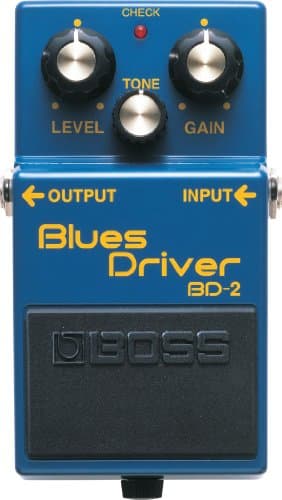
Top pick: BOSS BD-2 Blues Driver
#ad How we’re funded · price as of October 17, 2026
Pedal order: what changes and what does not
Two placements are load-bearing and the rest are preference. Which is which, and the impedance figures behind the first one.
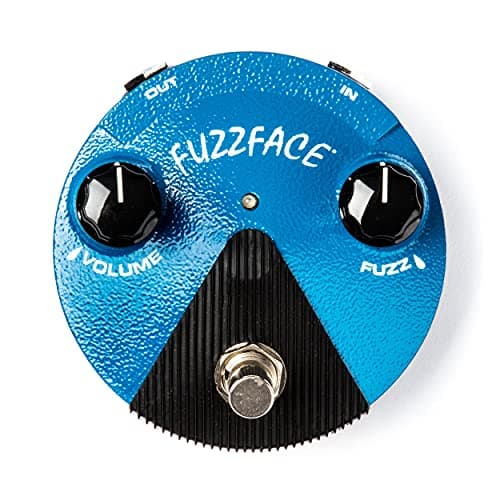
Top pick: Dunlop Fuzz Face Mini Silicon
#ad How we’re funded · price as of October 17, 2026
Best guitar pedals
One shortlist per job, chosen from published circuit and power specs. Every list names something we would not buy, and says why.
Delay vs reverb
Countable repeats or a cloud of reflections. Which to buy first, in what order to run them, and what each costs to power.
Top pick: BOSS DD-8 Digital Delay
Compressors, EQ, gates, tuners and loopers
The unglamorous half of a pedalboard. These pedals fix a named problem, which makes them the easiest category to shop for on specs alone.