Best delay pedals
Two published numbers settle most of this: maximum delay time and current draw. The first decides what the pedal can do, the second decides what it costs to power.
Fret & Fuzz earns a commission when you buy through the links on this page. It costs you nothing and it does not decide what we rank. How we’re funded.
We have not played this gear. Every pick below is chosen from published manufacturer specifications and the arithmetic set out in how we research, which you can re-run yourself.
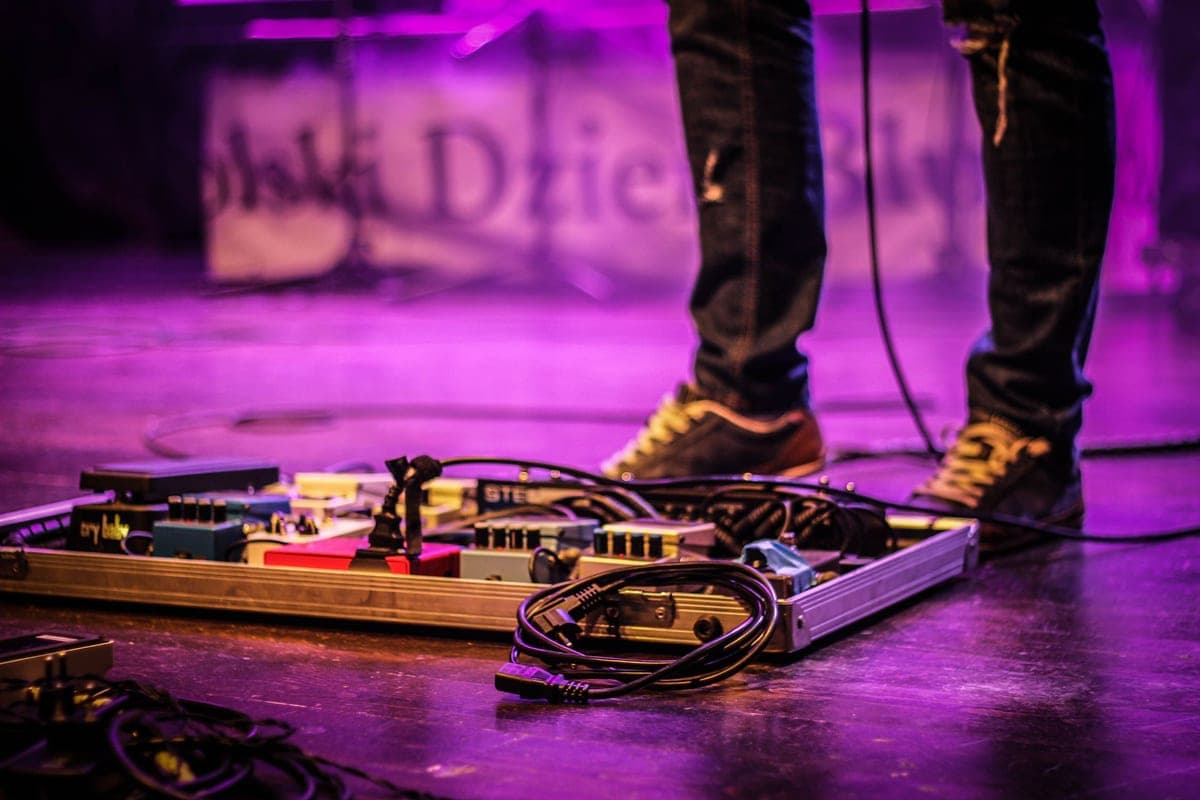
If you want one delay, buy a digital one — the BOSS DD-8 publishes eleven modes and up to 10 seconds, at a cost of 100 mA. If you specifically want short slapback with repeats that darken as they decay, an analog delay like the MXR Carbon Copy does that better and costs almost nothing to power, at a hard ceiling of 600 ms.
Delay is the effect people describe least usefully. 'Warm', 'lush' and 'tape-like' describe a listening impression; maximum delay time, repeat degradation and current draw describe what the pedal can and cannot do on your board.
Best delay pedals
| # | Product | Best for | Price |
|---|---|---|---|
| 01 | 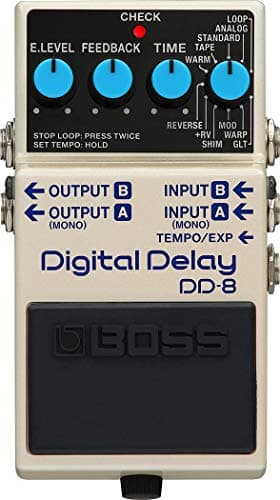 BOSS DD-8 Digital Delay Eleven modes, up to 10 seconds, tap tempo and true stereo I/O. | One delay that covers every job | |
| 02 | 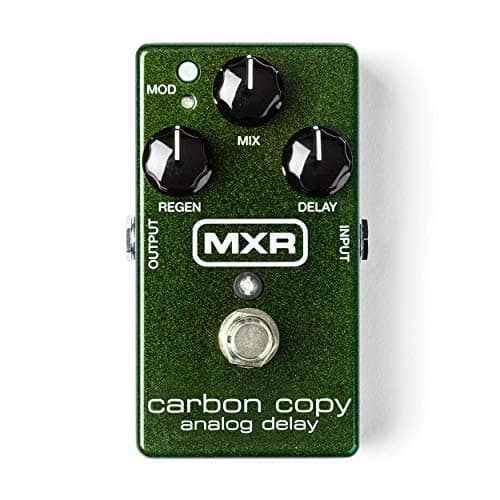 MXR Carbon Copy Analog Delay 600 ms of bucket-brigade delay with repeats that darken as they decay — that degradation is the sound. | Analog repeats at almost no power cost | $159.99 · Check price #ad How we’re funded · price as of October 18, 2026 |
| 03 | No photo TC Electronic Flashback 2 Delay The MASH footswitch is pressure-sensitive, so it doubles as an expression control without an expression pedal. | Tap tempo and a foot-controllable parameter | |
| 04 | 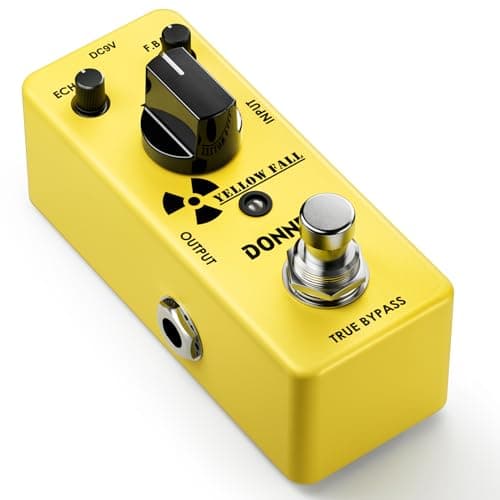 Donner Yellow Fall Analog Delay A genuine analog circuit in a mini enclosure, with the short delay time that implies. | Real analog delay at the lowest price | |
| ! | 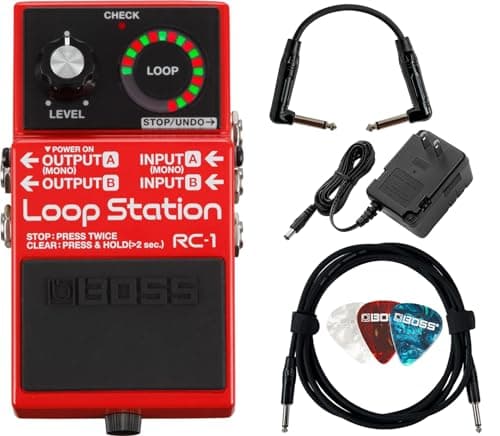 BOSS RC-1 Loop Station A looper, not a delay — and the confusion costs people a board slot. Skip this one — see why below | Not a delay, and frequently bought as one | $129.99 · Check price #ad How we’re funded · price as of October 18, 2026 |
Rows link to the full write-up further down this page. Prices come from the live price layer only — where there is no live figure the button reads “Check price” rather than showing a remembered number.
02Analog and digital are different tools, not different quality levels
| Analog (bucket brigade) | Digital | |
|---|---|---|
| Maximum delay | Typically under 600 ms; the Carbon Copy tops out there | Seconds — the DD-8 publishes up to 10 |
| Repeat character | Each repeat loses top end; degrades progressively | Clean unless a mode deliberately degrades them |
| Tap tempo | Rare | Standard |
| Modes | One | The DD-8 publishes eleven |
| Current draw | Low — single or low double digits | 100 mA on the DD-8 |
| Stereo | Rare | Common; the DD-8 has true stereo I/O |
| Best at | Slapback, short rhythmic repeats sitting behind the guitar | Long repeats, ambient washes, tempo-synced parts |
03Why analog repeats darken
A bucket-brigade device passes the signal through a long chain of capacitor stages, one clock cycle at a time. Every transfer loses a little accuracy and a little high-frequency content. Feed the output back to the input for multiple repeats and each pass through the chain compounds that loss.
The practical effect is that analog repeats sit further behind the dry signal with each iteration, which is why they stay out of the way in a busy arrangement. A clean digital repeat competes with the note you just played; a darkened one does not.
BOSS DD-8 Digital Delay
One delay that covers every job
The number100 mA — the single largest draw on most boards, and the reason people outgrow a daisy chain.
BOSS publishes eleven modes: Analog, Standard, Tape, Warm, Reverse, +RV, Shimmer, Mod, Warp, GLT and Loop. That covers the analog-style darkening repeats, the clean digital repeats, and the ambient modes in one pedal.
Up to 10 seconds of delay time with tap tempo, a Carryover switch so repeats ring out past bypass rather than cutting off, and true stereo in and out with three selectable output configurations.
The cost is 100 mA and a 3.5-hour battery life, which means battery power is a backup rather than a plan. If your board is currently on a daisy chain, this is the pedal that will make it hum. The power guide covers what to do about it.
| Modes | 11 — Analog, Standard, Tape, Warm, Reverse, +RV, Shimmer, Mod, Warp, GLT, plus Loop |
|---|---|
| Maximum delay | Up to 10 seconds, with tap tempo |
| Controls | Mode, Time, Feedback, E.Level, Carryover switch, pedal switch |
| Current draw | 100 mA |
| Battery life | Approx. 3.5 hours on alkaline |
| I/O | True stereo in and out, with three selectable output modes |
| Weight | 440 g including battery |
| What it does not do | No adaptor included. At 100 mA it is not a pedal you daisy-chain casually, and the 3.5-hour battery figure means battery power is a backup, not a plan. |
Specs from BOSS DD-8 specifications. We have not used this unit.
MXR Carbon Copy Analog Delay
Analog repeats at almost no power cost
The number600 ms maximum. Dunlop does not publish a current-draw figure.
An all-analog bucket-brigade circuit. Each repeat passes through the delay line again and loses a little top end each time, so the repeats get darker and murkier rather than staying clean. That is not a limitation being tolerated, it is the reason to buy an analog delay.
600 ms is the ceiling and there is no tap tempo, so this is a slapback and short-rhythmic-repeat pedal. It cannot do a long ambient wash and it is not trying to.
Two internal trim pots set modulation width and rate, and a footswitch brings the modulation in. True bypass. Dunlop publishes no current draw, but analog delay circuits are undemanding — this is not the pedal that will break your power supply.
| Maximum delay | 600 ms |
|---|---|
| Controls | Delay, Mix, Regen, plus a modulation footswitch |
| Modulation | Two internal trim pots set modulation width and rate |
| Signal path | All-analog bucket-brigade delay |
| Bypass | True bypass |
| Power | 9 V battery, Dunlop ECB003 adapter, or a DC Brick / Iso-Brick supply |
| Current draw | Not published by Dunlop |
| What it does not do | 600 ms is the ceiling — there is no tap tempo, no presets, and no way to get a long ambient wash out of it. Repeats darken by design and cannot be made bright. |
Specs from MXR Carbon Copy product page. We have not used this unit.
#ad How we’re funded · price as of October 18, 2026
TC Electronic Flashback 2 Delay
Tap tempo and a foot-controllable parameter
The MASH switch reads how hard you press and maps that to a parameter you choose. For delay specifically, having feedback or mix under your foot without a separate expression pedal is a genuine board-space saving.
Multiple delay types, subdivision selection and a TonePrint slot that loads over USB or by holding your phone to the pickup.
The TonePrint system needs a phone or a computer to be worth anything. Out of the box you get the front-panel modes, which is still a capable delay but less than the marketing implies. TC publishes no electrical figures.
| Controls | Delay, Feedback, Level, delay-type selector, subdivision selector |
|---|---|
| Tap tempo | MASH pressure-sensitive footswitch doubles as tap and as an expression control |
| Presets | TonePrint slots loaded over USB or by holding the guitar to the pickup |
| Power | 9 V DC center-negative |
| Electrical data | No current-draw or impedance figure is published for this pedal, so none is stated here. |
| What it does not do | No power supply included. The TonePrint system needs a phone or a computer to be worth anything — out of the box you get the front-panel modes only. |
Specs from TC Electronic Flashback 2 product page. We have not used this unit.
Donner Yellow Fall Analog Delay
Real analog delay at the lowest price
Analog delay is cheap to build and this is a real one — three knobs, repeats that darken, and a footprint small enough to squeeze onto a full board.
The maximum delay time is short even by analog standards, which puts this firmly in slapback territory. If you want anything longer, no pedal at this price will do it.
No power supply included and no battery compartment, so budget for a supply. No published electrical data either, which means you cannot plan a shared power output around it without measuring.
| Controls | Echo, Feedback, Time |
|---|---|
| Circuit | Analog delay in a mini enclosure |
| Power | 9 V DC center-negative — no battery compartment |
| Electrical data | No current-draw or impedance figure is published for this pedal, so none is stated here. |
| What it does not do | No power supply included, no tap tempo, no modulation. Maximum delay time is short — this is a slapback and short-repeat pedal, not an ambient one. |
Specs from Donner guitar effects range. We have not used this unit.
BOSS RC-1 Loop Station
Not a delay, and frequently bought as one
We are not picking this one, because it is not a delay pedal. It appears here because 'delay or looper' is a decision people make once and get wrong.
A delay repeats your signal automatically at an interval. A looper records a phrase and plays it back when you tell it to. They sound related and they solve completely different problems: delay is an effect you play through, a looper is an accompaniment you play over.
If you want to practice over a chord progression, a looper is right and the RC-1 is a good one — 12 minutes, one knob, 95 mA. If you want the repeats to be part of your guitar sound, you want a delay. The looper roundup covers the first case properly.
| Recording time | Approximately 12 minutes, stereo |
|---|---|
| Tracks | Single track with undo and redo |
| Controls | Level knob and the pedal switch — that is the entire interface |
| Current draw | 95 mA |
| Memory | Keeps the most recent loop after power-down |
| Weight | 430 g |
| What it does not do | One loop slot, no saved memories, no rhythm track and no USB. The circular LED indicator is your only visual feedback about where you are in the loop. |
Specs from BOSS RC-1 specifications. We have not used this unit.
04Where a delay goes
After your drives, and in the amp's effects loop if it has one. A delay in front of a distorting amp gets distorted along with everything else, which turns discrete repeats into a smear. That is the single most common cause of 'my delay sounds muddy'.
If your amp has no effects loop, get your dirt from pedals rather than the amp channel and put the delay after them. Pedal order covers the whole chain and the exceptions.
05The power consequence
A DD-8 at 100 mA is roughly thirty times what an analog fuzz draws and five times a BOSS TU-3 in normal mode. Adding one to a board previously running on a daisy chain is very often the moment hum appears — not because the pedal is faulty, but because a shared ground between a digital pedal and analog ones is a noise path. If the delay is the point of the board rather than an addition to it, best pedals for worship music builds a rig in that order — delay first, drive last. The winner here also has a page of its own: our BOSS DD-8 review. If tap tempo is a hard requirement, best tap tempo delay pedals narrows the field to the ones that have it. If you need a reverb in the same slot, best delay and reverb pedals covers the one-box options — and explains why the DD-8's +RV mode is not one of them.
Frequently asked questions
+ Analog or digital delay?
+ How much delay time do I need?
+ Why does my delay sound muddy?
+ Do I need tap tempo?
Sources
Related on Fret & Fuzz
Best tap tempo delay pedals
Tap tempo is useless without a subdivision switch. Three picks compared on published divisions, time and draw.
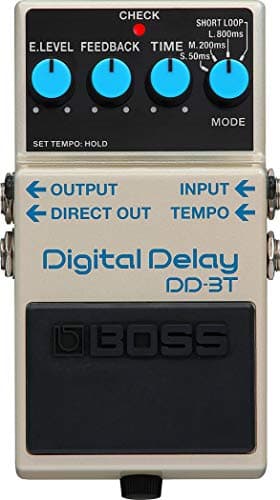
Best Tap Tempo Delay pick: BOSS DD-3T Digital Delay
Best delay and reverb pedals
One box, two effects. Three pedals with a section for each, and the two BOSS pedals that only let you set one.
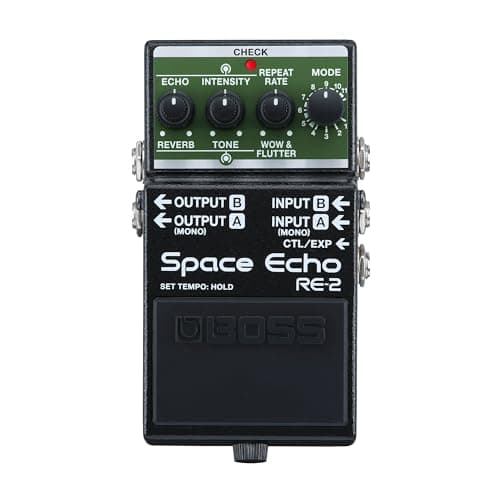
Best Delay + Reverb pick: BOSS RE-2 Space Echo
BOSS DD-8 review
Eleven modes, 10 seconds and carryover, against 100 mA and no presets. Both of those numbers are published.
Top pick: BOSS DD-8 Digital Delay

Best guitar pedals for worship music
Delay first, reverb second, gain last. Five picks judged on tap tempo, ducking reverb and blend — plus the pedal that gets bought for this and should not.
Best for Worship pick: BOSS DD-8 Digital Delay
Delay vs reverb
Countable repeats or a cloud of reflections. Which to buy first, in what order to run them, and what each costs to power.
Top pick: BOSS DD-8 Digital Delay
Best reverb pedals
Check your amp first. If you do need a reverb pedal, one multi-mode unit covers every type — here is what the modes actually differ on.
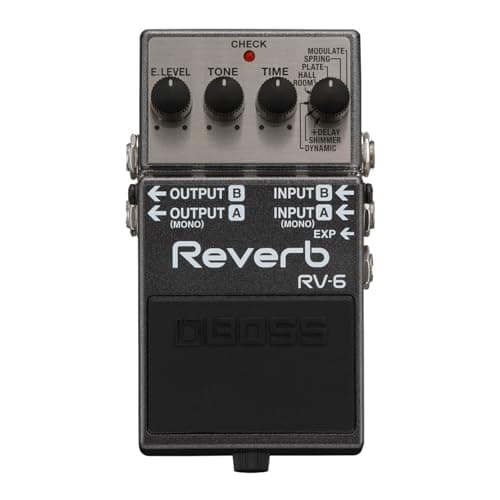
Best Reverb pick: BOSS RV-6 Reverb
Pedalboard power requirements explained
Two sums decide your power supply, and almost everyone only does the first. A worked example with real published figures.
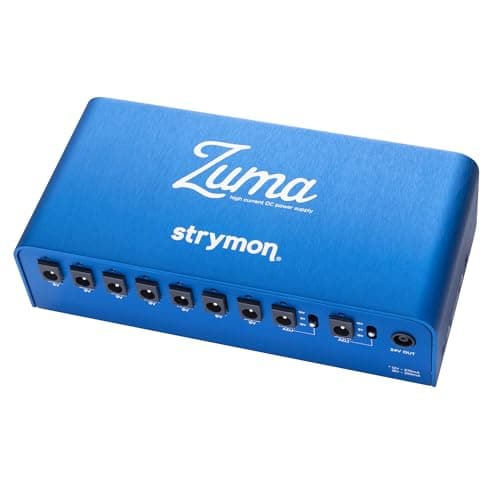
Top pick: Strymon Zuma
#ad How we’re funded · price as of October 18, 2026
Analog vs digital pedals
The label predicts your power budget reliably and your tone unreliably. Published draws across two orders of magnitude.
Top pick: MXR Carbon Copy Analog Delay
#ad How we’re funded · price as of October 18, 2026