Pedalboard power requirements explained
Two sums, not one. Total current tells you which supply is big enough; per-output current tells you whether it can actually run your pedals.
Fret & Fuzz earns a commission when you buy through the links on this page. It costs you nothing and it does not decide what we rank. How we’re funded.
We have not played this gear. Every pick below is chosen from published manufacturer specifications and the arithmetic set out in how we research, which you can re-run yourself.
Add up the published current draw of every pedal and add about 30% headroom — that gives you the total the supply must provide. Then check your single hungriest pedal against the highest single output rating on that supply. Both sums have to pass. A supply with 1,900 mA total but a 250 mA per-output ceiling cannot run a pedal that asks for 300 mA, no matter how much total current it has.
That second check is the one almost nobody publishes and the one that causes the most returned power supplies. Total current is a marketing number; per-output current is the constraint you actually run into.
01Step 1 — collect the published draws
Every figure below is what the manufacturer publishes. Where a maker does not publish one — MXR and Pro Co publish almost nothing electrical — you cannot plan around it and you should measure it or budget generously.
| Pedal | Published current draw | Source |
|---|---|---|
| Ibanez TS9 Tube Screamer | 8 mA at 9 V | Ibanez product page |
| BOSS SD-1 / DS-1 | 10 mA | BOSS specifications |
| BOSS BD-2 / CS-3 | 20 mA | BOSS specifications |
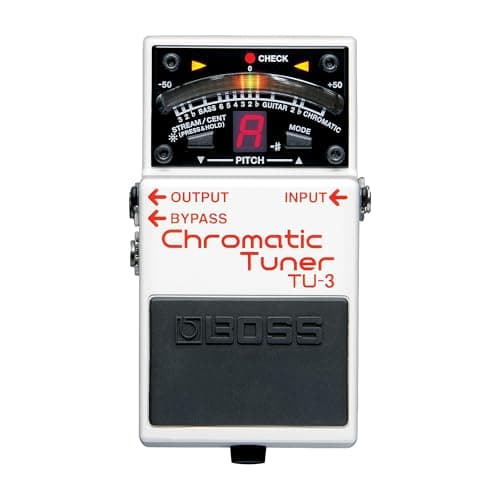
| BOSS TU-3 (normal) | 20 mA | BOSS specifications |
| BOSS TU-3 (High Brightness) | 80 mA | BOSS specifications |
| BOSS NS-2 | 25 mA | BOSS specifications |
| EarthQuaker Plumes | 25 mA | EarthQuaker product page |
| Wampler Tumnus | 20 mA at 9 V | Wampler product page |
| EHX Big Muff Pi | About 3 mA at 9 V | EHX documentation |
| EHX Op-Amp Big Muff | About 5 mA at 9 V | EHX documentation |
| BOSS RV-6 | 95 mA | BOSS specifications |
| BOSS RC-1 | 95 mA | BOSS specifications |
| BOSS DD-8 | 100 mA | BOSS specifications |
| TC PolyTune 3 | 100 mA | TC Electronic documentation |
| Strymon Flint | 300 mA minimum at 9 V | Strymon product page |
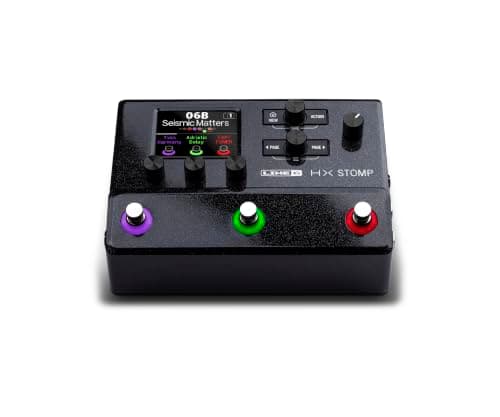
| Line 6 HX Stomp | 9 V DC, 3 A supply included | Line 6 owner's manual |
Analog dirt pedals are in the single-digit to low-double-digit range. Digital time effects are two orders of magnitude higher. That gap is the whole story of pedalboard power.
02Step 2 — a worked example
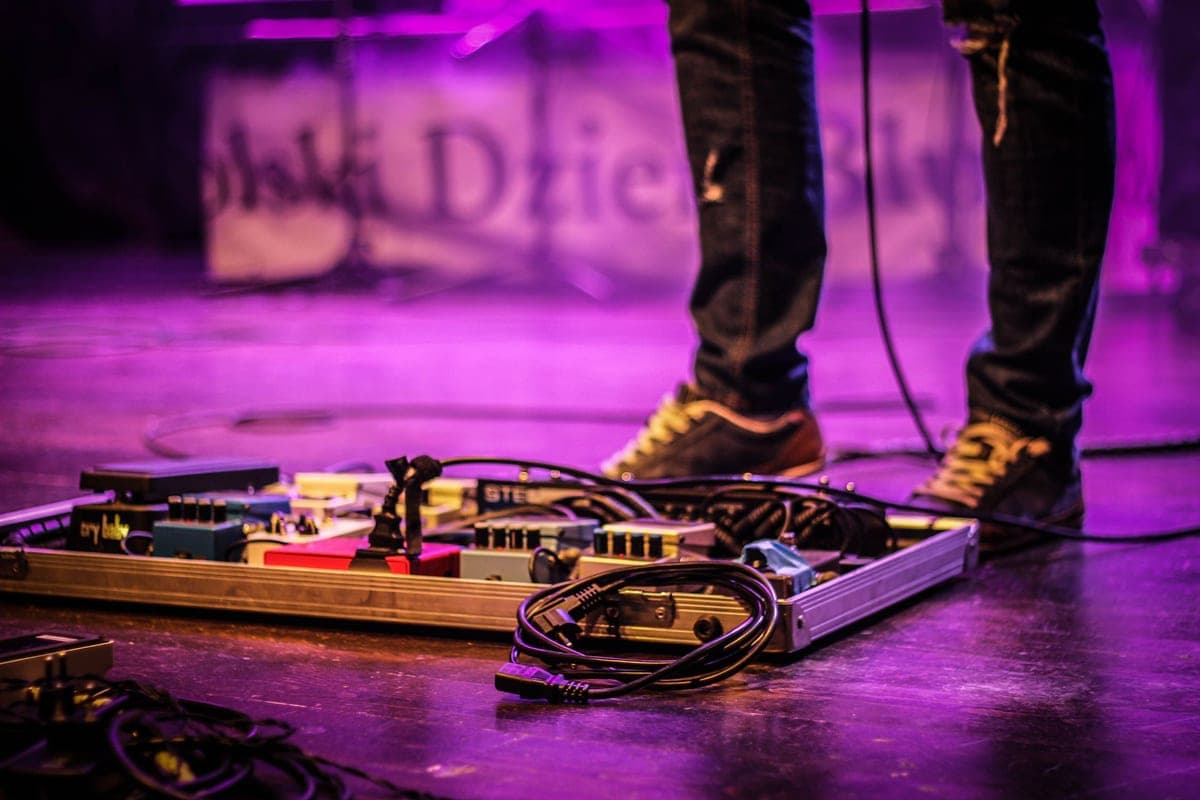
Take a realistic seven-pedal board: a BOSS TU-3 tuner, an EHX Big Muff, an Ibanez TS9, a BOSS BD-2, an EarthQuaker Plumes, a BOSS DD-8 and a BOSS RV-6.
- Add the published draws. 20 + 3 + 8 + 20 + 25 + 100 + 95 = 271 mA.
- Add 30% headroom. 271 x 1.3 = 353 mA. That is the total your supply must comfortably provide.
- Find the hungriest single pedal. The DD-8 at 100 mA.
- Check it against the highest single output. Any of the three isolated supplies above clears 100 mA easily. Even the Voodoo Lab's 250 mA outputs cover it.
- Check the voltages. Everything here is 9 V. No 18 V pedal, so no doubler cable needed.
That board is comfortable on any isolated supply here. Now change one thing: swap the RV-6 for a Strymon Flint.
- New total. 271 - 95 + 300 = 476 mA, plus 30% = 619 mA. Still small.
- New hungriest pedal. The Flint, at a published 300 mA minimum.
- Check against per-output ratings. Truetone CS7: two 500 mA outputs, fine. Strymon Zuma: 500 mA everywhere, fine. Voodoo Lab Pedal Power 2 PLUS: highest output is 250 mA — fails, and needs a doubler cable that consumes two outputs.
Supplies that satisfy the arithmetic
| # | Product | Best for | Price |
|---|---|---|---|
| 01 | 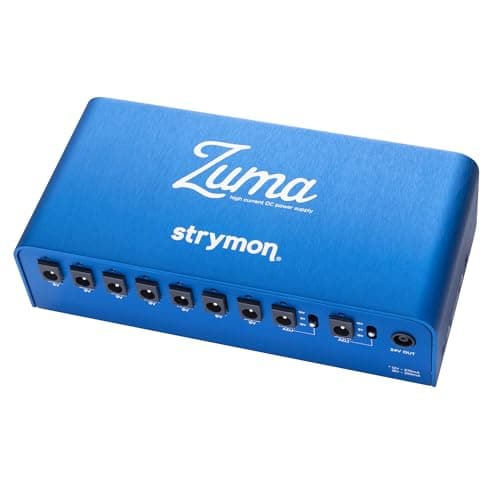 Strymon Zuma 500 mA on all nine outputs, so no pedal is ever assigned to the wrong one. | A board with any high-current digital pedal on it | $279.00 · Check price #ad How we’re funded · price as of October 18, 2026 |
| 02 | 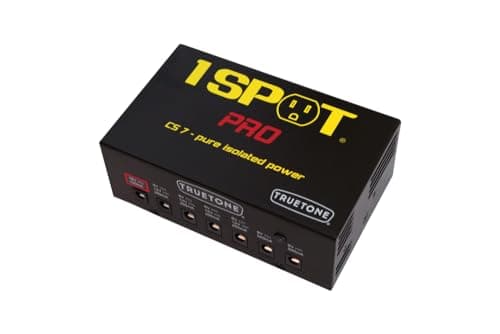 Truetone 1 SPOT Pro CS7 One 100 mA, four 200 mA switchable to 12 V, two 500 mA — enough range for most boards if you plan it. | A mixed board where you know your assignments | $169.99 · Check price #ad How we’re funded · price as of October 18, 2026 |
| 03 | 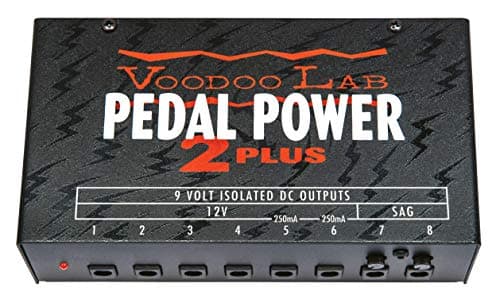 Voodoo Lab Pedal Power 2 PLUS Eight isolated sections and a SAG feature, with a 250 mA ceiling per output. | A board with no pedal above 250 mA | $199.99 · Check price #ad How we’re funded · price as of October 18, 2026 |
| 04 | 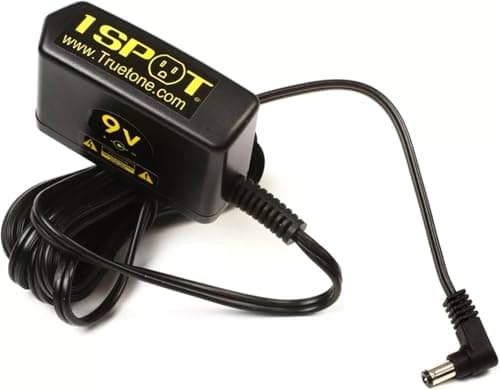 Truetone 1 SPOT 1,700 mA from one non-isolated output. Excellent until you add a digital pedal. | An all-analog board, and nothing more | $27.99 · Check price #ad How we’re funded · price as of October 18, 2026 |
| ! | 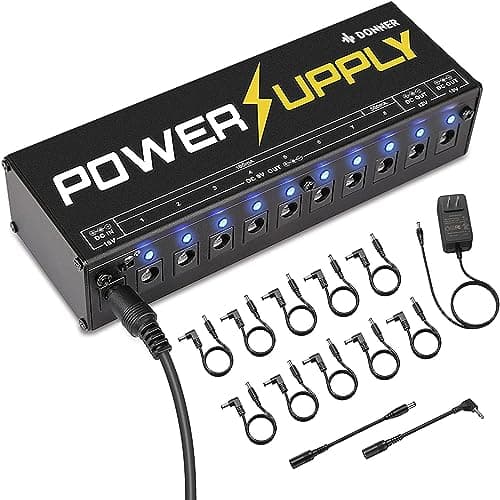 Donner DP-1 Power Supply Filtered outputs are not isolated outputs, and if you are buying it to stop hum that distinction is the whole purchase. Skip this one — see why below | Not the fix for a hum problem |
Rows link to the full write-up further down this page. Prices come from the live price layer only — where there is no live figure the button reads “Check price” rather than showing a remembered number.
04Step 3 — check the voltages, not just the current
Most pedals want 9 V DC, center-negative. Three exceptions cause almost all the problems:
- 18 V pedals. The MXR 10 Band EQ runs at 18 V. A 9 V-only brick cannot power it, and there is no partial credit — it will either not work or work badly.
- Center-positive pedals. Rare on modern guitar gear and instantly recognisable by the sticker. A center-negative supply will not run one, and forcing it can damage the pedal.
- AC rather than DC. A handful of older units want AC. A DC supply will not run them at all. Check the sticker, not the shape of the plug.
Voltage is not a volume or headroom control you can dial up freely. Some pedals tolerate 18 V and gain headroom from it; many do not and are damaged by it. Only run a pedal at a voltage the manufacturer states.
Strymon Zuma
A board with any high-current digital pedal on it
The number9 x 500 mA at 9 V, 48 W total, two outputs switchable to 12 V (375 mA) or 18 V (250 mA).
Strymon publishes 500 mA on every output, nine fully isolated channels with an individual transformer per channel, a 48 W total, and two outputs that switch to 12 V or 18 V.
The practical value of uniform outputs is that you cannot get the assignment wrong. On a mixed-rating supply you have to plan which pedal goes on which output and re-plan every time the board changes.
It still will not run a Line 6 HX Stomp, which asks for 3 A. Nothing in this class will — that pedal needs its own supply.
| Outputs | 9, fully isolated, one custom transformer per channel |
|---|---|
| Current per output | 500 mA at 9 V DC on every output |
| Selectable outputs | 2 outputs switch to 12 V (375 mA) or 18 V (250 mA) |
| Total power | 48 W maximum |
| Mains input | 100-240 V, worldwide |
| Size / weight | 6.8 x 3.3 x 1.8 in (173 x 84 x 46 mm), 680 g |
| What it does not do | It does not include the courtesy outlets or the sag feature some rivals have, and 500 mA per output still will not run an HX Stomp, which asks for 3 A. |
Specs from Strymon Zuma product page. We have not used this unit.
#ad How we’re funded · price as of October 18, 2026
Truetone 1 SPOT Pro CS7
A mixed board where you know your assignments
The number7 isolated outputs. Highest single output: 500 mA. Mains input 100-240 V.
Truetone publishes the rating of every output: output 1 at 9 V / 100 mA, outputs 2-5 at 9 or 12 V / 200 mA each, outputs 6-7 at 9 V / 500 mA each.
That covers a realistic board: tuner and analog dirt on the small outputs, a digital delay and a digital reverb on the 500 mA pair.
There is no 18 V output, so an MXR 10 Band EQ is not covered. Check your 18 V pedals against this before buying.
| Outputs | 7, independently isolated and filtered |
|---|---|
| Output 1 | 9 V DC, 100 mA |
| Outputs 2-5 | 9 / 12 V DC switchable, 200 mA each |
| Outputs 6-7 | 9 V DC, 500 mA each |
| Mains input | 100-240 V AC, worldwide |
| Size / weight | 5.5 x 3.37 x 2 in (140 x 86 x 50 mm), 592 g |
| What it does not do | No 18 V output, so an MXR 10 Band EQ or anything else that needs 18 V is not covered. Output 1 is only 100 mA — that one is for a tuner or an analog dirt pedal, not a digital reverb. |
Specs from Truetone 1 SPOT Pro CS7 product page. We have not used this unit.
#ad How we’re funded · price as of October 18, 2026
Voodoo Lab Pedal Power 2 PLUS
A board with no pedal above 250 mA
The number4 x 100 mA, 2 x 250 mA, 2 x 100 mA with SAG. 18 V and 24 V via optional doubler cables.
Voodoo Lab publishes eight isolated sections: four at 9/12 V 100 mA, two at 9/12 V 250 mA, and two at 9 V 100 mA with a SAG control that starves the voltage for a vintage, sputtering fuzz sound.
The SAG feature is genuinely unusual and it is the reason to choose this over higher-current rivals if you play fuzz.
The 250 mA ceiling is the constraint. A Strymon pedal asking for 300 mA minimum needs a doubler cable here, and that consumes two outputs.
| Outputs | 8 isolated sections |
|---|---|
| Outputs 1-4 | 9 / 12 V, 100 mA each |
| Outputs 5-6 | 9 / 12 V, 250 mA each |
| Outputs 7-8 | 9 V, 100 mA each, with a SAG control for starved-voltage sounds |
| Higher voltages | 18 V and 24 V via optional doubler cables |
| Mains input | 120 V 50/60 Hz (North American model) |
| Size / weight | 6 x 3.4 x 1.8 in (152 x 86 x 44 mm), 907 g |
| What it does not do | The highest single output is 250 mA, so a Strymon pedal that wants 300 mA minimum will not run from one output — you need the doubler cable or a different supply. It is also a fixed-region mains unit, not a worldwide one. |
Specs from Voodoo Lab Pedal Power 2 PLUS product page. We have not used this unit.
#ad How we’re funded · price as of October 18, 2026
Truetone 1 SPOT
An all-analog board, and nothing more
The number1,700 mA total, zero isolation.
For a board of analog dirt, a tuner and a compressor, this is the correct purchase and it costs less than most single pedals. 1,700 mA is more total current than most isolated bricks provide.
Every pedal on the daisy chain shares a ground. On an all-analog board that is fine. Add a digital delay or reverb, whose switching supply injects noise into that shared ground, and you get hum.
It is not a fault of the supply. It is the predictable consequence of the topology, and isolated vs daisy chain covers when you have crossed the line.
| Output | 9 V DC, 1,700 mA from a single non-isolated output |
|---|---|
| Isolation | None — this is a single supply intended for daisy-chaining |
| Mains input | 100-240 V AC, worldwide |
| Format | Single-space wall unit with a right-angle plug |
| What it does not do | No isolation at all. Every pedal on the chain shares a ground, which is exactly the condition that produces hum with a digital pedal in the mix. It is a great first supply and a bad final one. |
Specs from Truetone 1 SPOT product page. We have not used this unit.
#ad How we’re funded · price as of October 18, 2026
Donner DP-1 Power Supply
Not the fix for a hum problem
We are not picking this one for a board with a hum problem. Donner describes filtered outputs across 9 V, 12 V and 18 V. Filtering removes ripple on a supply rail; it does not break a shared ground path between two pedals.
A ground loop is created when two pedals share both a ground through the power supply and a ground through the signal cable. Only galvanic isolation — a separate transformer winding per output — breaks that loop.
It is a reasonable supply for what it is: multiple voltages at a low price for a board that does not have a noise problem. It is not a cheap substitute for an isolated brick, and buying it as one is the most common power-supply mistake we see described.
| Outputs | 10 outputs at 9 V, 12 V and 18 V |
|---|---|
| Isolation | Donner describes filtered outputs; the unit is not fully transformer-isolated per channel |
| Format | Under-board brick |
| Electrical data | Per-output current ratings are published on the packaging rather than a full spec sheet |
| What it does not do | Filtered is not the same as isolated. If your problem is a ground loop between a digital pedal and an analog one, filtering will not fix it. |
Specs from Donner guitar effects range. We have not used this unit.
05Step 4 — the pedals that break the model
A Line 6 HX Stomp ships with a 9 V DC 3 A supply. That is 3,000 mA — six times the highest single output on any brick on this page. No standard isolated pedalboard supply will run one, and this is the single most common mistake made when adding a multi-effects unit to an existing board.
The answer is not a bigger brick. It is to run that unit from its own supply and use the brick for everything else. Pedals vs multi-effects covers the wider decision, and the multi-effects roundup lists the published power requirement for every current unit — a BOSS GX-100 asks for 1.2 A, so this is not unique to Line 6.
06Why 30% headroom
Three reasons, all boring and all real. Published figures are typical rather than worst-case, and a pedal drawing more at a particular moment is normal. Supplies do not like running at their rated maximum continuously — they get hot and their ripple performance degrades. And you will add another pedal, because everyone does. One unit defeats this method entirely rather than stretching it: Line 6 specifies 3 A for the HX Stomp, which no standard isolated output supplies. Powering an HX Stomp has that case in full. Our HX Stomp review covers the rest of what that unit publishes, including the six-block ceiling.
Frequently asked questions
+ How many mA does my pedalboard need?
+ Can a power supply have too many mA?
+ What happens if I under-power a pedal?
+ Why does my board hum when everything is powered correctly?
+ Can I run a 9V pedal on 18V for more headroom?
Sources
Related on Fret & Fuzz
Line 6 HX Stomp review
Six simultaneous blocks and a 3 A supply requirement. Both are published, and both decide the purchase before tone does.
Top pick: Line 6 HX Stomp
#ad How we’re funded · price as of October 18, 2026
BOSS TU-3 vs TC Electronic PolyTune 3
20 mA against 100 mA, and a buffer you can switch out against one you cannot. Neither difference is the accuracy figure.
Top pick: BOSS TU-3 Chromatic Tuner
Powering an HX Stomp from a pedalboard supply
Line 6 specifies 3 A. The most generous common brick output is 500 mA. The arithmetic, and what to do instead.
Top pick: Strymon Zuma
#ad How we’re funded · price as of October 18, 2026
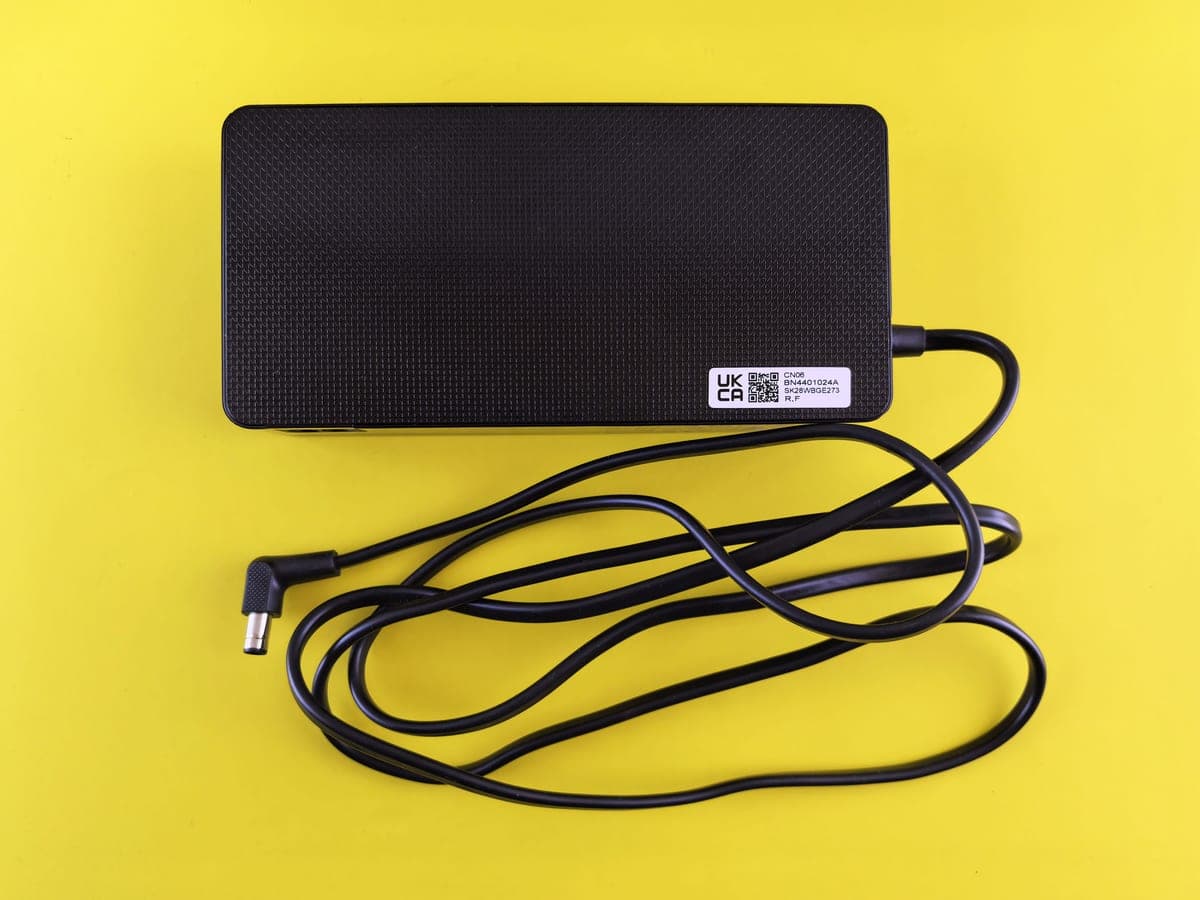
Best pedalboard power supplies
Compare on the highest single output, not total current. Five isolated supplies on their published per-output ratings.
Best Power Supply pick: Strymon Zuma
#ad How we’re funded · price as of October 18, 2026
Isolated power supply vs daisy chain
Two topologies, two failure modes. The mechanism behind the hum, and the point at which a daisy chain stops being enough.
Top pick: Truetone 1 SPOT
#ad How we’re funded · price as of October 18, 2026
Best pedalboard power supplies under $100
Cheap supplies buy current, not isolation. Which board that is fine for, and which board it is not.
Best Power Under $100 pick: Truetone 1 SPOT
#ad How we’re funded · price as of October 18, 2026
Best multi-effects pedals
Block count, routing freedom and current draw decide this. Four current units compared, plus the one BOSS has discontinued.
Best Multi-Effects pick: Line 6 HX Stomp
#ad How we’re funded · price as of October 18, 2026
Best delay pedals
Maximum delay time and current draw settle most of this category. Four delays on their published figures.
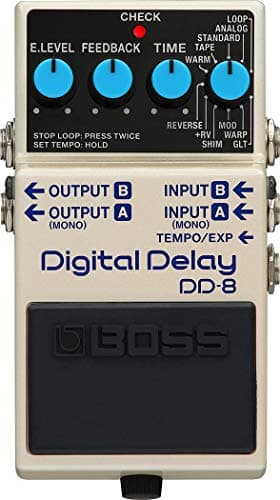
Best Delay pick: BOSS DD-8 Digital Delay