Attenuator vs master volume
Two different solutions to the same problem, working at opposite ends of the amp. The arithmetic says which one you actually need.
Fret & Fuzz earns a commission when you buy through the links on this page. It costs you nothing and it does not decide what we rank. How we’re funded.
We have not played this gear. Every pick below is chosen from published manufacturer specifications and the arithmetic set out in how we research, which you can re-run yourself.
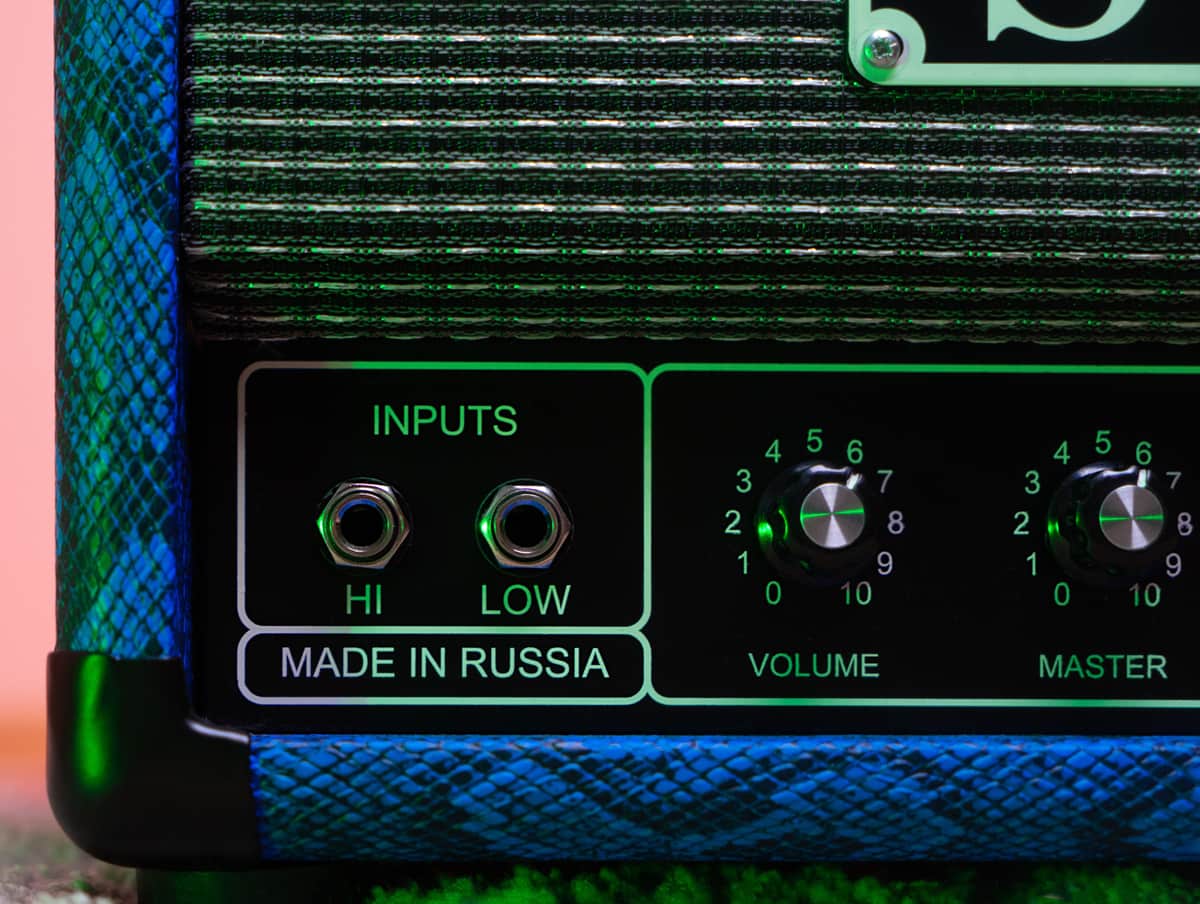
A master volume reduces the signal between the preamp and the power amp, so you get preamp distortion at any volume but the power section never works hard. An attenuator sits between the power amp and the speaker and burns off output as heat, so the power section stays cranked while the speaker gets less. If you want power-section distortion at low volume, only the attenuator does it — and it costs you some fidelity for physical reasons.
Before either, the arithmetic that makes the whole problem clear.
01The decibel arithmetic
Perceived loudness scales with the logarithm of power. Every doubling of power adds about 3 dB, and every halving costs about 3 dB. A 10 dB change is roughly what most listeners describe as twice or half as loud, and 10 dB is a factor of ten in power.
| Power change | Change in dB | How it reads |
|---|---|---|
| 100 W to 50 W | -3 dB | Noticeable, nowhere near half as loud |
| 100 W to 25 W | -6 dB | Clearly quieter, still loud |
| 100 W to 10 W | -10 dB | About half as loud |
| 100 W to 1 W | -20 dB | About a quarter as loud |
| 20 W to 5 W | -6 dB | Why a 5 W amp is not a bedroom amp |
| 20 W to 10 W (half-power switch) | -3 dB | What a typical half-power switch actually buys |
These are power ratios converted with 10 x log10(P2/P1). Speaker efficiency and room acoustics then modify the result substantially.
Two consequences follow immediately. A half-power switch is worth about 3 dB, which is real and small. And buying a 5 W valve amp instead of a 20 W one buys you 6 dB — noticeable, and nothing like enough to make a cranked amp acceptable through a wall.
The two ways out of the volume problem
| # | Product | Best for | Price |
|---|---|---|---|
| 01 | No photo Two Notes Torpedo Captor X A reactive load rather than a resistive one, plus a DI and cabinet simulation. | The complete solution, at a price | |
| 02 | 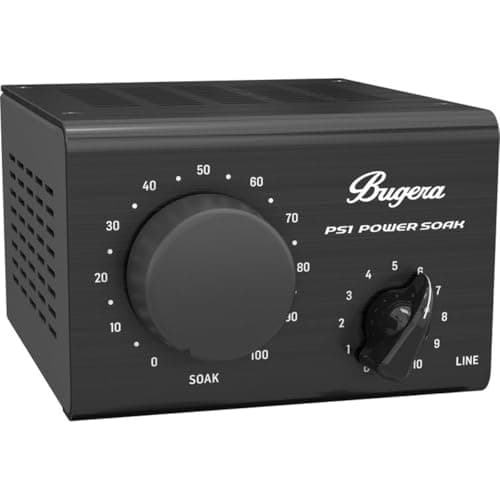 Bugera PS1 Power Attenuator A passive resistive attenuator with a continuous control and a line output. | Continuous attenuation at the lowest price | $129.00 · Check price #ad How we’re funded · price as of October 17, 2026 |
| 03 | No photo VOX AC10C1 A master volume lets the preamp work while the output stays down — and does nothing for power-section distortion. | The master-volume answer, which is free | |
| ! | 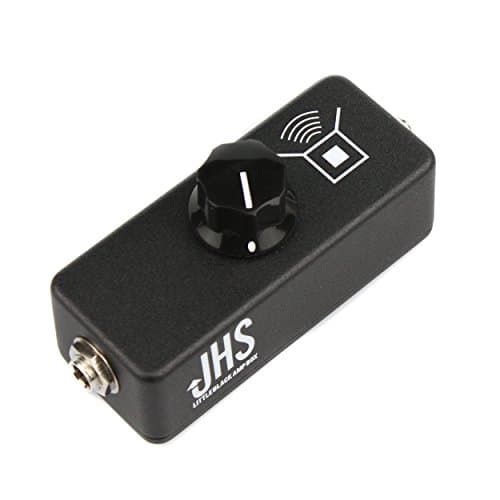 JHS Pedals Little Black Amp Box A small passive attenuator with no load-box function and no rating for a serious head. Skip this one — see why below | Not a real answer for a valve amp at volume | $65.00 · Check price #ad How we’re funded · price as of October 17, 2026 |
Rows link to the full write-up further down this page. Prices come from the live price layer only — where there is no live figure the button reads “Check price” rather than showing a remembered number.
03Where each solution sits in the amp
| Master volume | Attenuator | |
|---|---|---|
| Position | Between preamp and power amp | Between power amp and speaker |
| Preamp distortion at low volume | Yes | Yes |
| Power section distortion at low volume | No | Yes — that is the point |
| Cost | Built in, free | A separate purchase |
| Tone change | Preamp distortion instead of power distortion | Some, and more at heavy attenuation |
| Risk | None | Heat, and impedance matching matters |
04Why attenuation is not tonally free
A speaker's impedance varies enormously with frequency — an 8-ohm speaker is 8 ohms nominally and can be several times that at resonance. The amp's output stage interacts with that varying impedance, and that interaction is part of the sound.
A cheap resistive attenuator presents a flat resistance instead, so the interaction is gone. A reactive load box like the Two Notes Captor X models the frequency-dependent impedance, which is why it costs more and sounds closer.
The second effect is psychoacoustic and unavoidable: human hearing is less sensitive to low and high frequencies at low volumes. A cranked amp heard quietly sounds mid-heavy no matter how perfect the attenuation, because your ears are doing that, not the attenuator. For why buying a smaller amp is not the alternative it looks like, amp wattage and volume has the decibel arithmetic behind the whole problem.
Two Notes Torpedo Captor X
The complete solution, at a price
The number100 W RMS maximum, fixed 8 ohm nominal, attenuation at 0 dB, -20 dB and -38 dB.
Two Notes publishes a fixed 8-ohm nominal reactive load rated at 100 W RMS, with selectable 0 dB, -20 dB and -38 dB attenuation on the speaker output, plus stereo XLR DI, a headphone output and cabinet simulation.
The reactive part is what distinguishes it from a cheap resistive attenuator. A real speaker's impedance varies enormously with frequency, and an amp's output stage interacts with that variation. A purely resistive load does not reproduce it, and the tone at heavy attenuation suffers.
The attenuation is stepped rather than continuous — three positions, not a knob. And 100 W is the ceiling, so a 100 W head flat out is at the limit rather than comfortably inside it.
| Function | Reactive load box, attenuator, speaker simulator and DI in one unit |
|---|---|
| Load impedance | Fixed 8 ohm nominal (a 16 ohm version is sold separately) |
| Power handling | 100 W RMS maximum |
| Attenuation | Selectable 0 dB, -20 dB and -38 dB on the speaker output |
| Outputs | Speaker out, stereo XLR DI, headphone out, plus USB and Bluetooth for editing |
| What it does not do | The attenuation is stepped, not continuous — three positions, not a knob. 100 W is the ceiling, so a 100 W head run flat out is at the limit rather than comfortably inside it. |
Specs from Two Notes Torpedo Captor X product page. We have not used this unit.
Bugera PS1 Power Attenuator
Continuous attenuation at the lowest price
Rated for 100 W amplifiers with a continuous attenuation control, which is a genuine advantage over stepped units — you can dial the exact reduction the room needs.
It is a resistive load, which means it does not present the frequency-dependent impedance a real speaker does. At heavy attenuation the tone changes in ways a reactive load box avoids.
The line output has no serious cabinet simulation, so it is not something to record with directly. Treat it as a volume control for the speaker output.
| Function | Passive power attenuator between amp and speaker |
|---|---|
| Power handling | Rated for 100 W amplifiers |
| Controls | Continuous attenuation control plus a line output |
| Format | Compact pedal-sized enclosure |
| What it does not do | A purely resistive load does not behave like a speaker, so the tone at heavy attenuation is not the same as the tone at volume. There is no cabinet simulation on the line output worth recording as-is. |
Specs from Bugera PS1 product page. We have not used this unit.
#ad How we’re funded · price as of October 17, 2026
VOX AC10C1
The master-volume answer, which is free
The number10 W RMS, 2 x EL84, master volume.
A master volume sits between the preamp and the power amp. Turn the preamp gain up and the master down, and you get preamp distortion at any volume. That is most of what people mean by amp distortion and it costs nothing extra.
What it cannot do is give you power-section distortion at low volume, because the power section is being asked to do less, not to work harder into a smaller load.
For a 10 W EL84 amp in a small room, this is the practical answer and an attenuator is a solution to a problem the master volume mostly already solved.
| Power | 10 W RMS, all-tube |
|---|---|
| Speaker | 1 x 10" Celestion VX10 |
| Tubes | 2 x 12AX7 preamp, 2 x EL84 power |
| Controls | Gain, Volume, Bass, Treble, Reverb |
| Connections | One normal input, one external speaker jack |
| Size / weight | 520 x 210 x 410 mm, 12.3 kg (27.1 lb) |
| What it does not do | No effects loop, no channel switching, no attenuator. 10 W of EL84 with a master volume is still a loud amp before the power section does anything interesting. |
Specs from VOX AC10 Custom product page. We have not used this unit.
JHS Pedals Little Black Amp Box
Not a real answer for a valve amp at volume
We are not picking this for a valve amp you intend to crank. It is a simple passive attenuator with a single control, in a pedal-sized box.
The size is the problem. Attenuation works by turning the amp's output power into heat, and a small enclosure cannot dissipate the heat a driven valve amp produces. It is not rated for a large head.
For taming a small combo slightly it is a reasonable, cheap tool. For getting a cranked 20 W valve amp down to bedroom volume, it is the wrong size of device and the temperature is the reason.
| Function | Passive attenuator placed between amp and speaker |
|---|---|
| Controls | Single attenuation control |
| Format | Small pedal-sized box with speaker in and out jacks |
| What it does not do | No load box function, no DI, no cabinet simulation. It is a volume control for a speaker output and nothing else — and it is not rated for a big head. |
Specs from JHS Little Black Amp Box product page. We have not used this unit.
05The safety rules
- Match the impedance. The attenuator must present the amp's rated load. A mismatch stresses the output transformer.
- Check the power rating. An attenuator converts the amp's output into heat, and a device rated for 100 W is at its limit with a 100 W head flat out.
- Never run a valve amp with no load. Not with an attenuator disconnected mid-signal, not at all.
- Expect heat. Attenuators get hot because that is the mechanism. Give one air.
- Do not attenuate a solid-state amp for tone. Solid-state power sections do not produce a desirable distortion to unlock. Turn it down instead.
06Which you actually need
- You want the amp's gain channel at low volume. Master volume. You already have it.
- Your amp has no master volume and is too loud. Attenuator, or a different amp.
- You want power-section compression and sag at home. Attenuator, and a reactive one.
- You want to record silently. A reactive load box with a DI and cabinet simulation.
- You play a solid-state amp. Neither. Turn it down; there is nothing to unlock.
Frequently asked questions
+ Does an attenuator change the tone?
+ Is a master volume the same as an attenuator?
+ Will a lower wattage amp solve my volume problem?
+ Can I use an attenuator with a solid state amp?
+ How much attenuation do I need?
Sources
Related on Fret & Fuzz

Amp wattage and volume
Halving the watts costs 3 dB. A perceived halving needs a tenth of the power. The table that settles it.
Top pick: BOSS KATANA-50 GEN 3
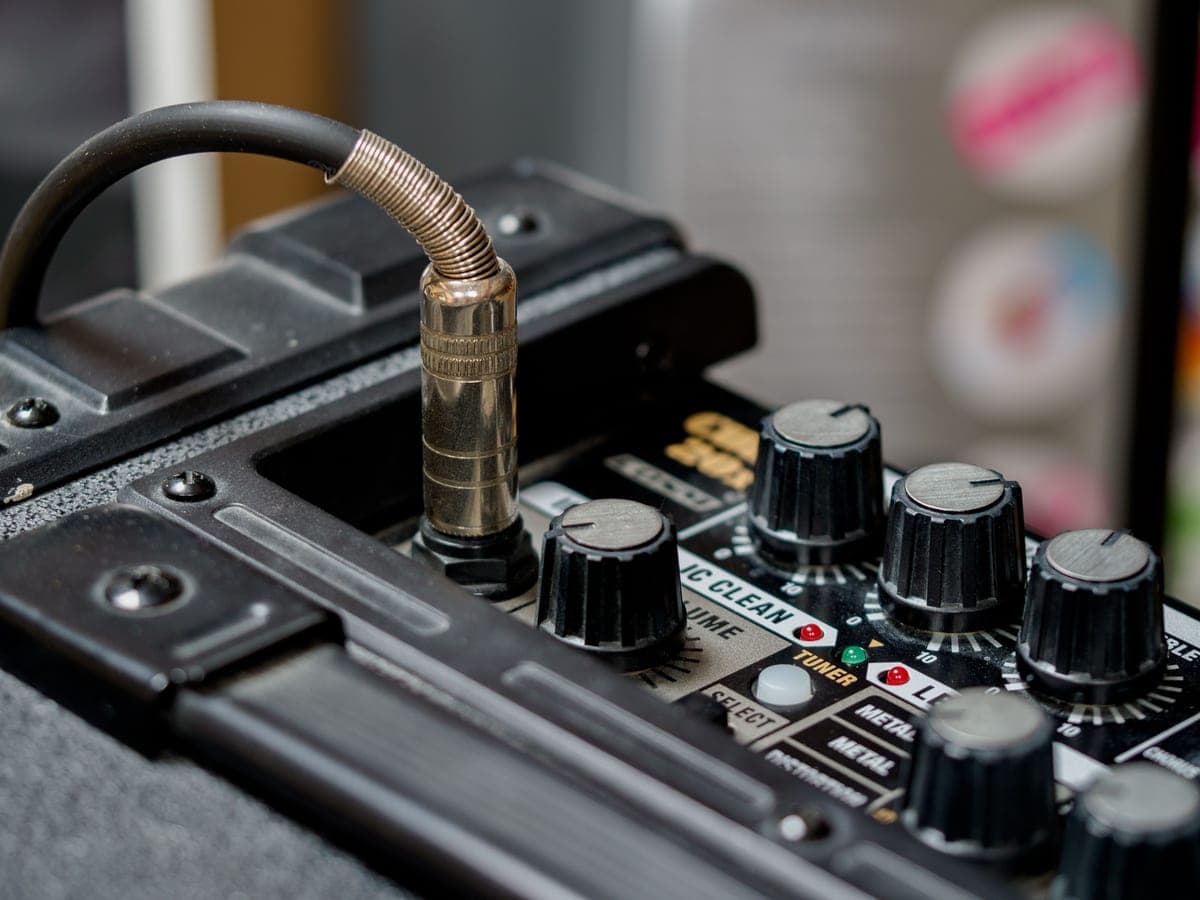
Best amp attenuators
Load type, power rating and attenuation steps. Three specs that decide whether an attenuator works for your amp.
Best Attenuator pick: Two Notes Torpedo Captor X
Tube vs solid state amps
Reframed as a question about where the distortion happens, this argument has a clear answer for any given player.
Top pick: BOSS KATANA-50 GEN 3
Best tube amps under $1,000
A real valve power section and a decent speaker. What this price does not buy is a way to use it at home.
Best Tube Amp Under $1,000 pick: Marshall DSL20CR
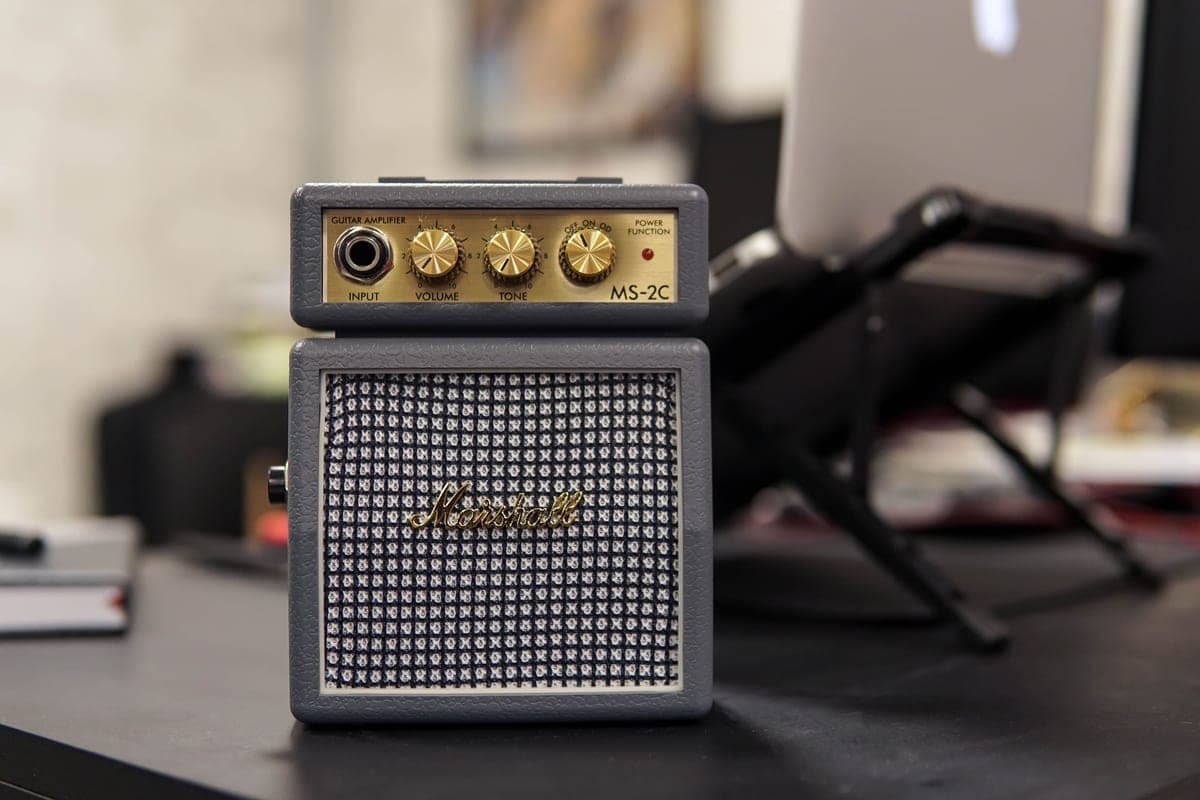
Best practice amps
Speaker size sets the ceiling and the headphone output decides the rest. Four practice amps on published specs.
Best Practice Amp pick: Positive Grid Spark 40