Amp wattage and volume
The most expensive misunderstanding in guitar amplification, and it resolves to a single logarithm.
Fret & Fuzz earns a commission when you buy through the links on this page. It costs you nothing and it does not decide what we rank. How we’re funded.
We have not played this gear. Every pick below is chosen from published manufacturer specifications and the arithmetic set out in how we research, which you can re-run yourself.

Doubling an amp's power raises its output by about 3 dB, and a perceived doubling of loudness takes roughly 10 dB — which is about ten times the power. So a 5 W amp is not a tenth as loud as a 50 W amp; it is about half as loud. That is why low-wattage amps do not solve the volume problem, and why an attenuator, a master volume or a speaker-emulated output does.
Every part of this follows from one relationship, and it is worth being able to do in your head before you spend money on a smaller amp.
01Step 1 — the formula
The change in level in decibels is ten times the base-ten logarithm of the power ratio. Written out: dB = 10 x log10(P2 / P1).
That is the whole thing. Every number below comes out of it, and the only fact you need alongside it is that a change of about 10 dB is what most listeners describe as twice or half as loud.
02Step 2 — the table that ends the argument
| Power change | Level change | What you hear |
|---|---|---|
| 100 W to 50 W | -3.01 dB | Just about noticeable |
| 50 W to 25 W | -3.01 dB | Just about noticeable |
| 50 W to 15 W | -5.2 dB | Clearly quieter, still loud |
| 50 W to 10 W | -7.0 dB | Substantially quieter |
| 50 W to 5 W | -10.0 dB | About half as loud |
| 50 W to 1 W | -17.0 dB | About a quarter as loud |
| 50 W to 0.5 W | -20.0 dB | Quieter again, by roughly the same step |
Level figures are the decibel arithmetic for the stated power ratio. The right-hand column applies the standard approximation that about 10 dB reads as a doubling or halving of perceived loudness — it is not a measured claim about any specific amplifier.
Read the last two rows carefully, because they are where the money goes. Getting to about a quarter of the perceived loudness of a 50 W amp takes 1 W. Not 25 W, not 10 W — 1 W. That is a factor of fifty, and no half-power switch on any amp comes close to it.
Amps whose published power controls actually help
| # | Product | Best for | Price |
|---|---|---|---|
| 01 | 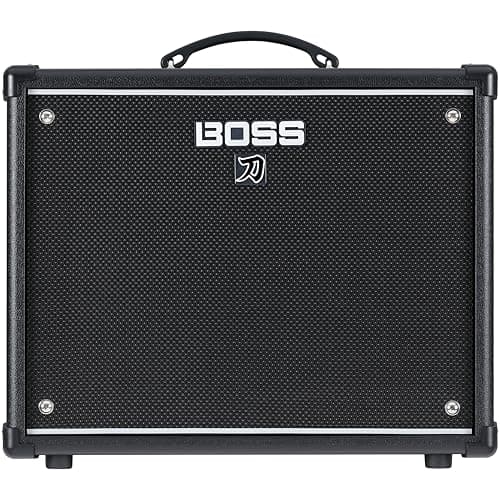 BOSS KATANA-50 GEN 3 A Power Control with a published 0.5 W position, on a 50 W amp — an output-stage step, not a master volume. | The widest usable volume range published here | |
| 02 | 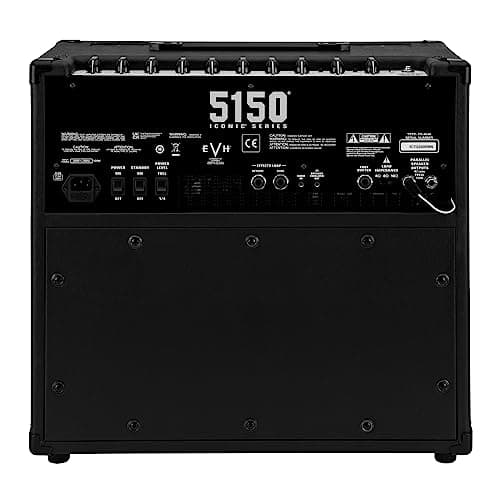 EVH 5150 Iconic Series 15W 1x10 combo 15 W with a quarter-power switch — about a 6 dB reduction, the largest here. | The biggest published step down on a valve amp | |
| 03 | No photo Marshall DSL20CR 20 W with a 10 W setting — a 3 dB reduction, which is close to the smallest step most people notice. | Showing exactly what a half-power switch is worth | |
| ! | No photo Blackstar HT-5R MkII 5 W of valve power is about 10 dB below 50 W — roughly half as loud, not a tenth as loud. Skip this one — see why below | The amp people buy expecting silence |
Rows link to the full write-up further down this page. Prices come from the live price layer only — where there is no live figure the button reads “Check price” rather than showing a remembered number.
04Step 3 — the speaker is the other half of the equation
Speaker sensitivity is quoted in dB at one watt at one meter, and it varies by several dB between models. A speaker 3 dB more sensitive than another is exactly as loud on half the power.
That is worth restating, because it means a speaker swap can undo a power switch entirely. Halving the wattage and fitting a speaker 3 dB more sensitive leaves you exactly where you started. It also means a less sensitive speaker is a legitimate volume control — one of the few that costs nothing in how the amp itself behaves, because you are still driving it exactly as before.
BOSS KATANA-50 GEN 3
The widest usable volume range published here
The number50 W down to a published 0.5 W is about a 20 dB drop — the largest step on this page.
BOSS publishes the Power Control positions for this generation rather than describing them: Standby, 0.5 W, Half and Max. That matters on this page, because a published figure can be turned into decibels and a vague claim cannot. Fifty watts to half a watt is ten times the base-ten logarithm of one hundredth — a 20 dB reduction, which is the largest step any amp here offers.
On a solid-state amp that is a straightforward attenuation of the power section, and it is the closest thing on this page to an amp that is genuinely quiet at the settings you actually want to use. The rest is documented too: 50 W rated, 47 W consumed, a 12-inch speaker, six amp characters with one variation each, and a five-section effects engine.
The cons: no effects loop and no line or Rec Out on the 50, no XLR, no IR loading, and deep editing needs BOSS Tone Studio on a computer. The front panel gives you the surface only.
| Rated power output | 50 W |
|---|---|
| Speaker | 30 cm (12") x 1 |
| Amp characters | Six — Acoustic, Clean, Pushed, Crunch, Lead and Brown — each with one selectable variation, which BOSS counts as 12 tones |
| Effects | Five simultaneous sections — Booster, Mod, FX, Delay and Reverb — with three variations each |
| Power Control | Standby, 0.5 W, Half and Max |
| Input impedance | INPUT -10 dBu (1 M ohm); AUX IN -10 dBu (20 k ohm) |
| Connectors | Input, Power Amp In, Stereo Phones, CTL CH1/CH2 SOLO (TRS), Exp Pedal (TRS), Aux In, USB-C and a Bluetooth adaptor slot |
| Power consumption | 47 W |
| Size / weight | 470 x 238 x 398 mm, 11.6 kg (25 lb 10 oz) |
| What it does not do | No effects loop and no line or Rec Out — the KATANA-100 GEN 3 has both, and on the 50 the only way off the amp is the Stereo Phones jack or USB-C. Nothing but the manual and a power cord is in the box: the FS-5L, FS-6 and FS-7 footswitches, the expression pedals and the BT-DUAL Bluetooth adaptor are all sold separately. |
Specs from BOSS KATANA-50 GEN 3 specifications. We have not used this unit.
EVH 5150 Iconic Series 15W 1x10 combo
The biggest published step down on a valve amp
The number15 W to roughly 3.75 W is a 6 dB drop. Real, and less than most people expect.
A quarter-power switch is twice the reduction a half-power switch gives you: ten times the base-ten logarithm of one quarter is about minus 6 dB. On a 15 W amp that takes you to roughly 3.75 W, and it is the most useful power switch on this page.
The rest is well specified — two channels each with an extra gain voicing, an effects loop, dual parallel speaker outputs, and a speaker-emulated DI with power amp mute. That last feature is the one that actually solves the volume problem, because it lets you take a signal with no speaker in the room at all.
The cons: the 10-inch speaker is the limiting factor on the low end, there is no reverb, and 6 dB down from very loud is still loud. A quarter-power switch moves you from unusable at home to nearly usable, not to quiet.
| Power | 15 W, with a quarter-power switch |
|---|---|
| Speaker | 1 x 10" |
| Tubes | 2 x ECC83 preamp, 1 x 6L6 power |
| Channels | Two, each with an extra gain voicing (Overdrive on green, Burn on red) |
| Extras | Effects loop, dual parallel speaker outputs, speaker-emulated DI with power amp mute |
| Weight | 38.2 lb |
| Included | One-button footswitch |
| What it does not do | The 10" speaker is the limiting factor on the low end — this amp sounds materially different through a 4x12. No reverb. |
Specs from EVH 5150 Iconic Series 15W 1x10 combo product page. We have not used this unit.
Marshall DSL20CR
Showing exactly what a half-power switch is worth
The number20 W to 10 W is minus 3.01 dB.
Marshall publishes the half-power setting as 10 W, and that is exactly the arithmetic this page is about: halving the power costs about 3 dB, which is close to the smallest level change most listeners reliably notice.
The amp itself is well equipped for the format — two channels with per-channel gain and volume, an effects loop, digital reverb and a Resonance control, driven by two EL34s into a 12-inch Celestion Seventy-80.
The cons are the ones the specification implies. The half-power switch takes it to 10 W, not to bedroom volume — this is not a power scaler. At 35.2 lb it is also the heaviest amp on this page.
| Power | 20 W, with a half-power (10 W) setting |
|---|---|
| Speaker | 12" Celestion Seventy-80 |
| Preamp tubes | 3 x ECC83 |
| Power tubes | 2 x EL34 |
| Channels | Two — Classic Gain and Ultra Gain — with per-channel gain and volume |
| Extras | Digital reverb, effects loop, Resonance control |
| Weight | 35.2 lb |
| What it does not do | The half-power switch takes it to 10 W, not to bedroom volume — this is not a power scaler. The reverb is digital and there is only one reverb level per channel. |
Specs from Marshall DSL20CR product page. We have not used this unit.
Blackstar HT-5R MkII
The amp people buy expecting silence
We are not picking a 5 W valve amp as a solution to the volume problem, and the HT-5R MkII is a good amp being asked to do something no amp of its type can do.
The arithmetic: 5 W against 50 W is ten times the base-ten logarithm of one tenth, which is minus 10 dB. A 10 dB reduction is roughly a perceived halving of loudness. So a 5 W valve amp cranked is about half as loud as a 50 W amp cranked — and a 50 W amp cranked is far more than twice as loud as a flat allows.
The genuinely useful features here are the effects loop, the USB audio out and the speaker-emulated line output — the line output being the thing that actually lets you play at night. The 5 W figure is not it.
| Power | 5 W, valve |
|---|---|
| Speaker | 12" |
| Channels | Two, footswitchable, with Blackstar's ISF tone control |
| Extras | Digital reverb, effects loop, USB audio out, speaker-emulated line output |
| What it does not do | 5 W of valve power is still too loud for a small flat at the volume where the power section works. The USB output is a convenience, not a studio interface. |
Specs from Blackstar HT-5R MkII product page. We have not used this unit.
05Step 4 — what actually makes an amp quiet
- A speaker-emulated line output or DI with the power amp muted. No speaker in the room means no volume in the room. The EVH and the Blackstar above both publish one.
- An attenuator between the amp and the speaker. This is the tool designed for exactly this problem — best attenuators covers them, and attenuator vs master volume covers what each one costs you.
- A master volume. It gets you preamp distortion at low level and not power-amp distortion, which is a real difference and a workable compromise.
- Headphones. Unglamorous, free if the amp has the jack, and by a wide margin the most effective item on this list.
- Buying a smaller amp. Last, because the arithmetic above shows how little it buys you.
06Where the confusion comes from
It comes from watts being a linear number while hearing is logarithmic. Fifty is ten times five, so a 50 W amp sounds like it should be ten times as loud as a 5 W one. Ears do not work that way, and the whole decibel system exists because they do not.
There is a second and much better reason to buy a low-wattage valve amp, and it is not about volume at all: a smaller power section reaches the point where it distorts at a lower absolute level. That is a real effect and it is worth paying for. It is a tone argument, not a neighbours argument. Tube vs solid state covers what power-amp distortion contributes.
Frequently asked questions
+ Is a 5 watt amp quiet enough for an apartment?
+ How much quieter is a half-power switch?
+ How many watts is twice as loud as 25 watts?
+ Does speaker choice affect volume as much as wattage?
Sources
Related on Fret & Fuzz
Best gigging amps
Headroom, an effects loop, a way out to the PA and a weight you will still accept at 1 a.m. Five picks, plus the amp not to gig with.
Best Gigging Amp pick: BOSS KATANA-100 GEN 3
#ad How we’re funded · price as of October 20, 2026
Attenuator vs master volume
Halving power costs 3 dB. That one fact explains why a low-wattage amp is not a quiet amp, with the full table.
Top pick: Two Notes Torpedo Captor X
Best amp attenuators
Load type, power rating and attenuation steps. Three specs that decide whether an attenuator works for your amp.
Best Attenuator pick: Two Notes Torpedo Captor X
Best tube amps under $1,000
A real valve power section and a decent speaker. What this price does not buy is a way to use it at home.
Best Tube Amp Under $1,000 pick: Marshall DSL20CR
Tube vs solid state amps
Reframed as a question about where the distortion happens, this argument has a clear answer for any given player.
Top pick: BOSS KATANA-50 GEN 3
Best practice amps
Speaker size sets the ceiling and the headphone output decides the rest. Four practice amps on published specs.
Best Practice Amp pick: Positive Grid Spark 40