Best amp attenuators
Three published figures decide this: what kind of load it presents, how much power it can dissipate, and whether the attenuation is stepped or continuous.
Fret & Fuzz earns a commission when you buy through the links on this page. It costs you nothing and it does not decide what we rank. How we’re funded.
We have not played this gear. Every pick below is chosen from published manufacturer specifications and the arithmetic set out in how we research, which you can re-run yourself.
Three published specs decide an attenuator: whether the load is reactive or resistive, how much power it can dissipate, and whether the attenuation is stepped or continuous. Reactive costs more and preserves more of the amp's behavior, because a real speaker's impedance varies with frequency and a resistor's does not. Power rating is a hard limit — the device is converting your amp's output into heat.
Read attenuator vs master volume first if you have not. A good proportion of people shopping for an attenuator want preamp distortion at low volume, which their amp's master volume already provides for free.
Best attenuators and load boxes
| # | Product | Best for | Price |
|---|---|---|---|
| 01 | No photo Two Notes Torpedo Captor X A reactive load, three attenuation steps, cabinet simulation and a stereo DI in one unit. | The one to buy if you can | |
| 02 | 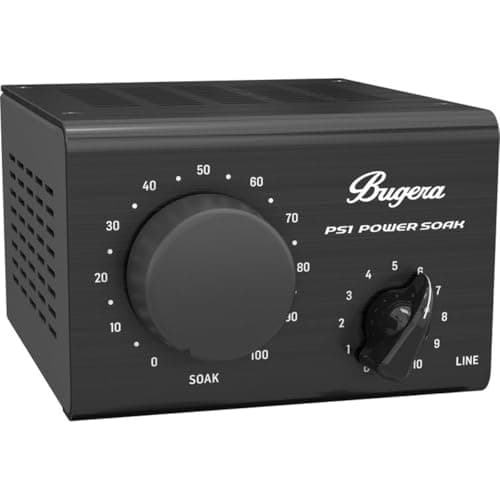 Bugera PS1 Power Attenuator A resistive attenuator with a continuous control, rated for 100 W amplifiers. | Continuous attenuation on a budget | $129.00 · Check price #ad How we’re funded · price as of October 17, 2026 |
| 03 | 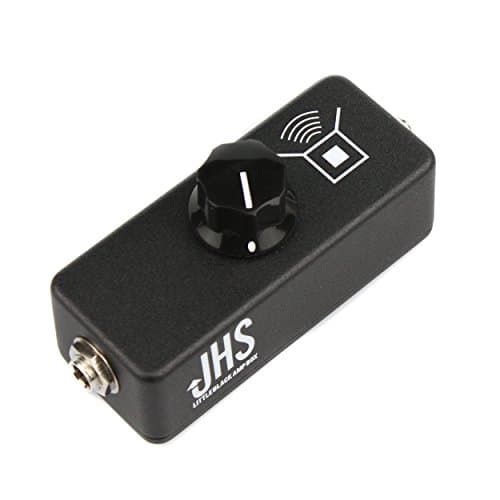 JHS Pedals Little Black Amp Box A pedal-sized passive attenuator — and the size is the specification. | Small combos only | $65.00 · Check price #ad How we’re funded · price as of October 17, 2026 |
| ! | No photo Blackstar HT-5R MkII A low-wattage valve amp with a speaker-emulated output — which solves the same problem differently. Skip this one — see why below | Not needing an attenuator in the first place |
Rows link to the full write-up further down this page. Prices come from the live price layer only — where there is no live figure the button reads “Check price” rather than showing a remembered number.
02Reactive and resistive, side by side
| Resistive | Reactive | |
|---|---|---|
| What it presents to the amp | A fixed resistance | An impedance that varies with frequency, like a speaker |
| Tone at light attenuation | Close to the amp's own | Close to the amp's own |
| Tone at heavy attenuation | Noticeably altered | Closer to the amp's own |
| Cost | Lower | Higher |
| Typical extras | A line output at best | DI, cabinet simulation, headphone output |
03Matching the attenuator to the amp
- Impedance. The attenuator must match your amp's rated output impedance. The Captor X is a fixed 8-ohm unit; a 16-ohm amp needs the 16-ohm version, which is a different product.
- Power rating. The Captor X handles 100 W RMS. A 100 W head running flat out is at that limit, not comfortably inside it. For a 20 W combo it is enormous headroom.
- Attenuation range. Stepped units give fixed positions — 0, -20, -38 dB on the Captor X. Continuous units let you find the exact level.
- Heat. Whatever the amp puts out becomes heat somewhere. Give the unit air, and be suspicious of anything small claiming a large power rating.
- Never run a valve amp without a load. Not while patching, not at all.
Two Notes Torpedo Captor X
The one to buy if you can
The number100 W RMS max, fixed 8 ohm nominal, 0 / -20 / -38 dB, stereo XLR DI.
Two Notes publishes a reactive load with a fixed 8-ohm nominal impedance rated at 100 W RMS, selectable attenuation at 0 dB, -20 dB and -38 dB on the speaker output, a stereo XLR DI, a headphone output, and cabinet simulation editable over USB or Bluetooth.
Reactive is the important word. A real speaker's impedance varies with frequency and the amp's output stage interacts with that; a resistive load does not reproduce it. That is where a cheap attenuator loses fidelity at heavy settings.
The attenuation is stepped rather than continuous, and 8 ohms is fixed — a 16-ohm amp needs the 16-ohm version, which is a separate product.
| Function | Reactive load box, attenuator, speaker simulator and DI in one unit |
|---|---|
| Load impedance | Fixed 8 ohm nominal (a 16 ohm version is sold separately) |
| Power handling | 100 W RMS maximum |
| Attenuation | Selectable 0 dB, -20 dB and -38 dB on the speaker output |
| Outputs | Speaker out, stereo XLR DI, headphone out, plus USB and Bluetooth for editing |
| What it does not do | The attenuation is stepped, not continuous — three positions, not a knob. 100 W is the ceiling, so a 100 W head run flat out is at the limit rather than comfortably inside it. |
Specs from Two Notes Torpedo Captor X product page. We have not used this unit.
Bugera PS1 Power Attenuator
Continuous attenuation on a budget
Continuous attenuation is a genuine advantage over stepped units: you dial the exact reduction the room needs instead of choosing between three fixed positions.
It is resistive, so it does not present the frequency-dependent impedance a speaker does. At light attenuation the difference is minor; at heavy attenuation it is not.
The line output has no serious cabinet simulation, so it is not a recording solution. Treat this as a volume control for the speaker output and nothing more.
| Function | Passive power attenuator between amp and speaker |
|---|---|
| Power handling | Rated for 100 W amplifiers |
| Controls | Continuous attenuation control plus a line output |
| Format | Compact pedal-sized enclosure |
| What it does not do | A purely resistive load does not behave like a speaker, so the tone at heavy attenuation is not the same as the tone at volume. There is no cabinet simulation on the line output worth recording as-is. |
Specs from Bugera PS1 product page. We have not used this unit.
#ad How we’re funded · price as of October 17, 2026
JHS Pedals Little Black Amp Box
Small combos only
A single control in a small box, placed between amp and speaker. For taking the edge off a small valve combo it is cheap and it works.
Attenuation works by converting the amp's output power into heat. A pedal-sized enclosure has limited surface area to dissipate that heat, which is why this is not rated for a large head.
No load-box function, no DI, no cabinet simulation. It is a volume control for a speaker output.
| Function | Passive attenuator placed between amp and speaker |
|---|---|
| Controls | Single attenuation control |
| Format | Small pedal-sized box with speaker in and out jacks |
| What it does not do | No load box function, no DI, no cabinet simulation. It is a volume control for a speaker output and nothing else — and it is not rated for a big head. |
Specs from JHS Little Black Amp Box product page. We have not used this unit.
#ad How we’re funded · price as of October 17, 2026
Blackstar HT-5R MkII
Not needing an attenuator in the first place
We are not picking this as an attenuator, and it is on the page because it is frequently the better purchase.
Blackstar publishes 5 W of valve power with two channels, an effects loop, a USB audio output and a speaker-emulated line output. For silent practice and recording, the emulated output does what a load box does at a fraction of the price of a good one.
What it does not do is let you use a valve amp you already own at lower volume. If the amp is the thing you want to keep, an attenuator is the answer. If you are buying anyway, an amp with an emulated output may be the cheaper route.
| Power | 5 W, valve |
|---|---|
| Speaker | 12" |
| Channels | Two, footswitchable, with Blackstar's ISF tone control |
| Extras | Digital reverb, effects loop, USB audio out, speaker-emulated line output |
| What it does not do | 5 W of valve power is still too loud for a small flat at the volume where the power section works. The USB output is a convenience, not a studio interface. |
Specs from Blackstar HT-5R MkII product page. We have not used this unit.
04What an attenuator cannot fix
Human hearing. We are less sensitive to low and high frequencies at low volume, so a cranked amp heard quietly sounds mid-heavy however perfectly it is attenuated. That is your ears, not the device, and no product solves it.
It also cannot make a solid-state amp sound better. Solid-state power sections do not produce a desirable distortion when driven, so there is nothing to unlock — turning the amp down achieves the same result for free.
05The load box alternative
A load box takes the amp's full output, dissipates all of it, and gives you a line-level signal instead. Add cabinet simulation and you can record or play through headphones with the speaker completely silent.
The Captor X does both jobs: it is an attenuator when you want the speaker running quietly, and a silent load box with a DI when you do not. That dual function is most of why it is worth more than a plain attenuator. Amp wattage and volume covers how much attenuation you actually need in decibels, which is the number to shop against. If the reason you want to be louder is that your lead is getting buried, turning up is the wrong control — that problem has its own page. A load box with a DI also solves a second gigging problem at the same time, by giving an amp with no line out a way to reach the desk — best gigging amps covers that retrofit.
Frequently asked questions
+ What is the best amp attenuator?
+ Do attenuators damage amps?
+ Reactive or resistive attenuator?
+ Can an attenuator make my amp bedroom quiet?
Sources
Related on Fret & Fuzz

Your solo disappears in a band — which pedal fixes it
Three different faults produce the same complaint. The diagnostic table first, then the pedal that fixes yours.
Top pick: BOSS GE-7 Equalizer
#ad How we’re funded · price as of October 17, 2026
Best gigging amps
Headroom, an effects loop, a way out to the PA and a weight you will still accept at 1 a.m. Five picks, plus the amp not to gig with.
Best Gigging Amp pick: BOSS KATANA-100 GEN 3
#ad How we’re funded · price as of October 17, 2026

Amp wattage and volume
Halving the watts costs 3 dB. A perceived halving needs a tenth of the power. The table that settles it.
Top pick: BOSS KATANA-50 GEN 3
Attenuator vs master volume
Halving power costs 3 dB. That one fact explains why a low-wattage amp is not a quiet amp, with the full table.
Top pick: Two Notes Torpedo Captor X
Best tube amps under $1,000
A real valve power section and a decent speaker. What this price does not buy is a way to use it at home.
Best Tube Amp Under $1,000 pick: Marshall DSL20CR
Tube vs solid state amps
Reframed as a question about where the distortion happens, this argument has a clear answer for any given player.
Top pick: BOSS KATANA-50 GEN 3
Combo vs head and cab
One box or two, and the impedance rule that matters more than the ergonomics. Plus the middle option most people miss.
Top pick: Marshall DSL20CR