Best delay and reverb pedals
One box, two effects, half the board space. The catch is that several pedals sold as delay and reverb only let you control one of them.
Fret & Fuzz earns a commission when you buy through the links on this page. It costs you nothing and it does not decide what we rank. How we’re funded.
We have not played this gear. Every pick below is chosen from published manufacturer specifications and the arithmetic set out in how we research, which you can re-run yourself.
Buy the BOSS RE-2 Space Echo: it has separate ECHO and REVERB level knobs, true stereo, tap tempo and carryover, and it is the only pedal in this category that publishes its current draw (75 mA) and dimensions. Take the NUX Atlantic if you want to choose which effect comes first, or the MOOER Ocean Machine II if you want two delay engines, presets and a looper. Avoid buying the BOSS DD-8 or RV-6 for this job: both give you one effect you can set and one you cannot.
A delay and a reverb are the two effects most likely to be at the end of a chain and the two most likely to be squeezed out of a small board. Putting them in one enclosure is an obvious win on space, power and patch cables — which is why so many pedals claim it, and why the claim needs checking.
01The criteria, before any product
| Criterion | Why it matters | What to look for |
|---|---|---|
| Can you set both effects | Several pedals give you one effect plus a fixed version of the other | A published control for each section, not just a combined mode |
| Which one comes first | Reverb into delay smears repeats; delay into reverb keeps them distinct | A published routing switch, serial or parallel |
| Published current draw | Two digital engines in one box is a heavy load on a supply output | A stated mA figure — only one pedal here has one |
| Board footprint | The space saving is the entire reason to buy one of these | Published dimensions against the two pedals it replaces |
| Stereo | A delay and reverb slot is where a stereo rig usually starts | Published stereo in and out, not just stereo out |
| Tails and bypass | A reverb cut off at bypass is an audible edit | Carryover, trails, or a selectable bypass type |
| Presets | Two effects means twice as many knobs to reset between songs | Published preset count, if any |
The first row does most of the work here, and it is the reason two of the five pedals below are skip picks rather than recommendations. A combined mode is not the same as two sections.
Best delay and reverb pedals
| # | Product | Best for | Price |
|---|---|---|---|
| 01 | 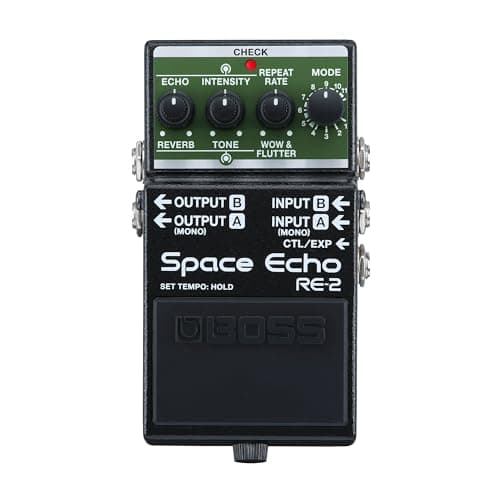 BOSS RE-2 Space Echo Independent echo and reverb level knobs, true stereo, tap tempo and carryover, in a standard compact enclosure at 75 mA. | The one to buy, and the only one here that publishes its current draw | |
| 02 | 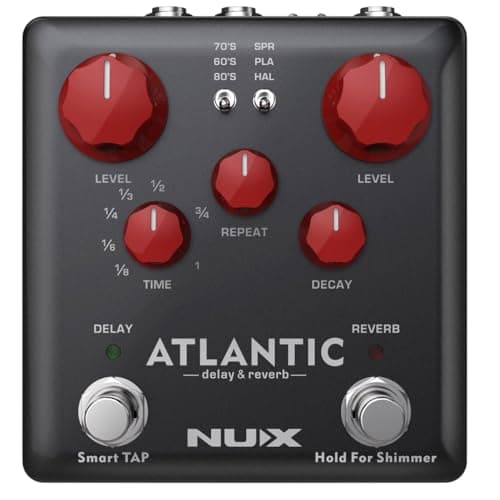 NUX Atlantic Delay & Reverb Three delays and three reverbs with published time ranges, separate controls for each section, and a switch for which one comes first. | The most control over how the two effects are wired together | $159.00 · Check price #ad How we’re funded · price as of October 17, 2026 |
| 03 | 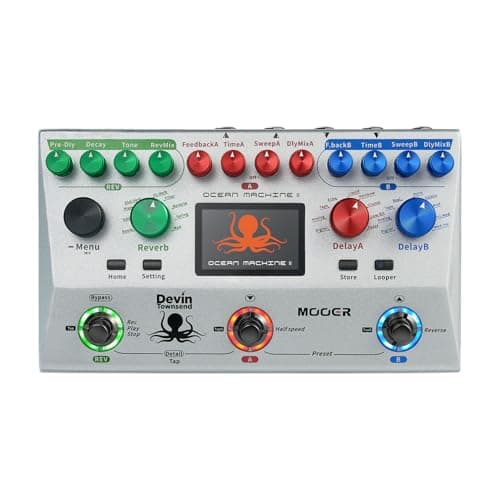 MOOER Ocean Machine II Two independent delay engines with nine types each, nine reverbs plus shimmer, 24 presets and a two-minute looper. | Two delays at once, a looper, and presets to recall it all | $299.00 · Check price #ad How we’re funded · price as of October 17, 2026 |
| ! | 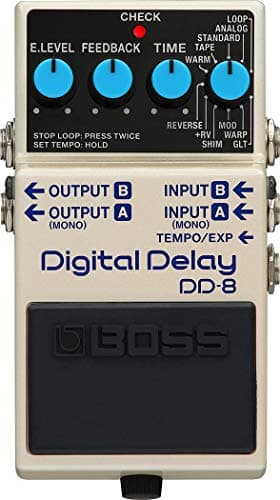 BOSS DD-8 Digital Delay Its +RV mode adds reverb you cannot adjust — there is no reverb level, decay or type control anywhere on the pedal. Skip this one — see why below | Not this list, despite being our pick for best delay | |
| ! | 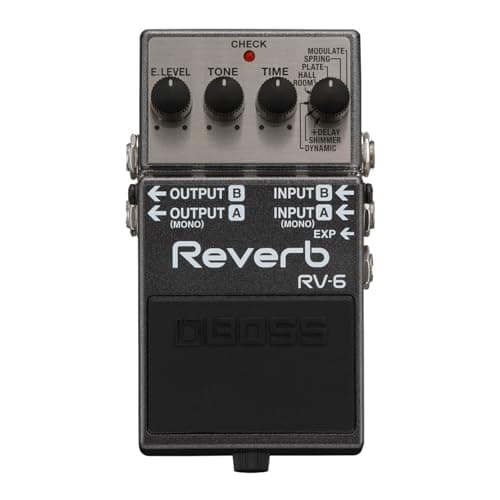 BOSS RV-6 Reverb The +DELAY mode is reverb with a fixed delay attached; BOSS publishes no control for the delay and does not state the two can be set independently. Skip this one — see why below | Not this list either — it is the same trap from the other direction |
Rows link to the full write-up further down this page. Prices come from the live price layer only — where there is no live figure the button reads “Check price” rather than showing a remembered number.
03The one question that sorts this whole category
Ask whether the pedal has a control for each effect, and check it against the maker's own published control list rather than the marketing copy.
There are two designs sold under the same description. In the first, the pedal has a delay section and a reverb section, each with its own level and its own character controls — the RE-2's ECHO and REVERB knobs, the Atlantic's Delay Level / Time / Repeat against Reverb Level / Decay. In the second, the pedal is a delay or a reverb, and one of its modes adds a fixed amount of the other effect behind it. The BOSS DD-8's +RV and RV-6's +DELAY are both the second kind, and BOSS's own published control lists prove it: neither pedal has a single knob that touches the added effect.
BOSS RE-2 Space Echo
The one to buy, and the only one here that publishes its current draw
The number75 mA, 73 x 129 x 59 mm, 1 M ohm in, 1 k ohm out. All published by BOSS.
This is the pick for most players, and the reason is boring rather than glamorous: it is the only pedal on this page whose maker publishes the numbers you need to actually plan a board around it. 75 mA, 73 x 129 x 59 mm, 450 g, 1 M ohm in and 1 k ohm out, recommended load 10 k ohms or greater. Everything else here asks you to buy on faith.
On the sound, BOSS publishes 11 sound combinations built on the original RE-201's three-head configuration, with and without the spring reverb, and — the line that matters most for this page — says you can *balance the echo/reverb blend with independent level knobs*. There is a dedicated ECHO knob and a dedicated REVERB knob. That is the whole test this page is built around, and this pedal passes it on the front panel rather than in a menu. Add true stereo in and out, tap tempo, a carryover switch so the repeats ring out past bypass, a Wow & Flutter control for tape modulation, and a CTL/EXP jack.
The cons are real and two of them are unusual. First, BOSS publishes no delay time figure at all — the specification says only that delay time has been doubled against the RE-201, which is a comparison and not a number. On a delay pedal that is a strange gap, and it means you cannot check before buying whether it reaches the long repeat you have in mind. Second, this is a tape echo voice, not a clean modern digital delay; if you want pristine, unsmeared repeats this is the wrong flavor and the NUX below has an 80's digital mode for exactly that. It is also buffered bypass only, no preset memory is published, the alkaline figure is about 4.5 hours so battery power is a backup rather than a plan, and no adaptor is in the box.
| Modes | 11 sound combinations built on the original RE-201 three-head configuration, with and without spring reverb |
|---|---|
| Blend | Separate ECHO and REVERB level knobs, described by BOSS as independent level knobs for the echo/reverb blend |
| Controls | Mode, Repeat Rate, Wow & Flutter, Intensity, Tone, Echo, Reverb, Carryover switch, pedal switch |
| Current draw | 75 mA |
| Battery life | Approx. 4.5 hours on alkaline |
| I/O | True stereo in and out, plus a CTL/EXP TRS jack. Input 1 M ohm, output 1 k ohm, recommended load 10 k ohms or greater |
| Size and weight | 73 x 129 x 59 mm, 450 g including battery |
| What it does not do | No adaptor included, and BOSS publishes no delay time figure anywhere — the specification says only that delay time is doubled against the RE-201, which is a comparison rather than a number. Buffered bypass only, and no preset memory is published. |
Specs from BOSS RE-2 Space Echo specifications. We have not used this unit.
NUX Atlantic Delay & Reverb
The most control over how the two effects are wired together
The numberDelays 40 to 400 ms, 55 to 550 ms and 80 to 800 ms; tap 125 to 1500 ms. No current draw published.
The cheapest of the three here and, on paper, the most configurable. NUX publishes three delay types each with its own range — a 70's BBD analog voice at 40 to 400 ms, a 60's tape echo at 55 to 550 ms and an 80's digital delay at 80 to 800 ms — alongside three reverbs: spring, plate with a shimmer effect, and hall. Published ranges per mode is more than most makers in this category give you.
The reason to choose it over the others is the routing. NUX publishes serial or parallel chain routing with separated dry signals, and a switch for which effect comes first — reverb into delay smears the repeats together, delay into reverb keeps them distinct, and this is the only pedal here that puts that choice on the outside of the box. The two sections have their own controls (Delay Level, Time and Repeat; Reverb Level and Decay), tap tempo runs 125 to 1500 ms across all three delay types with subdivisions and a Smart TAP footswitch, and there is a TRS input for an effects loop plus a +4 dB / -10 dB input level switch.
The cons are all about what is not published. NUX states no current draw, no dimensions, no weight and no bypass type. That is four of the figures you would use to plan a board, absent, on a pedal with two digital engines that is certainly not a light load. You cannot size a supply output for it or measure a board slot from the spec sheet, and this page's top pick publishes all of it. Stock is also thinner than the other two — it is a live listing, but not a deep one — and no power supply is included.
| Delay types | Three, each with a published range: 70's BBD analog 40 to 400 ms, 60's tape echo 55 to 550 ms, 80's digital 80 to 800 ms |
|---|---|
| Reverb types | Three — spring, plate with shimmer, and hall |
| Routing | Serial or parallel chain with separated dry signals, and a switch for which effect comes first |
| Controls | Delay Level, Time and Repeat; Reverb Level and Decay; routing and input level toggles |
| Tap tempo | 125 ms to 1500 ms across all three delay types, with tap subdivisions and a Smart TAP footswitch |
| I/O | 6.35 mm stereo input and two outputs, plus a TRS input for an effects loop. Input level switch, +4 dB or -10 dB |
| Electrical data | No current-draw or impedance figure is published for this pedal, so none is stated here. |
| What it does not do | No power supply included. NUX publishes no current draw, no dimensions and no weight for this pedal, so neither a supply output nor a board slot can be budgeted for it from the specification. |
Specs from NUX Atlantic Delay & Reverb product page. We have not used this unit.
#ad How we’re funded · price as of October 17, 2026
MOOER Ocean Machine II
Two delays at once, a looper, and presets to recall it all
The numberTwo delay engines, up to 2 s; 120 s looper; 24 presets; 215 x 127 x 56 mm, 1.1 kg.
The maximal answer, and the only one here that is really a small ambient workstation rather than a two-effect pedal. MOOER publishes two fully independent delay engines with nine delay types each and a ceiling of 2 seconds, nine reverb types — room, hall, plate, distorted, flanger, filter, reverse, spring and modulated — plus a shimmer mode. Two delays running against one reverb is a genuinely different proposition from anything else on this page: it is how dotted-eighth-plus-quarter patterns get built.
It is also the only pedal here with presets — 24 across eight banks, with what MOOER calls hybrid parallel/serial routing for the signal flow — and the only one with a looper, at 120 seconds with overdub, undo and redo, half speed and reverse. Twelve knobs and an LCD screen drive it, three multifunction footswitches including tap, full stereo in and out at 44.1 kHz and 24-bit, and selectable true or buffered bypass.
The cons start with the same gap as the NUX and get worse because of the size. MOOER publishes the 9 V DC requirement but no current-draw figure, and this is a pedal with a screen, two delay engines and a reverb engine — the one number you most want before choosing a supply, missing on the pedal most likely to need its own output. It is also the largest and heaviest thing here at 215 x 127 x 56 mm and 1.1 kg, which is three standard compact pedals' worth of board; it is the most expensive of the three; and MOOER does not spell out how the three footswitches are assigned or confirm in writing that both delays and the reverb run concurrently. Twelve knobs and a screen is a learning curve, not a plug-in.
| Delay | Two fully independent delay engines with nine types each, up to 2 seconds |
|---|---|
| Reverb | Nine types — room, hall, plate, distorted, flanger, filter, reverse, spring and modulated — plus a shimmer mode |
| Looper | 120 seconds, with overdub, undo/redo, half speed and reverse |
| Presets | 24, across eight banks |
| Controls | Twelve physical knobs driving an LCD screen, and three multifunction footswitches including tap tempo |
| Audio | Full stereo in and out, 44.1 kHz at 24-bit, selectable true or buffered bypass |
| Size and weight | 215 x 127 x 56 mm, 1.1 kg |
| What it does not do | No power supply included. MOOER publishes the 9 V DC requirement but no current-draw figure and no impedance data, which on a pedal this size with a screen and two delay engines is the one number you most want before choosing a supply. |
Specs from MOOER Ocean Machine II product page. We have not used this unit.
#ad How we’re funded · price as of October 17, 2026
BOSS DD-8 Digital Delay
Not this list, despite being our pick for best delay
This is the most likely wrong purchase on this page, and it is wrong for an unusual reason: it is a genuinely excellent pedal that we recommend elsewhere. The DD-8 is our best delay pedals winner and it has a mode called +RV, which BOSS describes as *digital delay with reverb added*. If you are searching for a delay and reverb pedal and you land on the best delay pedal and it lists reverb among its modes, the conclusion writes itself.
Look at the control list instead. BOSS publishes Mode, Time, Feedback, E.Level, a Carryover switch and the pedal switch — and nothing that adjusts the reverb. No reverb level, no decay, no reverb type. The delay is fully under your hands and the reverb is a fixed garnish on it, the same in every setting. That is a fine thing for a delay pedal to offer and it is not the thing this page is about.
Buy the DD-8 if you want a delay pedal — eleven modes, up to 10 seconds, true stereo, carryover, and our full DD-8 review covers why it wins its own category. Do not buy it expecting a reverb you can set. At 100 mA it is also the hungriest pedal named on this page.
| Modes | 11 — Analog, Standard, Tape, Warm, Reverse, +RV, Shimmer, Mod, Warp, GLT, plus Loop |
|---|---|
| Maximum delay | Up to 10 seconds, with tap tempo |
| Controls | Mode, Time, Feedback, E.Level, Carryover switch, pedal switch |
| Current draw | 100 mA |
| Battery life | Approx. 3.5 hours on alkaline |
| I/O | True stereo in and out, with three selectable output modes |
| Weight | 440 g including battery |
| What it does not do | No adaptor included. At 100 mA it is not a pedal you daisy-chain casually, and the 3.5-hour battery figure means battery power is a backup, not a plan. |
Specs from BOSS DD-8 specifications. We have not used this unit.
BOSS RV-6 Reverb
Not this list either — it is the same trap from the other direction
The mirror image of the DD-8, and it catches the same buyer coming the other way. The RV-6 is a very good reverb pedal with a mode literally named +DELAY, which BOSS describes as *reverb combined with delay. The synergistic effect provides rich reverberation.* Read that sentence closely: the delay is there to enrich the reverb, and the reverb is the effect being described.
The control list says the same thing. BOSS publishes E.Level, Tone, Time and Mode — reverb parameters — and no delay control at all, and nowhere states that the delay and reverb levels can be set independently in this mode. So you get a reverb you can shape and a delay you cannot, which is exactly the DD-8's problem with the two effects swapped. At 95 mA it also draws more than the RE-2 above while doing less of what this page asks for.
It is still worth owning as what it is. Eight modes including shimmer, dynamic and spring, true stereo, and a place on our best reverb pedals list. If a fixed, pleasant delay tucked behind the reverb is honestly all you want, it is the cheapest route to that and there is no reason to spend more. If you want two effects you can actually balance against each other, the three picks above are where this page points.
| Modes | 8 — Hall, Plate, Room, Spring, Modulate, +Delay, Shimmer, Dynamic |
|---|---|
| Controls | E.Level, Tone, Time, Mode, pedal switch |
| Current draw | 95 mA |
| Battery life | Approx. 3 hours on alkaline |
| I/O | Input A (mono) and B, Output A (mono) and B, expression jack |
| Weight | 450 g including battery |
| What it does not do | No adaptor included. 95 mA rules out a daisy chain shared with other digital pedals, and there is no way to save a setting — every mode change is a knob move. |
Specs from BOSS RV-6 specifications. We have not used this unit.
04Which effect should come first
Almost every rig runs delay into reverb, and the reason is audible rather than traditional: the delay produces distinct repeats and the reverb then blurs the whole result, including the repeats, into one space. Reverse the order and you are feeding a diffuse wash into a delay, which repeats the wash — the repeats stop sounding like repeats and start sounding like a longer tail.
Neither is wrong. Reverb into delay is a real ambient technique and it is how a lot of swelling, indistinct textures are made. The point is that it is a choice, and in a single enclosure the maker has usually made it for you. The NUX Atlantic is the pedal here that hands it back: NUX publishes serial and parallel routing with separated dry signals and a switch for which effect leads. On the RE-2 the echo and reverb are two parts of one emulated tape machine and the relationship is fixed by design, which is the correct decision for what that pedal is.
05The power budget is where these pedals hurt
This is the awkward finding of the page. Two of the three picks do not publish a current-draw figure, and both are the kind of pedal that needs one.
BOSS publishes 75 mA for the RE-2 — modest, and lower than either of the two BOSS pedals in the skip slots below it, which draw 95 mA and 100 mA while doing less. NUX publishes nothing for the Atlantic. MOOER publishes the 9 V DC requirement for the Ocean Machine II and no milliamp figure, on a pedal with an LCD screen, two delay engines and a reverb engine. In both cases you are either measuring the draw yourself or leaving a generous margin on a supply output and hoping. Power requirements explained sets out the method, and best power supplies compares bricks on published per-output current.
It is worth being blunt about what that gap costs. If a supply output is rated 100 mA and the pedal turns out to want 300 mA, the pedal does not politely refuse — it browns out, or it works until the moment a second pedal shares the output, which is the hardest class of fault to diagnose at a gig. A published number is not a detail.
06Does one box actually save you anything
On space, usually yes, but check the arithmetic rather than assuming. The RE-2 is a standard BOSS compact at 73 x 129 x 59 mm, so it genuinely replaces two pedals with one and returns a slot. The Ocean Machine II is 215 x 127 x 56 mm and 1.1 kg, which is roughly three compacts of width — against a separate delay and reverb it is close to a wash on space, and you are buying it for the two delay engines, the presets and the looper rather than for the footprint.
On money, one box is usually cheaper than two pedals of similar quality, and you save a patch cable and a supply output as well. On flexibility it is a clear loss: two separate pedals can be reordered, replaced one at a time, and put on opposite sides of an amp's effects loop. If you already own a delay you like, adding a reverb beside it is often the better buy than replacing both. Delay vs reverb covers what each effect is actually doing if you are not yet sure you need both.
07Where these go in the chain
Last, after the drives, and in the effects loop if the amp has one. Time-based effects in front of a distorting preamp get distorted along with the note, which turns individual repeats and a defined reverb tail into an undifferentiated wash — the single most common reason a delay or reverb sounds worse on a board than it did in the shop.
Stereo is the other consideration and it is the reason this slot is where stereo rigs usually begin. The RE-2 and the Ocean Machine II both publish true stereo in and out, and the Atlantic publishes a stereo input and two outputs. Running two amps from a delay and reverb pedal is the cheapest convincing stereo rig there is, and it is worth knowing the pedal supports it before you buy rather than after. Pedal order covers the full chain.
Frequently asked questions
+ What is the best delay and reverb pedal in one box?
+ Does the BOSS DD-8 count as a delay and reverb pedal?
+ Should delay go before or after reverb?
+ Is one delay and reverb pedal better than two separate pedals?
+ How much current do these pedals draw?
Sources
Related on Fret & Fuzz
Best delay pedals
Maximum delay time and current draw settle most of this category. Four delays on their published figures.
Best Delay pick: BOSS DD-8 Digital Delay

Best reverb pedals
Check your amp first. If you do need a reverb pedal, one multi-mode unit covers every type — here is what the modes actually differ on.
Best Reverb pick: BOSS RV-6 Reverb
Delay vs reverb
Countable repeats or a cloud of reflections. Which to buy first, in what order to run them, and what each costs to power.
Top pick: BOSS DD-8 Digital Delay
Best tap tempo delay pedals
Tap tempo is useless without a subdivision switch. Three picks compared on published divisions, time and draw.
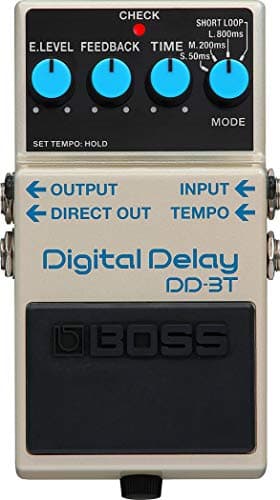
Best Tap Tempo Delay pick: BOSS DD-3T Digital Delay
Pedalboard power requirements explained
Two sums decide your power supply, and almost everyone only does the first. A worked example with real published figures.
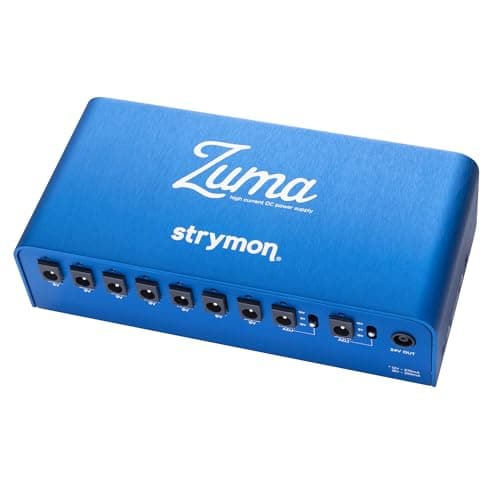
Top pick: Strymon Zuma
#ad How we’re funded · price as of October 17, 2026