Delay vs reverb
Both put your guitar in a space. One does it with discrete repeats you can count, the other with a cloud of reflections you cannot.
Fret & Fuzz earns a commission when you buy through the links on this page. It costs you nothing and it does not decide what we rank. How we’re funded.
We have not played this gear. Every pick below is chosen from published manufacturer specifications and the arithmetic set out in how we research, which you can re-run yourself.
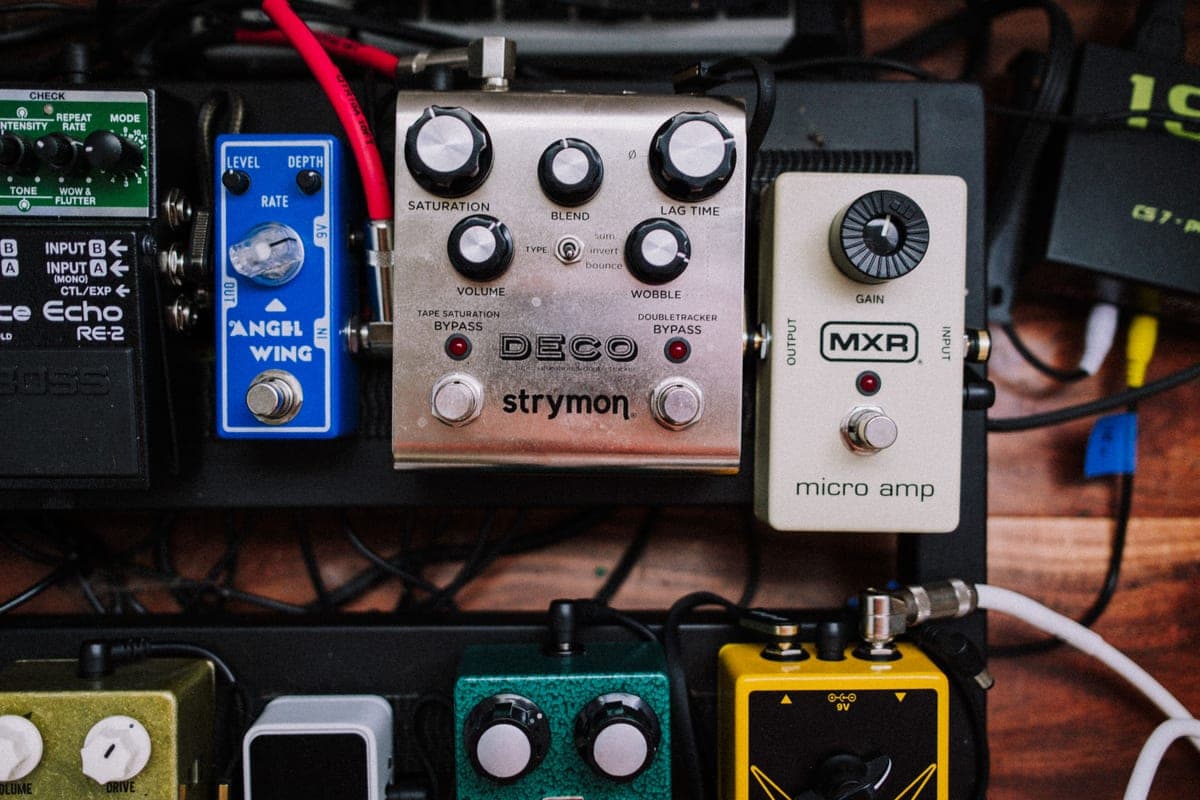
If you can count the repeats, it is delay. If you cannot, it is reverb. Delay repeats your signal at a set interval; reverb produces a dense cloud of very short reflections that simulates a space. Buy a delay first if your amp already has reverb — which most amps do — because delay is the capability you are actually missing.
They get conflated because both make a guitar sound less dry and both are described as adding 'space'. Mechanically they are the same idea at different scales, and that scale difference changes everything about how you use them.
If you are buying one of them first
| # | Product | Best for | Price |
|---|---|---|---|
| 01 | 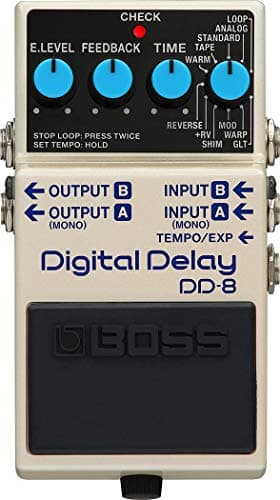 BOSS DD-8 Digital Delay Delay is the more musical of the two — it can be a rhythmic part rather than an ambience. | Buy this first if your amp already has reverb | |
| 02 | 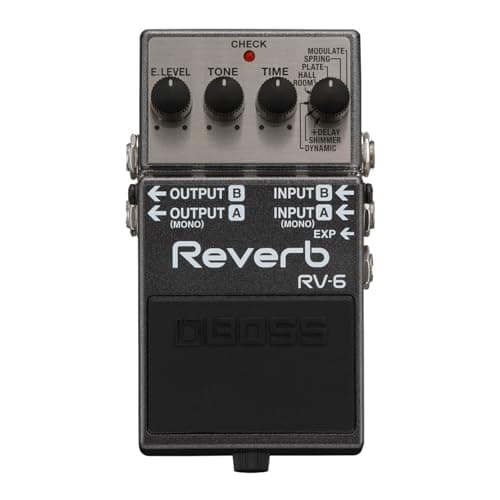 BOSS RV-6 Reverb Eight modes covering every reverb type, plus a Dynamic mode that ducks while you play. | Buy this first if your amp has no reverb at all |
Rows link to the full write-up further down this page. Prices come from the live price layer only — where there is no live figure the button reads “Check price” rather than showing a remembered number.
02The same mechanism at different scales
Reverb is what happens when sound bounces off surfaces in a room and arrives at your ear thousands of times, at intervals of a few milliseconds, each quieter than the last. Your brain does not hear individual reflections — it hears a space.
Delay is the same idea with a handful of reflections at intervals long enough to hear separately. At 500 ms you hear discrete repeats; at 50 ms you hear a slapback; below about 30 ms you stop hearing repeats and start hearing comb filtering, which is where chorus and flanger live.
| Delay time | What you perceive | Called |
|---|---|---|
| 1-20 ms | A single thickened sound with frequency notches | Comb filtering — flanger territory |
| 20-50 ms | Thickening and width, no distinct repeat | Chorus / doubling |
| 50-150 ms | A single distinct echo close behind the note | Slapback |
| 150 ms+ | Countable repeats | Delay |
| Thousands of overlapping reflections | A space, not repeats | Reverb |
03Which to buy first
- Your amp has reverb you like — buy the delay. You are missing a capability rather than upgrading one.
- Your amp has no reverb — buy the reverb. A completely dry guitar sounds unfinished in a way delay does not fix.
- You play in a band with a lot going on — delay, and used sparingly. Reverb fills space a band has already filled.
- You play alone, or ambient parts — reverb, and a lot of it. This is the context reverb was made for.
- You want rhythmic effects locked to tempo — delay with tap tempo, which means a digital pedal.
BOSS DD-8 Digital Delay
Buy this first if your amp already has reverb
The number100 mA. Eleven modes, up to 10 seconds, true stereo.
Most amps have a reverb and almost none have a delay. If yours does, buying a delay first gets you a capability you do not have rather than a better version of one you do.
Delay is also the more compositional effect. A dotted-eighth repeat is a part; reverb is a treatment. You can build a song around a delay setting in a way you cannot around a reverb setting.
Eleven modes, up to 10 seconds, tap tempo, Carryover, true stereo I/O — and 100 mA, which is the number to check against your power supply.
| Modes | 11 — Analog, Standard, Tape, Warm, Reverse, +RV, Shimmer, Mod, Warp, GLT, plus Loop |
|---|---|
| Maximum delay | Up to 10 seconds, with tap tempo |
| Controls | Mode, Time, Feedback, E.Level, Carryover switch, pedal switch |
| Current draw | 100 mA |
| Battery life | Approx. 3.5 hours on alkaline |
| I/O | True stereo in and out, with three selectable output modes |
| Weight | 440 g including battery |
| What it does not do | No adaptor included. At 100 mA it is not a pedal you daisy-chain casually, and the 3.5-hour battery figure means battery power is a backup, not a plan. |
Specs from BOSS DD-8 specifications. We have not used this unit.
BOSS RV-6 Reverb
Buy this first if your amp has no reverb at all
The number95 mA, stereo in and out, expression pedal input.
If your amp is a small solid-state practice amp with no reverb, or a modeler you are using dry, this is the more urgent purchase — a completely dry guitar sounds unfinished in a way a delay does not fix.
Eight modes means you never need a second reverb: Hall, Plate, Room, Spring, Modulate, +Delay, Shimmer, Dynamic.
Dynamic mode is worth the pedal on its own. It ducks the reverb while you play and lets it bloom in the gaps, so you can use much more of it without losing definition.
| Modes | 8 — Hall, Plate, Room, Spring, Modulate, +Delay, Shimmer, Dynamic |
|---|---|
| Controls | E.Level, Tone, Time, Mode, pedal switch |
| Current draw | 95 mA |
| Battery life | Approx. 3 hours on alkaline |
| I/O | Input A (mono) and B, Output A (mono) and B, expression jack |
| Weight | 450 g including battery |
| What it does not do | No adaptor included. 95 mA rules out a daisy chain shared with other digital pedals, and there is no way to save a setting — every mode change is a knob move. |
Specs from BOSS RV-6 specifications. We have not used this unit.
04Running both, and in what order
Delay first, then reverb. Each delay repeat then gets its own reverb tail, which is organized and predictable. Reverb into delay means the delay is repeating an already-reverberated signal, which piles up quickly and loses definition.
Both belong after your drives and, if the amp has one, in the effects loop. Distorting a delay repeat is the single most common cause of 'my delay sounds muddy' — see pedal order. If the answer to this page is that you want both, best delay and reverb pedals covers putting them in a single enclosure.
05The power cost of adding either
This is where the decision has a practical consequence beyond the pedal price. BOSS publishes 100 mA for the DD-8 and 95 mA for the RV-6. Adding either to an all-analog board multiplies the total current draw several times over, and adding both is often the point at which a daisy chain starts to hum.
Budget for a supply at the same time as the pedal. The power arithmetic guide has a worked example, and isolated vs daisy chain covers when the cheap option stops being adequate.
Frequently asked questions
+ What is the difference between delay and reverb?
+ Should I buy a delay or a reverb first?
+ Can a delay pedal do reverb?
+ Which order do delay and reverb go in?
Sources
Related on Fret & Fuzz
Best delay pedals
Maximum delay time and current draw settle most of this category. Four delays on their published figures.
Best Delay pick: BOSS DD-8 Digital Delay
Best reverb pedals
Check your amp first. If you do need a reverb pedal, one multi-mode unit covers every type — here is what the modes actually differ on.
Best Reverb pick: BOSS RV-6 Reverb
Best delay and reverb pedals
One box, two effects. Three pedals with a section for each, and the two BOSS pedals that only let you set one.
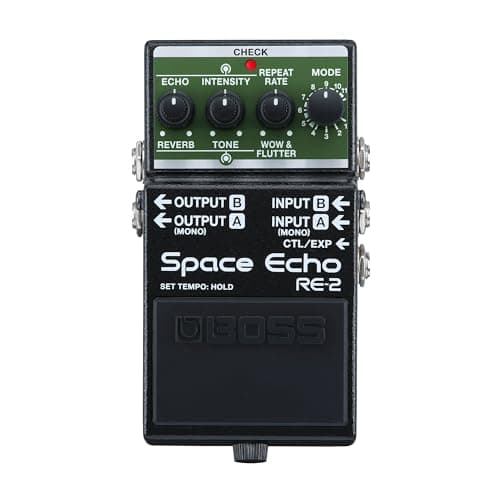
Best Delay + Reverb pick: BOSS RE-2 Space Echo
Pedal order: what changes and what does not
Two placements are load-bearing and the rest are preference. Which is which, and the impedance figures behind the first one.
Top pick: Dunlop Fuzz Face Mini Silicon
#ad How we’re funded · price as of October 17, 2026
Guitar pedal types explained
Five families defined by what they do to the waveform, and the map that turns a hundred-brand problem into five decisions.
Top pick: BOSS TU-3 Chromatic Tuner