TC Electronic Hall of Fame 2 vs BOSS RV-6
The two compact reverbs that end up on most shortlists, and the difference is whether you want the pedal fixed or programmable.
Fret & Fuzz earns a commission when you buy through the links on this page. It costs you nothing and it does not decide what we rank. How we’re funded.
We have not played this gear. Every pick below is chosen from published manufacturer specifications and the arithmetic set out in how we research, which you can re-run yourself.
Buy the BOSS RV-6 if you want to plug in and play: eight modes including Shimmer and Dynamic, true stereo, and a published 95 mA so you can plan a supply around it. Buy the TC Electronic Hall of Fame 2 if you want a pedal you can reshape — a loadable TonePrint slot, a pre-delay selector the RV-6 lacks, and the pressure-sensitive MASH switch. The catch is that TC publishes no current draw at all, so the Hall of Fame 2 cannot be budgeted from its own specification.
These two land on the same shortlists because they are the same size and roughly the same money. They are built on opposite philosophies: one is a finished pedal with eight settings, the other is a platform with a slot you fill.
01What each maker publishes
| BOSS RV-6 | TC Electronic Hall of Fame 2 | |
|---|---|---|
| Modes | 8 — Hall, Plate, Room, Spring, Modulate, +Delay, Shimmer, Dynamic | Reverb-type selector plus a loadable TonePrint slot |
| Programmable | No | Yes — TonePrint loaded over USB |
| Pre-delay control | Not published | Yes, a dedicated selector |
| Footswitch | Standard | MASH — pressure sensitive, assignable |
| Controls | E.Level, Tone, Time, Mode | Decay, Tone, Level, type and pre-delay selectors |
| Stereo | True stereo, A/Mono and B in and out | Not published in the same form |
| Expression | Expression jack | MASH switch acts as the expression control |
| Current draw | 95 mA | Not published |
| Battery life | Approx. 3 hours alkaline | Not published |
| Weight | 450 g including battery | Not published |
Every figure is the manufacturer's own published specification. Where a row says not published, that is what the maker states — or does not.
Which reverb
| # | Product | Best for | Price |
|---|---|---|---|
| 01 | 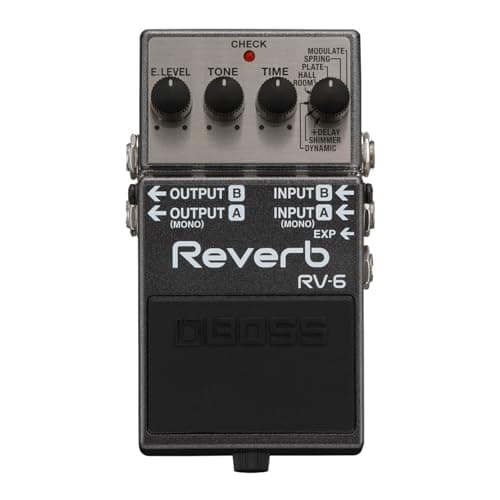 BOSS RV-6 Reverb Eight modes on a knob, true stereo in and out, and a published 95 mA so you can budget for it. | Knowing what you are getting, and being able to power it | |
| 02 | 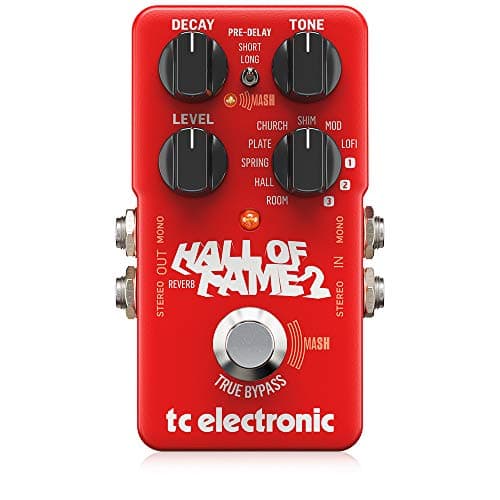 TC Electronic Hall of Fame 2 Reverb A loadable TonePrint slot and a pressure-sensitive MASH switch that turns the footswitch into a control. | One pedal you can reshape, and expression under your foot | $129.00 · Check price #ad How we’re funded · price as of October 17, 2026 |
Rows link to the full write-up further down this page. Prices come from the live price layer only — where there is no live figure the button reads “Check price” rather than showing a remembered number.
03Pre-delay is the control people do not know they want
If you have ever turned a reverb up to the level you wanted and found your playing turned to soup, pre-delay is the setting that fixes it.
Pre-delay is the gap between the dry note and the start of the reverb tail. With none, the reverb begins at the same instant as the note and blurs the attack; add 20 or 30 milliseconds and the attack lands clean, with the space opening up behind it. The practical effect is that you can run a much larger reverb without losing definition — the same trick a mix engineer uses on vocals for the same reason.
The Hall of Fame 2 gives you a selector for it. The RV-6 does not publish a pre-delay control, so on that pedal your tool for the same problem is the Tone knob and restraint with the level. This is the clearest functional advantage either pedal holds over the other. Reverb types explained covers what the algorithm choices are doing underneath.
BOSS RV-6 Reverb
Knowing what you are getting, and being able to power it
The number95 mA, 8 modes, stereo A/B in and out, expression jack, 450 g. All published by BOSS.
The RV-6 is the safer buy and the reason is that BOSS tells you everything. Eight modes on a single knob — Hall, Plate, Room, Spring, Modulate, +Delay, Shimmer and Dynamic — with E.Level, Tone and Time to shape them. Two of those modes are the reason to pick it over something cheaper: Shimmer, which BOSS describes as producing sparkling high-frequency overtones, and Dynamic, which sets its own depth according to how you are playing so the reverb gets out of the way when you dig in.
It publishes true stereo operation on A/Mono and B jacks in and out, an expression pedal jack, 95 mA of draw, roughly 3 hours of alkaline life and 450 g. There is nothing to configure and nothing to load — you turn the knob and the pedal is in that mode.
The cons: 95 mA is a real load for a reverb and more than the RE-2 Space Echo draws while doing more. There is no way to save a setting — every change is a knob move, so a set needing three different reverb sounds means three visits to the pedal. Alkaline life of about three hours makes battery power a backup rather than a plan, and no adaptor is included.
| Modes | 8 — Hall, Plate, Room, Spring, Modulate, +Delay, Shimmer, Dynamic |
|---|---|
| Controls | E.Level, Tone, Time, Mode, pedal switch |
| Current draw | 95 mA |
| Battery life | Approx. 3 hours on alkaline |
| I/O | Input A (mono) and B, Output A (mono) and B, expression jack |
| Weight | 450 g including battery |
| What it does not do | No adaptor included. 95 mA rules out a daisy chain shared with other digital pedals, and there is no way to save a setting — every mode change is a knob move. |
Specs from BOSS RV-6 specifications. We have not used this unit.
TC Electronic Hall of Fame 2 Reverb
One pedal you can reshape, and expression under your foot
The numberDecay, Tone, Level, type and pre-delay selectors, MASH switch, TonePrint over USB. No draw published.
The Hall of Fame 2's argument is that the pedal is not finished when you buy it. TC publishes a TonePrint slot loadable over USB, so one position on the type selector becomes whatever reverb you put there — a different algorithm, or a signature setting — and you can change it later without buying another pedal. Alongside that are Decay, Tone and Level knobs plus a pre-delay selector, which is a genuinely useful control the RV-6 does not offer at all: pre-delay is the gap between your note and the onset of the reverb, and it is what keeps a big reverb from swallowing your attack.
The MASH footswitch is the headline. It is pressure-sensitive, so how hard you press controls a parameter you assign — you can swell the reverb mix under your foot mid-phrase rather than reaching for a knob or an expression pedal. Nothing else at this size does that.
The cons start with a missing number. TC publishes no current draw and no impedance figures for this pedal, which means you cannot budget a supply output for it from the specification — an awkward gap on a digital reverb, where the draw is never trivial. No power supply is included. And the MASH switch, which is much of what you are paying for, is the feature most owners never end up assigning to anything; if you want a set-and-forget hall, you are buying it anyway.
| Controls | Decay, Tone, Level, reverb-type selector, pre-delay selector |
|---|---|
| Switching | MASH pressure-sensitive footswitch controls a chosen parameter under foot |
| Presets | TonePrint slot loadable over USB |
| Power | 9 V DC center-negative |
| Electrical data | No current-draw or impedance figure is published for this pedal, so none is stated here. |
| What it does not do | No power supply included. The MASH switch is a genuinely different way to play reverb and it is also the part most people never use — if you only want a set-and-forget hall, you are paying for it anyway. |
Specs from TC Electronic Hall of Fame 2 product page. We have not used this unit.
#ad How we’re funded · price as of October 17, 2026
04The missing current figure
BOSS publishes 95 mA for the RV-6. TC publishes nothing for the Hall of Fame 2, and on a digital reverb that gap has consequences.
A digital reverb is running a processor continuously, so its draw is never in analog-pedal territory. Without a number you cannot tell whether it will share a 100 mA output with your tuner or needs one of its own, and the failure mode is not a polite refusal — it is a pedal that works on the bench and browns out when a second pedal joins the output, which is the most annoying class of fault to chase at a gig. The honest planning answer is to give it its own output and leave headroom. Pedalboard power requirements explained covers the method.
05Shimmer and Dynamic against a slot you fill yourself
The RV-6's two distinctive modes are worth naming because they are the reason to choose it over a cheaper spring-and-hall box.
Shimmer adds pitch-shifted octaves into the tail, producing the huge synthetic wash used all over ambient and worship playing — a sound that used to require a rack. Dynamic is subtler and more broadly useful: the pedal reduces the reverb while you are playing hard and lets it bloom when you back off, so a big setting stops turning busy passages to mush. Both are fixed, both are good, and neither can be altered.
The Hall of Fame 2's counter-offer is that its equivalent slot is empty and you decide what goes in it. Whether that is better depends entirely on whether you will ever plug the pedal into a computer. If you know you will not, the RV-6's fixed modes are the more honest purchase. Best reverb pedals compares the wider category, and our BOSS RV-6 review goes deeper on the modes.
06Where these go, and the one-box alternative
Last in the chain, after the drives, and in the effects loop if the amp has one. A reverb in front of a distorting preamp gets distorted along with the note, which turns a defined tail into a wash.
It is also worth asking whether you need a reverb pedal at all rather than a reverb and delay in one enclosure — the RV-6's +Delay mode gestures at that and does not really deliver it, because the delay in that mode has no control of its own. Best delay and reverb pedals covers the pedals that give you a section for each.
Frequently asked questions
+ Is the Hall of Fame 2 better than the BOSS RV-6?
+ How much current does the Hall of Fame 2 draw?
+ What is pre-delay and do I need it?
+ Does the BOSS RV-6 do shimmer?
Sources
Related on Fret & Fuzz
Best reverb pedals
Check your amp first. If you do need a reverb pedal, one multi-mode unit covers every type — here is what the modes actually differ on.
Best Reverb pick: BOSS RV-6 Reverb
BOSS RV-6 review
Shimmer and Dynamic are the two modes worth paying for. 95 mA is the number that decides whether you can.
Top pick: BOSS RV-6 Reverb
Reverb types explained
What spring, room, plate, hall and shimmer each simulate, plus the pre-delay setting that makes heavy reverb usable.
Top pick: BOSS RV-6 Reverb
Best delay and reverb pedals
One box, two effects. Three pedals with a section for each, and the two BOSS pedals that only let you set one.
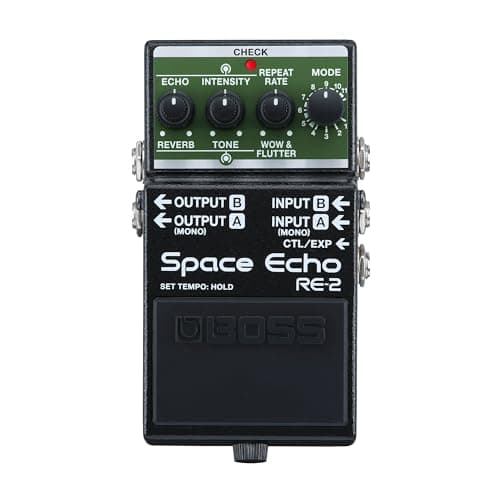
Best Delay + Reverb pick: BOSS RE-2 Space Echo