BOSS RV-6 review
The reverb that made shimmer a compact-pedal feature, and the one mode on it that almost nobody switches to.
Fret & Fuzz earns a commission when you buy through the links on this page. It costs you nothing and it does not decide what we rank. How we’re funded.
We have not played this gear. Every pick below is chosen from published manufacturer specifications and the arithmetic set out in how we research, which you can re-run yourself.
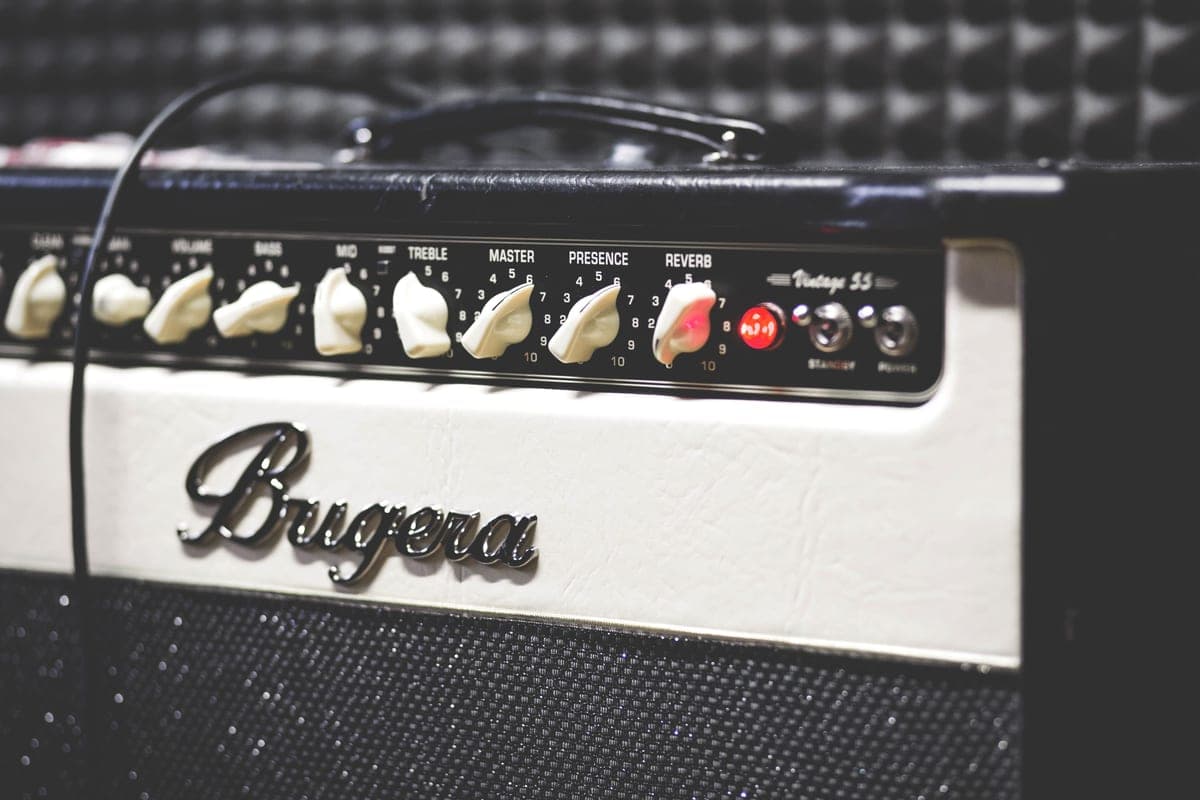
Buy an RV-6 if you want one reverb that covers spring through ambient and you can spare 95 mA. Shimmer and Dynamic are the two modes that justify it over a cheaper pedal — Dynamic in particular lets you use far more reverb than usual without losing the note attack. The expression input is worth planning for, because swelling reverb level with a foot is a control you cannot get from the front panel.
We have not played this pedal, and this is not a tone review. What follows is BOSS's published specification, what it means on a board, and who should buy something else. How we research sets out the method.
01What BOSS publishes
| Specification | Published figure | What it means in practice |
|---|---|---|
| Modes | 8: Hall, Plate, Room, Spring, Modulate, +Delay, Shimmer, Dynamic | Conventional types plus four that are not |
| Controls | E.LEVEL, TONE, TIME, MODE, pedal switch | Four knobs; no mix-versus-decay confusion |
| Nominal input level | -20 dBu | Instrument level |
| Input impedance | 1 M ohm | Does not load a passive pickup |
| Output impedance | 1 k ohm | Recommended load 10 k ohm or greater |
| I/O | INPUT-A (MONO)/INPUT-B, OUTPUT-A (MONO)/OUTPUT-B | True stereo in and out |
| Expression | EXP jack | Swell reverb level with a foot |
| Current draw | 95 mA | Plan the supply around this |
| Battery life | Approx. 3 hours (alkaline) | Use a supply |
| Size / weight | 73 x 129 x 59 mm, 450 g | Standard BOSS compact footprint |
Every figure is BOSS's own published specification. We have not measured any of them.
The pedal
| # | Product | Best for | Price |
|---|---|---|---|
| 01 | 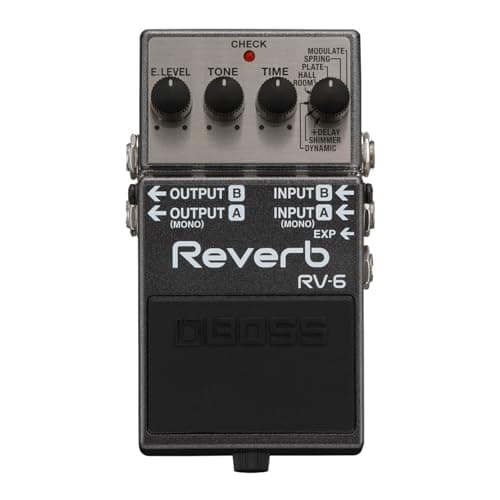 BOSS RV-6 Reverb Eight modes including Shimmer and Dynamic, with an expression input and true stereo I/O — at 95 mA. | One reverb that covers spring through ambient |
Rows link to the full write-up further down this page. Prices come from the live price layer only — where there is no live figure the button reads “Check price” rather than showing a remembered number.
03Dynamic is the mode that changes how you use reverb
The universal problem with reverb is that the setting which sounds good alone buries you in a band. Reverb fills the space between notes, and a full mix has already filled that space — so the wash that sounded huge in a bedroom turns into mud the moment a drummer starts.
Dynamic mode attacks that directly by ducking the reverb while you are playing and letting it bloom in the gaps. The practical result is that you can run a reverb level you would never get away with in Hall mode, because it steps out of the way of the note attack and only fills the spaces where there is room. It is the single most useful mode on the pedal and the one least likely to be found by someone turning the MODE knob in a shop.
BOSS RV-6 Reverb
One reverb that covers spring through ambient
The number95 mA, 1 M ohm in, 1 k ohm out, 450 g. All published by BOSS.
BOSS publishes eight modes: Hall, Plate, Room, Spring, Modulate, +Delay, Shimmer and Dynamic. Four of those are the conventional reverb types every pedal has. The other four are the reason to buy this one rather than something cheaper.
Shimmer adds a pitch-shifted octave into the tail, which is the sound behind most modern ambient guitar parts. Dynamic ducks the reverb while you play and lets it bloom in the gaps, which is how you run far more reverb than usual without burying the note attack or the vocal. +Delay puts both effects in one block, which on a tight board removes a pedal.
The cons: at 95 mA it is nearly as hungry as a digital delay, and two such pedals together will end a modest supply. There are no presets, so mode changes are manual. And the four conventional modes are conventional — if Hall and Spring are all you need, you are paying for four modes you will not use.
| Modes | 8 — Hall, Plate, Room, Spring, Modulate, +Delay, Shimmer, Dynamic |
|---|---|
| Controls | E.Level, Tone, Time, Mode, pedal switch |
| Current draw | 95 mA |
| Battery life | Approx. 3 hours on alkaline |
| I/O | Input A (mono) and B, Output A (mono) and B, expression jack |
| Weight | 450 g including battery |
| What it does not do | No adaptor included. 95 mA rules out a daisy chain shared with other digital pedals, and there is no way to save a setting — every mode change is a knob move. |
Specs from BOSS RV-6 specifications. We have not used this unit.
04The expression jack is worth a board slot
BOSS publishes an EXP jack, and it is the feature most owners never wire up. An expression pedal assigned to reverb level lets you swell the ambience up under a sustained chord and pull it back for a verse, with your hands still on the guitar.
That is a genuinely different musical control from anything on the front panel, and it replaces a volume-pedal swell technique that takes far longer to learn. The cost is a treadle-sized slot on the board and a TRS cable, which on a small board is a real trade rather than a free upgrade.
05The power question, since it is the usual dealbreaker
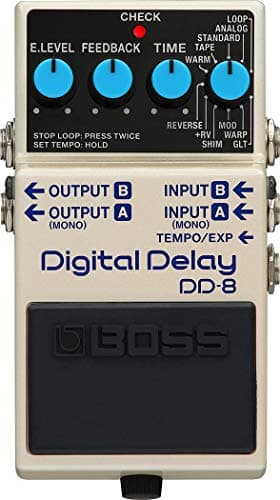
Ninety-five milliamps puts the RV-6 in the same class as a digital delay. Run both — an RV-6 and a DD-8 at 100 mA — and you are at 195 mA for two pedals before the tuner and the drives, which is past a modest daisy chain and into isolated-brick territory.
That is the normal shape of a modern board and it is worth budgeting for rather than discovering. Power requirements explained has the arithmetic, and isolated vs daisy chain covers why two digital pedals on one non-isolated supply is where hum usually starts.
06Who should buy something else
- Your amp already has good spring reverb. Many do, and it is the right kind for a lot of music. Save the slot and the 95 mA.
- You need presets. There are none. Mode changes are manual.
- You only want one reverb sound. Four of the eight modes are conventional; a cheaper single-voice pedal does that job.
- Your supply is already full. 95 mA is not a rounding error.
- You want reverb and tremolo in one box. That is a different product — best tremolo pedals covers a pedal that does both.
07Who should buy it
Someone who wants one reverb slot filled for good, and who will actually use Shimmer or Dynamic. If those two modes do not appeal, most of the reason to pay for this pedal disappears and a simpler reverb will serve.
It is also the obvious pick for ambient and modern worship playing, where the reverb is closer to an instrument than an effect. Best pedals for worship music builds a board in that order, with the RV-6 doing exactly this job. Against its usual rival, Hall of Fame 2 vs BOSS RV-6 sets the eight fixed modes against a loadable TonePrint slot and a pre-delay control the RV-6 does not have.
Frequently asked questions
+ How much current does the BOSS RV-6 draw?
+ What does Dynamic mode do on the RV-6?
+ Does the RV-6 have an expression pedal input?
+ Is the RV-6 true stereo?
Sources
Related on Fret & Fuzz
Best reverb pedals
Check your amp first. If you do need a reverb pedal, one multi-mode unit covers every type — here is what the modes actually differ on.
Best Reverb pick: BOSS RV-6 Reverb
TC Electronic Hall of Fame 2 vs BOSS RV-6
Eight fixed modes and a published 95 mA against a loadable slot, a pressure-sensitive switch and no draw figure.
Top pick: BOSS RV-6 Reverb
Reverb types explained
What spring, room, plate, hall and shimmer each simulate, plus the pre-delay setting that makes heavy reverb usable.
Top pick: BOSS RV-6 Reverb
Delay vs reverb
Countable repeats or a cloud of reflections. Which to buy first, in what order to run them, and what each costs to power.
Top pick: BOSS DD-8 Digital Delay

Best guitar pedals for worship music
Delay first, reverb second, gain last. Five picks judged on tap tempo, ducking reverb and blend — plus the pedal that gets bought for this and should not.
Best for Worship pick: BOSS DD-8 Digital Delay
Pedalboard power requirements explained
Two sums decide your power supply, and almost everyone only does the first. A worked example with real published figures.
Top pick: Strymon Zuma
#ad How we’re funded · price as of October 17, 2026