BOSS TR-2 review
The cheapest route to a real tremolo, and the published specification that tells you what it will and will not do.
Fret & Fuzz earns a commission when you buy through the links on this page. It costs you nothing and it does not decide what we rank. How we’re funded.
We have not played this gear. Every pick below is chosen from published manufacturer specifications and the arithmetic set out in how we research, which you can re-run yourself.
The TR-2 is worth buying if you want a genuine tremolo with control over the waveform and you will set the speed by ear. Its Wave knob sweeps continuously from triangle to square, which covers both the smooth amp-style pulse and the hard surf chop, and it draws only 25 mA. Do not buy it if you need tempo-locked tremolo or a stereo effect: there is no tap tempo, no stereo output, and BOSS does not publish a rate range.
We have not played this pedal, and this is not a tone review. What follows is BOSS's published specification, what each figure means in practice, and who should buy something else. How we research sets out the method.
01What BOSS publishes
| Specification | Published figure | What it means in practice |
|---|---|---|
| Controls | Depth, Rate, Wave, pedal switch | Three knobs — no tap, no tone control |
| Wave | Sweeps the LFO shape from triangle to square | Continuous, not a set of fixed presets |
| Rate range | Not published | You cannot check the slowest or fastest speed before buying |
| Input impedance | 1 M ohm | Will not load a guitar pickup |
| Output impedance | 1 k ohm, 10 k ohm load or greater | Drives a normal amp input |
| Nominal level | -20 dBu in and out | Instrument level |
| Current draw | 25 mA | Trivial on any supply |
| Battery life | Approx. 12 h carbon-zinc, 28 h alkaline | Among the longer BOSS battery figures |
| Size and weight | 73 x 129 x 59 mm, 385 g | Standard BOSS compact |
| Stereo | Not offered — mono in and out | One amp only |
Every figure is BOSS's own published specification. Where a row says not published, that is what the manufacturer states.
The pedal
| # | Product | Best for | Price |
|---|---|---|---|
| 01 | 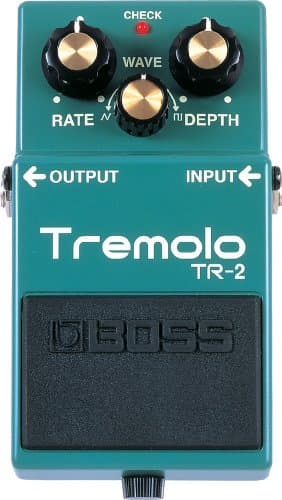 BOSS TR-2 Tremolo Depth, Rate and a Wave knob that sweeps the shape continuously — for 25 mA and a standard compact footprint. | A tremolo you set by ear and leave alone |
Rows link to the full write-up further down this page. Prices come from the live price layer only — where there is no live figure the button reads “Check price” rather than showing a remembered number.
03What the Wave knob actually does
Tremolo is volume going up and down. The waveform is the shape of that movement over time, and it changes the effect more than the speed does.
A triangle wave rises and falls at a constant rate, so the volume glides smoothly between loud and quiet — this is the soft, watery pulse of a vintage amp's built-in tremolo, and it sits under a chord without drawing attention. A square wave jumps between the two levels almost instantly, so the sound is chopped into distinct blocks — the stuttering, rhythmic effect of surf and a lot of modern indie parts. These are not variations on one sound; they are two different effects.
Most cheap tremolos pick one. The TR-2 publishes a control that sweeps between them, which is the strongest single argument for it — one pedal covers both idioms, and the settings in between are genuinely useful rather than a compromise.
BOSS TR-2 Tremolo
A tremolo you set by ear and leave alone
The number25 mA, 1 M ohm in, 1 k ohm out, 385 g, approx. 28 h alkaline. All published by BOSS.
Three knobs, and the third one is the interesting one. BOSS publishes Depth, Rate and Wave, and the Wave control sweeps the modulation shape from triangle toward square rather than switching between fixed presets. That is the difference between a tremolo that does one thing and one that covers the range: a triangle wave gives the smooth, sine-like swell of an old amp tremolo, a square wave gives the hard on-off chop used in surf and modern indie playing, and the knob lets you sit anywhere between them.
The electrical picture is fully published and unremarkable in the best way: 25 mA, 1 M ohm input and 1 k ohm output with a recommended load of 10 k ohms or greater, nominal levels of -20 dBu in and out, roughly 28 hours of alkaline battery life, and 385 g in the standard BOSS compact enclosure. At 25 mA it is one of the least demanding pedals you can add to a board.
The cons start with a figure that is missing. BOSS publishes no rate range — no slowest and no fastest speed in Hz or bpm — which on a tempo-based effect is the specification you most want, because it tells you whether the pedal can reach the slow pulse or the fast flutter you have in mind. It is also mono only, with no stereo output and no tap tempo, so matching the tremolo to a song's tempo means setting the Rate by ear every time. No adaptor is included.
| Controls | Depth, Rate, Wave, pedal switch |
|---|---|
| Wave control | Sweeps the modulation shape rather than switching between fixed presets |
| Input impedance | 1 M ohm |
| Output impedance | 1 k ohm |
| Current draw | 25 mA |
| Power | 9 V battery (6F22 / 6LR61) or PSA-series adaptor |
| Size / weight | 73 x 129 x 59 mm, 385 g including battery |
| What it does not do | Mono only — there is no stereo output and no tap tempo, so a tempo-locked tremolo means setting the Rate by ear every time the song changes. No adaptor included. |
Specs from BOSS TR-2 Tremolo specifications. We have not used this unit.
04The rate range BOSS does not publish
This site's standard is that a specification exists when the manufacturer publishes it, and here BOSS does not. There is no stated minimum or maximum rate anywhere in the TR-2's specification.
That is a real gap on this particular effect. With a delay you can check whether 800 milliseconds is enough for what you want; with a tremolo the equivalent question — will it go slow enough for a long, lazy swell, or fast enough for a hard flutter — has no published answer. You find out when the pedal arrives. It is worth knowing that before you order rather than after.
The related gap is tap tempo, which the TR-2 does not have. Tremolo is a rhythmic effect and the sound most people want is locked to the song, so the absence of tap means setting the Rate by ear against the drummer at the start of every song that uses it. That is workable for a band with one tremolo song and tiresome for a band with five.
05Where it goes in the chain
After the drives, with the other modulation effects, and before delay and reverb. A tremolo placed in front of a distorting amp has its volume dips partly flattened by the distortion — the amp compresses the quiet parts back up, so a deep setting arrives sounding shallow.
That is the single most common complaint about tremolo on a board and it is a placement problem rather than a pedal problem. Put it after the gain stages and the depth you set is the depth you hear. Pedal order covers the reasoning, and best modulation pedals sets tremolo against the chorus, phaser and flanger it is usually shortlisted against.
06Who should buy something else
Anyone who needs the tremolo locked to a tempo, because no amount of ear-setting replaces a tap switch in a set with tempo changes.
Anyone running a stereo rig, since the TR-2 is mono and stereo tremolo — where the volume moves between two amps rather than up and down in one — is a genuinely different and much larger effect. And anyone who wants the amp-style pulse specifically and already owns an amp with tremolo built in, in which case the honest answer is to use the one you have. Best tremolo pedals compares the category on published waveshape control, which is the specification that actually separates them.
Frequently asked questions
+ Is the BOSS TR-2 a good tremolo pedal?
+ Does the BOSS TR-2 have tap tempo?
+ What is the difference between triangle and square wave tremolo?
+ Where should a tremolo pedal go in the chain?
Sources
Related on Fret & Fuzz
Best tremolo pedals
Waveshape is the specification that separates tremolo pedals. Three compared, plus the one already inside your multi-effects unit.
Best Tremolo pick: BOSS TR-2 Tremolo
Best modulation pedals
Four mechanisms that get shelved together and share almost nothing. Pick the mechanism and the pedal follows.
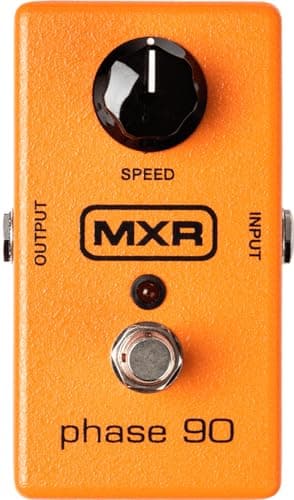
Best Modulation pick: MXR Phase 90
#ad How we’re funded · price as of October 17, 2026
Delay time and tempo: the arithmetic
60,000 divided by the tempo. The full table for quarter, eighth, dotted-eighth and sixteenth notes.
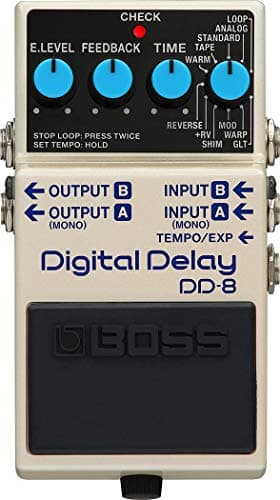
Top pick: BOSS DD-8 Digital Delay
Pedal order: what changes and what does not
Two placements are load-bearing and the rest are preference. Which is which, and the impedance figures behind the first one.
Top pick: Dunlop Fuzz Face Mini Silicon
#ad How we’re funded · price as of October 17, 2026