Best tremolo pedals
The simplest modulation effect there is, and the one whose controls differ most between pedals. Waveshape is the specification that matters.
Fret & Fuzz earns a commission when you buy through the links on this page. It costs you nothing and it does not decide what we rank. How we’re funded.
We have not played this gear. Every pick below is chosen from published manufacturer specifications and the arithmetic set out in how we research, which you can re-run yourself.
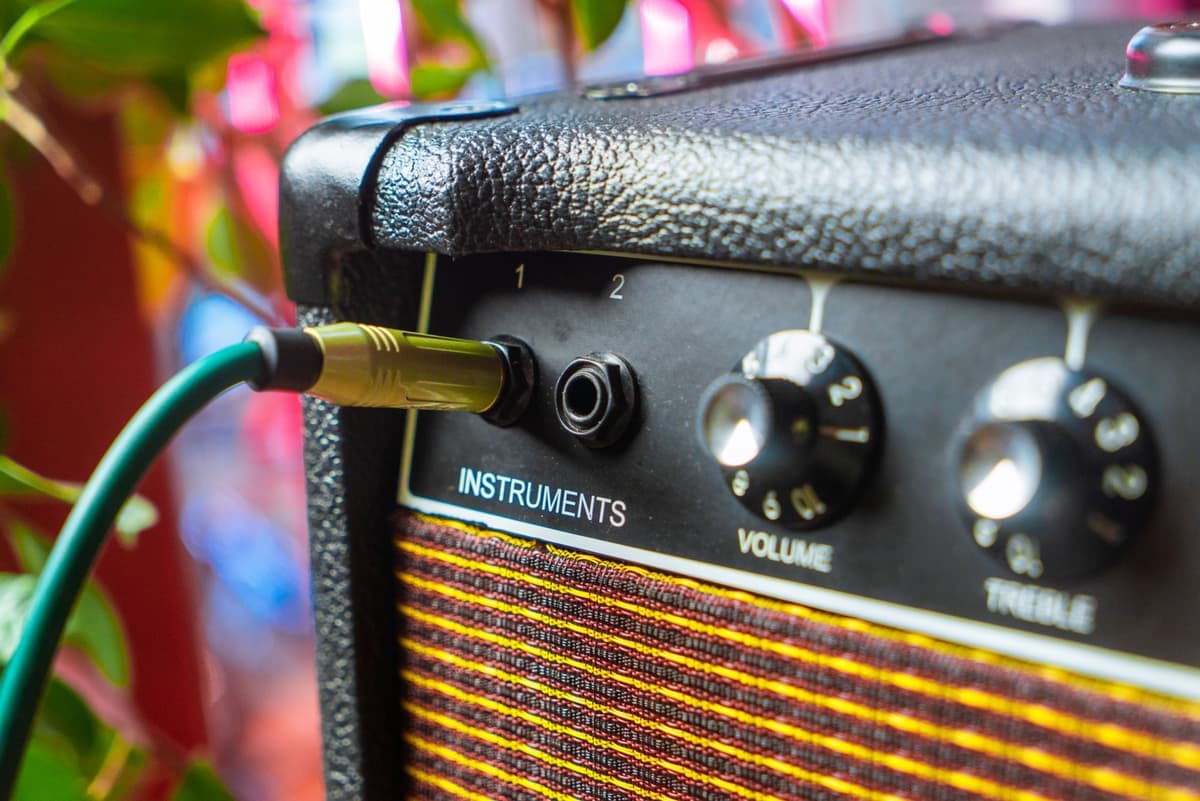
Tremolo modulates volume and nothing else — not pitch, not phase. What separates the pedals is the shape of that modulation: a smooth sine-like sweep, a hard square-wave chop, or a sawtooth that ramps and snaps back. Buy the BOSS TR-2 for a continuously variable shape at 25 mA, the EHX Nano Pulsar for six named waveshapes and stereo, and the Strymon Flint if you want reverb in the same slot.
It is the simplest effect on a pedalboard and the one most often confused with something else, so it is worth being exact before comparing anything.
01Tremolo is not vibrato, and your amp is probably lying
Tremolo modulates amplitude — the volume goes up and down. Vibrato modulates pitch — the note bends up and down. They sound completely different and they are produced by completely different circuits.
A great many amplifiers have a control labeled "vibrato" that is actually a tremolo, a naming error that dates back decades and has never been corrected. If your amp's effect makes the volume pulse, it is a tremolo whatever the panel says. A pedal labeled vibrato that mixes no dry signal is the real thing.
02The criteria, before any product
| Criterion | Why it matters | What to look for |
|---|---|---|
| Waveshape control | The single biggest difference between tremolo pedals | A continuous sweep, or several named shapes |
| Depth range | Whether it can go from a shimmer to a hard chop | A full-travel depth control |
| Tap tempo | Locking the pulse to the song rather than setting it by ear | Rare on compact tremolos — none here has it |
| Stereo output | Panning tremolo across two amps is a different effect entirely | Published stereo out |
| Current draw | Decides whether it shares your board's supply | 25 mA on the TR-2; 300 mA minimum on the Flint |
| Bypass type | Whether it is in your path when off | The Flint lets you choose; most do not |
Best tremolo pedals
| # | Product | Best for | Price |
|---|---|---|---|
| 01 | 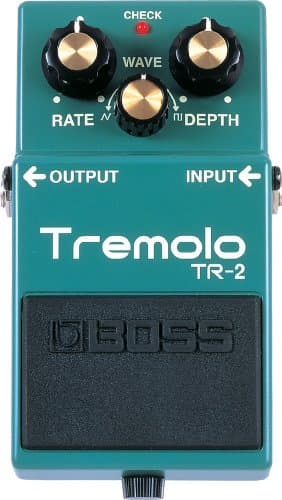 BOSS TR-2 Tremolo Depth, Rate and a Wave control that sweeps the shape rather than switching between presets. | The default, and the cheapest to power | |
| 02 | 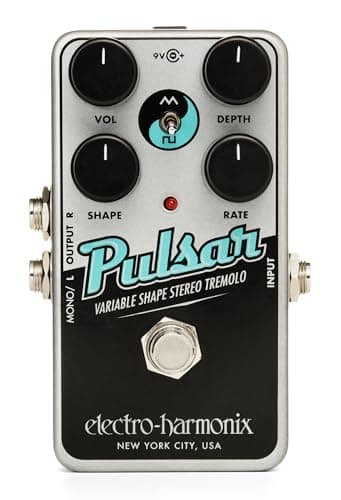 Electro-Harmonix Nano Pulsar Six named waveshapes including rising and falling sawtooth, plus stereo — unusual at this size. | Waveshape choice and a stereo output | $99.99 · Check price #ad How we’re funded · price as of October 21, 2026 |
| 03 | 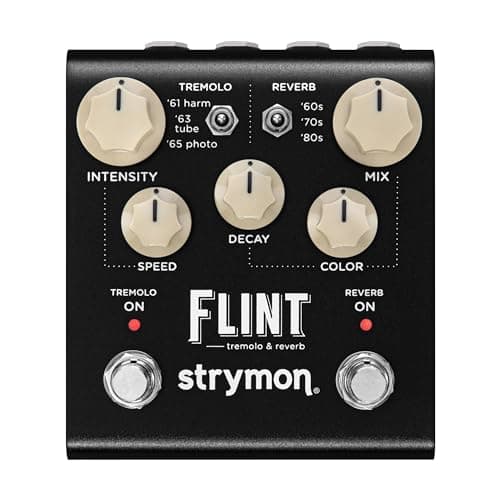 Strymon Flint Tremolo & Reverb Three tremolo voicings alongside three reverbs, with selectable true or buffered bypass. | Tremolo and reverb in one slot | $349.00 · Check price #ad How we’re funded · price as of October 21, 2026 |
| ! | 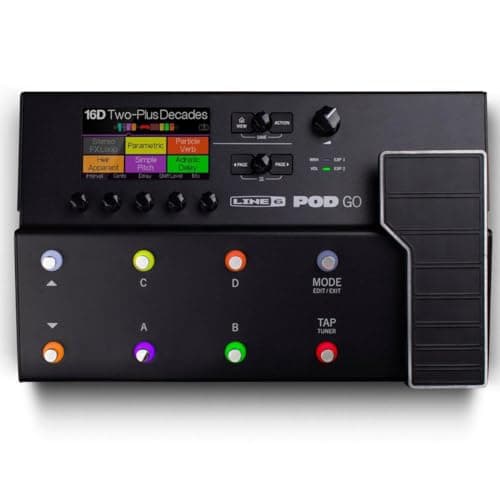 Line 6 POD Go If there is a multi-effects unit on your board, it already has several tremolos in it. Skip this one — see why below | The tremolo you may already own | $599.99 · Check price #ad How we’re funded · price as of October 21, 2026 |
Rows link to the full write-up further down this page. Prices come from the live price layer only — where there is no live figure the button reads “Check price” rather than showing a remembered number.
04Setting the rate without tap tempo
None of these pedals has tap tempo, so the rate is set by ear against the song. Two shortcuts make that easier. For a pulse on every eighth note, the rate is twice the tempo in beats per minute. For a pulse on every quarter note, it is the tempo itself.
In practice most players set tremolo slightly off the grid deliberately, because a tremolo locked exactly to the beat disappears into the drums. The interest comes from the pulse drifting against the rhythm rather than reinforcing it, which is one of the few places on this site where the imprecise answer is the better one.
BOSS TR-2 Tremolo
The default, and the cheapest to power
The number25 mA, 1 M ohm in, 1 k ohm out — all published by BOSS.
Three knobs, and the third one is the reason to buy it. The Wave control sweeps continuously between a smooth, rounded modulation and a sharper, more abrupt one, rather than offering two or three fixed shapes. For an effect this simple, a continuous control is worth more than a mode switch.
BOSS publishes the whole sheet: 25 mA, 1 M ohm input, 1 k ohm output, 385 g. It will run off any supply, share a daisy chain happily, and outlast the rest of the board.
The cons: mono only, and no tap tempo. A tempo-locked tremolo therefore means setting the Rate by ear every time the song changes, which is fine for a set with two tempos and irritating for a set with ten. No adaptor included.
| Controls | Depth, Rate, Wave, pedal switch |
|---|---|
| Wave control | Sweeps the modulation shape rather than switching between fixed presets |
| Input impedance | 1 M ohm |
| Output impedance | 1 k ohm |
| Current draw | 25 mA |
| Power | 9 V battery (6F22 / 6LR61) or PSA-series adaptor |
| Size / weight | 73 x 129 x 59 mm, 385 g including battery |
| What it does not do | Mono only — there is no stereo output and no tap tempo, so a tempo-locked tremolo means setting the Rate by ear every time the song changes. No adaptor included. |
Specs from BOSS TR-2 Tremolo specifications. We have not used this unit.
Electro-Harmonix Nano Pulsar
Waveshape choice and a stereo output
EHX publishes rising and falling sawtooth, narrow and wide pulse width, triangle and square. That is a genuinely wider palette than a single sweep control gives you, and the sawtooth shapes in particular do something no other pedal here does — the volume ramps in one direction and snaps back, which reads as rhythmic rather than as pulsing.
Stereo output on a compact tremolo is rare and it matters more here than on most effects: a tremolo panning across two amps is a different and much larger sound than the same pedal in mono.
The cons: EHX publishes no current-draw figure at all, so you cannot plan a shared supply output around it without measuring. There is no tap tempo, and the square-wave setting is a specific effect rather than a general-purpose tremolo.
| Waveshapes | Rising and falling sawtooth, narrow and wide pulse width, triangle and square |
|---|---|
| Controls | Rate, Depth and a variable shape control |
| Outputs | Stereo |
| Power | 9 V battery included; also runs from an optional 9 V supply |
| Electrical data | No current-draw or impedance figure is published for this pedal, so none is stated here. |
| What it does not do | EHX publishes no current-draw figure, so you cannot plan a shared supply output around it without measuring. No tap tempo, and the square-wave setting is a specific effect rather than a general-purpose tremolo. |
Specs from Electro-Harmonix Nano Pulsar product page. We have not used this unit.
#ad How we’re funded · price as of October 21, 2026
Strymon Flint Tremolo & Reverb
Tremolo and reverb in one slot
The number9 V DC, minimum 300 mA — check your supply's highest single output before buying.
Three distinct tremolo circuits rather than one adjustable one, sitting in the same enclosure as three reverbs. On a board where both effects are wanted and space is short, that is the most sound per slot available.
Strymon publishes the full specification: 1 M ohm input, 100 ohm output, 24-bit/96 kHz conversion, and a choice of relay true bypass or buffered bypass — the only pedal here that lets you pick.
The cons: the 300 mA minimum is the constraint. A Voodoo Lab Pedal Power 2 PLUS tops out at 250 mA per output, so this pedal needs a doubler cable there or a higher-current supply. You also cannot reorder the tremolo and reverb inside the box, and you are paying for three reverbs even if you only wanted tremolo.
| Effects | Three tremolo voicings and three reverb voicings in one enclosure |
|---|---|
| Power requirement | 9 V DC center-negative, minimum 300 mA (supply not included) |
| Input impedance | 1 M ohm |
| Output impedance | 100 ohm |
| Converters | 24-bit / 96 kHz A/D and D/A |
| Bypass | Selectable relay true bypass or buffered bypass |
| Size | 4.5" deep x 4" wide x 2.4" tall (11.43 x 10.16 x 6.1 cm) |
| What it does not do | No power supply in the box, and the 300 mA minimum means most cheap bricks cannot run it. There is no delay in here and no way to reorder the tremolo and reverb. |
Specs from Strymon Flint product page. We have not used this unit.
#ad How we’re funded · price as of October 21, 2026
Line 6 POD Go
The tremolo you may already own
We are not picking this as a tremolo purchase, and it is on the page because a meaningful share of people shopping for a tremolo pedal already have one.
Any current multi-effects unit includes several tremolo models, and tremolo is one of the effects modeling handles most convincingly — it is amplitude modulation, which is far easier to reproduce faithfully than a distortion circuit's interaction with a pickup.
Buy a dedicated pedal when you want a knob under your hand rather than a menu, when you need it in a chain position the unit's fixed routing will not allow, or when you want stereo tremolo the unit cannot do. Otherwise you have saved a board slot. The multi-effects roundup covers the units.
| Format | All-in-one floor unit with a built-in expression pedal |
|---|---|
| Signal chain | Line 6 describes a semi-fixed serial signal path with snapshots |
| Models | HX-family amp, cab and effect models with IR loading |
| Power | External DC-3 supply included; Line 6 recommends using only that supply |
| What it does not do | The semi-fixed chain is a genuine limitation compared to a Helix — you cannot put anything anywhere. No XLR outputs on the standard model. |
Specs from Line 6 POD Go product page. We have not used this unit.
05Where tremolo goes in the chain
After your drives, before delay and reverb. Modulating a distorted signal is the conventional order and it is what most records do — a tremolo before the distortion gets flattened by it, because a distortion circuit compresses away most of the volume variation the tremolo just created.
That interaction is worth understanding rather than memorising: tremolo works by changing level, and distortion works by removing level differences. Put them in the wrong order and one undoes the other. Pedal order covers the whole chain. The pedal most of these get measured against has a page of its own: our BOSS TR-2 review covers the Wave knob and the rate range BOSS does not publish.
06How much is too much
Deeper and slower than feels right when you are playing alone, and shallower and faster than feels right in a mix. A tremolo set to full depth removes so much signal on the down-phase that a band simply plays over the gaps.
The setting that survives a mix is usually around half depth with the shape rounded rather than square. The square-wave chop is a real and dramatic effect, and it is a special-occasion setting rather than a rhythm sound.
Frequently asked questions
+ What is the difference between tremolo and vibrato?
+ What is the best tremolo pedal?
+ Where does tremolo go in the signal chain?
+ Do I need tap tempo on a tremolo?
Sources
Related on Fret & Fuzz
Chorus vs phaser
One adds a detuned second voice; the other sweeps notches through the one you have. The control layout gives it away.
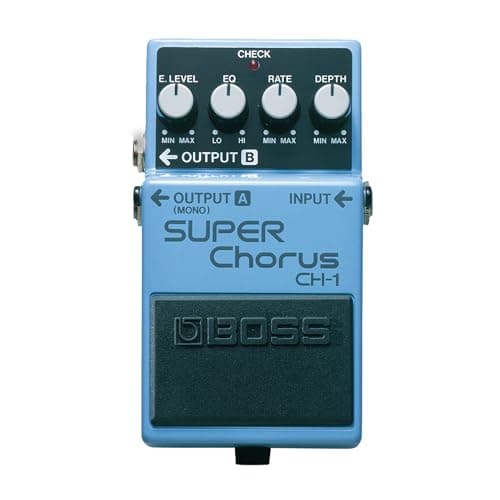
Top pick: BOSS CH-1 Super Chorus
BOSS TR-2 review
Three knobs, 25 mA, and a Wave control that sweeps triangle to square. No tap tempo and no published rate range.
Top pick: BOSS TR-2 Tremolo
Best modulation pedals
Four mechanisms that get shelved together and share almost nothing. Pick the mechanism and the pedal follows.
Best Modulation pick: MXR Phase 90
#ad How we’re funded · price as of October 21, 2026

Best reverb pedals
Check your amp first. If you do need a reverb pedal, one multi-mode unit covers every type — here is what the modes actually differ on.
Best Reverb pick: BOSS RV-6 Reverb
Pedal order: what changes and what does not
Two placements are load-bearing and the rest are preference. Which is which, and the impedance figures behind the first one.
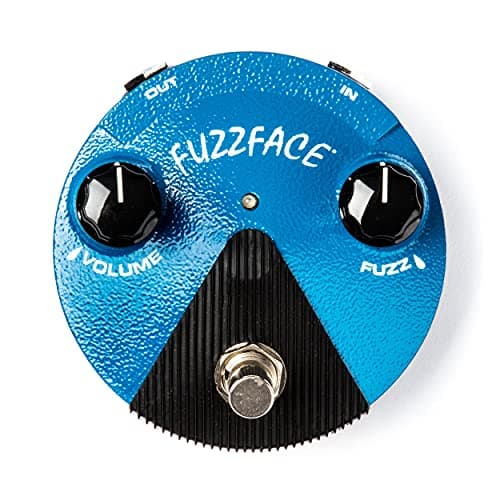
Top pick: Dunlop Fuzz Face Mini Silicon
#ad How we’re funded · price as of October 21, 2026

Best multi-effects pedals
Block count, routing freedom and current draw decide this. Four current units compared, plus the one BOSS has discontinued.
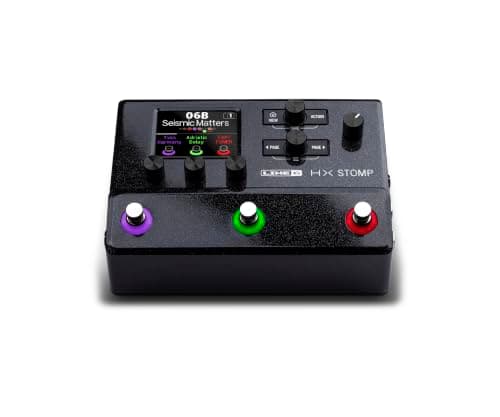
Best Multi-Effects pick: Line 6 HX Stomp
#ad How we’re funded · price as of October 21, 2026