Chorus vs phaser
The two modulation effects most often confused before purchase, and the mechanism that separates them is audible once you know what to listen for.
Fret & Fuzz earns a commission when you buy through the links on this page. It costs you nothing and it does not decide what we rank. How we’re funded.
We have not played this gear. Every pick below is chosen from published manufacturer specifications and the arithmetic set out in how we research, which you can re-run yourself.
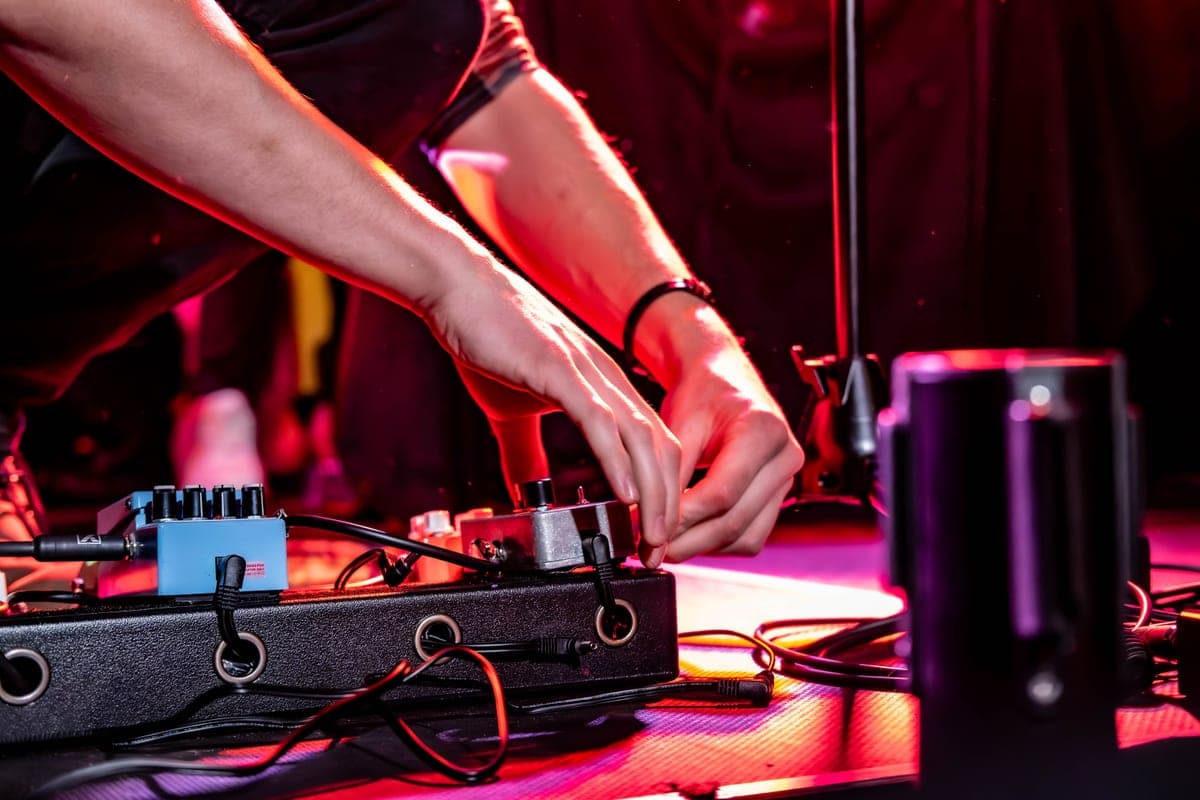
A chorus detunes a delayed copy of your signal and mixes it back, so it sounds like two guitars playing together — wider, thicker, shimmering. A phaser sweeps notches through your frequency response, so it sounds like a swoosh moving through the sound. They are different mechanisms with different results, and the quickest way to tell them apart is that a chorus adds a second voice while a phaser filters the one you have.
This is a comparison people make before buying, usually from demo videos where both are set deep and fast and genuinely do sound similar. At normal settings they do not.
01The mechanisms, briefly
| Chorus | Phaser | |
|---|---|---|
| What it does | Delays a copy by a few ms and modulates the delay time | Shifts phase across the spectrum and recombines |
| What that produces | A detuned second voice mixed with your signal | Moving notches in the frequency response |
| What you hear | Width, thickness, shimmer — two guitars | A swoosh sweeping through — one guitar, filtered |
| Pitch is affected | Yes, that is the mechanism | No — only phase and therefore amplitude |
| Stereo | Genuinely useful; the CH-1 publishes stereo out | Rarely used stereo |
| Typical controls | Rate, Depth, Level, sometimes EQ | Speed, sometimes Depth or Feedback |
| Sounds like | A twelve-string, a doubled part | A rotary speaker, a wah moving on its own |
The control list at the bottom is the fastest way to identify an unlabelled pedal. A modulation effect with a Level or Mix control is almost always a chorus, because you need to balance the second voice against the original. A phaser rarely has one, because the notches are applied to your whole signal rather than added to it.
Which modulation effect
| # | Product | Best for | Price |
|---|---|---|---|
| 01 | 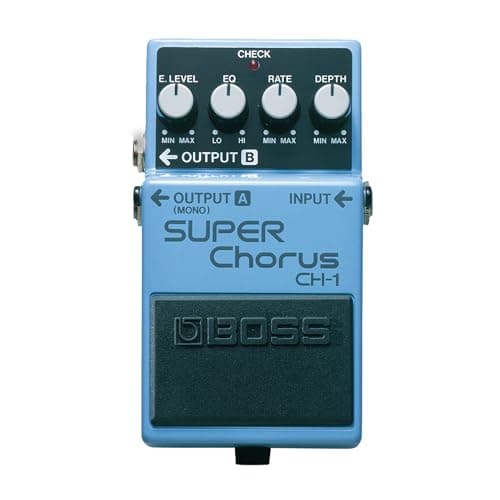 BOSS CH-1 Super Chorus Four controls including an EQ and a stereo output — the most adjustable chorus here. | Width, and a chorus you can set precisely | $126.45 · Check price #ad How we’re funded · price as of September 13, 2026 |
| 02 | 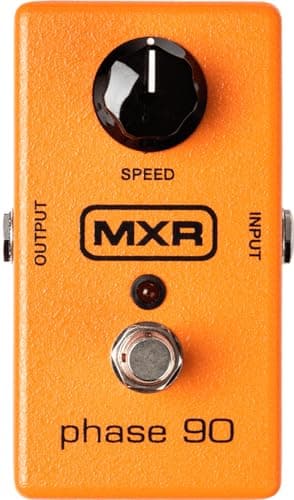 MXR Phase 90 One Speed knob. That is the entire interface, and it is either the appeal or the problem. | The phaser sound, with no decisions to make | $99.99 · Check price #ad How we’re funded · price as of September 13, 2026 |
| 03 | No photo Electro-Harmonix Small Clone Analog Chorus A bucket-brigade circuit with a Rate knob and a two-position Depth switch. | The analog chorus voice, if you accept two settings |
Rows link to the full write-up further down this page. Prices come from the live price layer only — where there is no live figure the button reads “Check price” rather than showing a remembered number.
03Which one for what you are trying to do
- Make a clean part sound bigger. Chorus. Adding a detuned voice is literally more signal; a phaser only filters what is there.
- Add movement to a sustained chord. Either, and a phaser is subtler at slow speeds.
- Sound like a twelve-string. Chorus, with the depth low and the level moderate.
- Funk rhythm playing. Phaser, fast, and it is one of the defining sounds of the idiom.
- Thicken a solo. Chorus in stereo if you have two amps; otherwise neither, and a delay is the better tool.
- Fix a thin tone. Neither. That is an EQ or a pickup problem — your solo disappears covers it.
BOSS CH-1 Super Chorus
Width, and a chorus you can set precisely
A chorus delays a copy of your signal by a few milliseconds, modulates that delay time so the copy drifts in pitch, and mixes it back in. The result reads as two slightly out-of-tune guitars playing together, which is where the name comes from.
BOSS publishes four controls — E.Level, EQ, Rate and Depth — plus mono and stereo outputs. The EQ control is the useful one: chorus adds most of its character in the upper mids and being able to shape that is the difference between shimmer and harshness. The stereo output is what turns it from an effect into a width.
The cons: it is a bright, clearly digital-voiced chorus, so if you are chasing a warm analog bucket-brigade sound this is not that circuit. No adaptor is included and BOSS publishes no electrical data for it.
| Controls | E.Level, EQ, Rate, Depth |
|---|---|
| Outputs | Mono and stereo outputs |
| Power | 9 V battery or PSA-series adaptor |
| Electrical data | No current-draw or impedance figure is published for this pedal, so none is stated here. |
| What it does not do | No adaptor included. It is a bright, clearly digital-voiced chorus — if you are chasing a warm analog bucket-brigade sound, this is not that circuit. |
Specs from BOSS CH-1 product page. We have not used this unit.
#ad How we’re funded · price as of September 13, 2026
MXR Phase 90
The phaser sound, with no decisions to make
A phaser splits your signal, shifts the phase of one copy across the frequency range, and recombines them. Where the two are out of phase they cancel, producing notches in the frequency response — and sweeping those notches up and down is the swooshing sound.
MXR publishes one control: Speed. There is no depth, no mix and no feedback, which means there is exactly one Phase 90 sound and you cannot get it wrong. On a dark stage that is a real advantage, and this specific circuit is on a very large number of records.
The cons are the same single knob from the other side. No depth control and no mix control, so a subtle phase is not available — you get the Phase 90 amount or nothing. MXR publishes no current-draw or impedance data either.
| Controls | One Speed knob |
|---|---|
| Power | 9 V battery, Dunlop ECB003 adapter, or a DC Brick / Iso-Brick supply |
| Electrical data | No current-draw or impedance figure is published for this pedal, so none is stated here. |
| What it does not do | One knob means no depth control and no mix control. If you want a subtle phase you cannot dial it — you get the Phase 90 amount or nothing. |
Specs from MXR Phase 90 product page. We have not used this unit.
#ad How we’re funded · price as of September 13, 2026
Electro-Harmonix Small Clone Analog Chorus
The analog chorus voice, if you accept two settings
The analog answer to the CH-1. A bucket-brigade delay line is the original way this effect was built, and it sounds warmer and less precise than a digital chorus — the wobble has a character that the cleaner circuit does not.
Two controls is the whole interface: Rate as a knob, Depth as a switch. For a sound that is famous for one specific setting, that is arguably enough.
The cons: a two-position depth switch instead of a knob means you get shallow or deep and nothing between. There is no mix control, so you cannot dial the effect back. And it is mono only — no stereo spread is available, which is the CH-1's main structural advantage.
| Controls | Rate knob, Depth switch |
|---|---|
| Circuit | Analog bucket-brigade chorus |
| Power | 9 V battery or a 9 V DC center-negative supply |
| Electrical data | No current-draw or impedance figure is published for this pedal, so none is stated here. |
| What it does not do | A two-position depth switch instead of a knob, and no mix control. Mono only — there is no stereo spread to be had. |
Specs from Electro-Harmonix Small Clone product page. We have not used this unit.
04Where they go in the chain
After your drive pedals and before delay and reverb. Modulating a distorted signal is the conventional order and what most records do — a chorus in front of a distortion gets largely flattened, because the distortion compresses away the level and pitch variation the chorus just created.
A phaser is the more common exception. Placed in front of a driven amp it modulates what the amp is clipping rather than the clipped result, which is a more dramatic and less polite sound, and it is a legitimate choice rather than a mistake. Pedal order covers the reasoning and the exceptions in full.
05How much is too much
Both effects are set deeper by players alone in a room than by players in a band, for the same reason: they sound impressive in isolation and eat clarity in a mix. A chorus at full depth makes a chord sound detuned rather than wide, and a phaser at full depth removes enough of the frequency range to make you quieter.
The setting that survives a mix is usually far shallower than the one you would choose alone, which is the same lesson as best tremolo pedals and the modulation roundup — and the roundup is where to go once you have decided which of these two effects you actually want.
Frequently asked questions
+ What is the difference between a chorus and a phaser?
+ Which should I buy first, chorus or phaser?
+ Does a chorus change pitch?
+ Where does modulation go in the signal chain?
Sources
Related on Fret & Fuzz
Best modulation pedals
Four mechanisms that get shelved together and share almost nothing. Pick the mechanism and the pedal follows.
Best Modulation pick: MXR Phase 90
#ad How we’re funded · price as of September 13, 2026
Best tremolo pedals
Waveshape is the specification that separates tremolo pedals. Three compared, plus the one already inside your multi-effects unit.
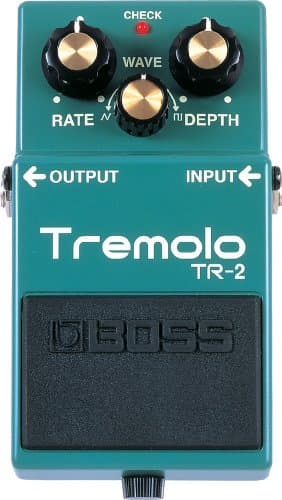
Best Tremolo pick: BOSS TR-2 Tremolo
Pedal order: what changes and what does not
Two placements are load-bearing and the rest are preference. Which is which, and the impedance figures behind the first one.
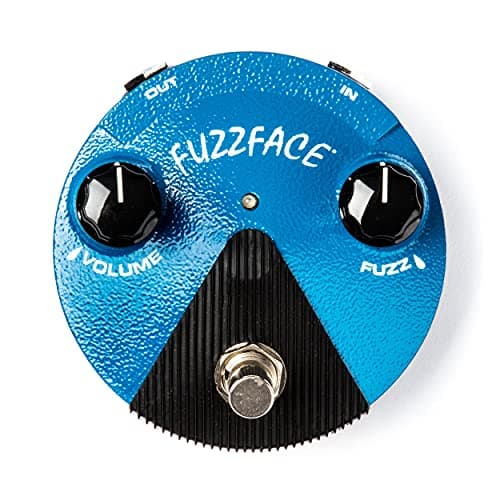
Top pick: Dunlop Fuzz Face Mini Silicon
#ad How we’re funded · price as of September 13, 2026
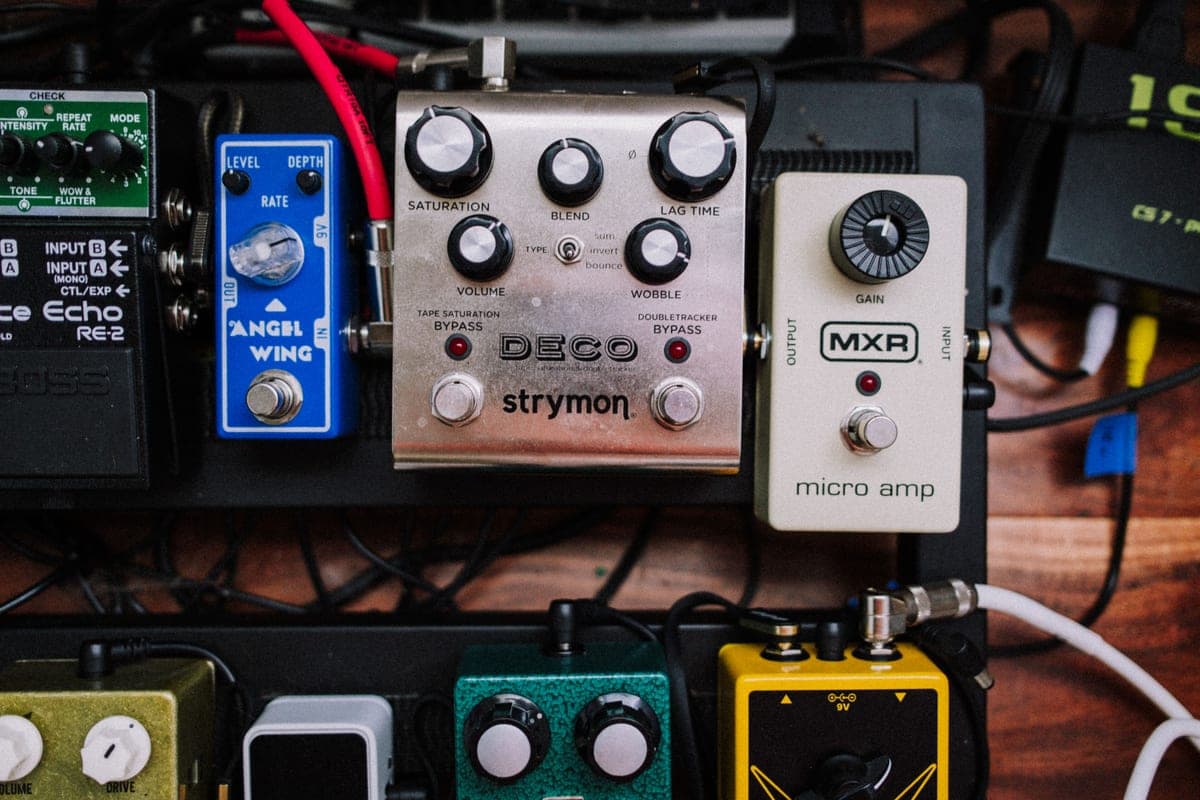
Delay vs reverb
Countable repeats or a cloud of reflections. Which to buy first, in what order to run them, and what each costs to power.
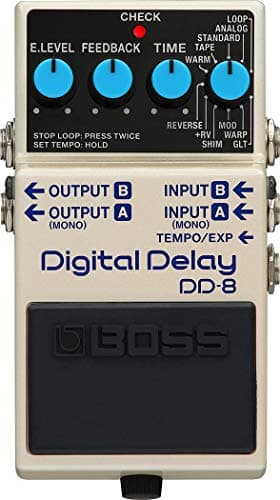
Top pick: BOSS DD-8 Digital Delay
Guitar pedal types explained
Five families defined by what they do to the waveform, and the map that turns a hundred-brand problem into five decisions.
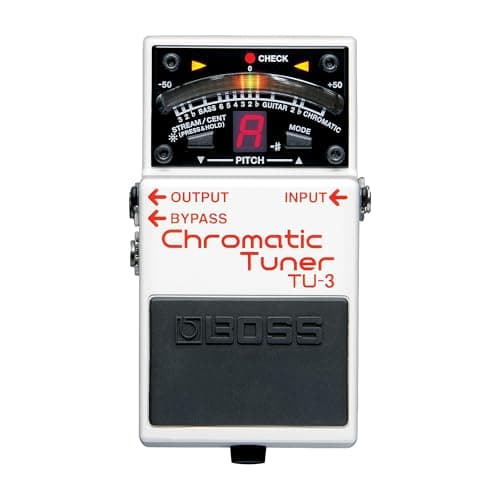
Top pick: BOSS TU-3 Chromatic Tuner