Best looper pedals
Recording time is the number everybody compares and the one that never matters. Interface complexity is what decides whether the pedal gets used.
Fret & Fuzz earns a commission when you buy through the links on this page. It costs you nothing and it does not decide what we rank. How we’re funded.
We have not played this gear. Every pick below is chosen from published manufacturer specifications and the arithmetic set out in how we research, which you can re-run yourself.
Buy the simplest looper that does what you need. Recording time is the specification everybody compares and it is almost never the binding constraint — nobody runs out of five minutes. What decides whether a looper gets used is how much you have to think about the interface while you are also playing.
Loopers are the most-abandoned pedal category. They get bought for practice, they turn out to require conscious operation at the exact moment you are trying to concentrate on something else, and they come off the board.
Best looper pedals
| # | Product | Best for | Price |
|---|---|---|---|
| 01 | 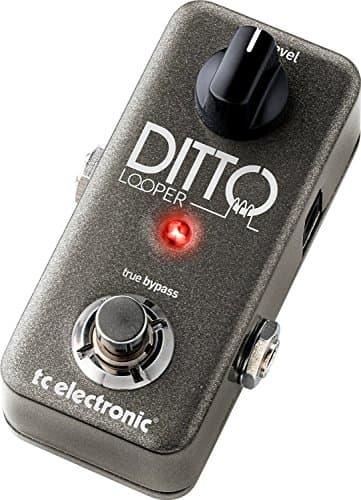 TC Electronic Ditto Looper One knob, one footswitch, five minutes, true bypass and an analog dry path. | The looper you will actually use | $83.90 · Check price #ad How we’re funded · price as of October 17, 2026 |
| 02 | 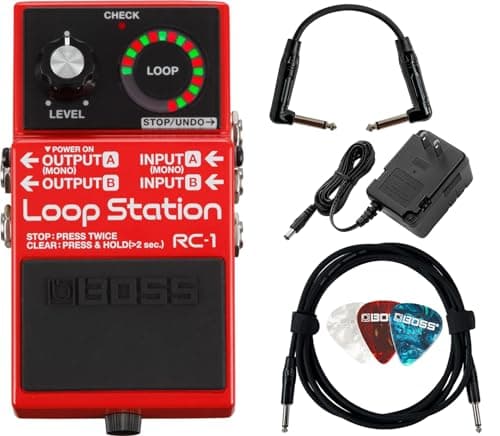 BOSS RC-1 Loop Station 12 minutes, stereo, and a circular LED display that shows loop position. | A visual indicator of where you are in the loop | $129.99 · Check price #ad How we’re funded · price as of October 17, 2026 |
| 03 | 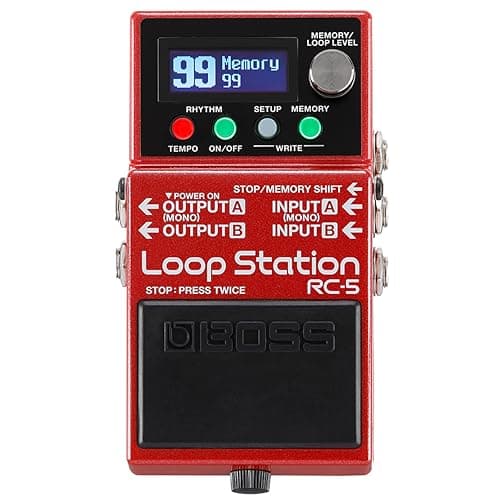 BOSS RC-5 Loop Station 99 memories, built-in rhythms, a backlit display and USB import/export. | Practice with a rhythm track and saved loops | |
| ! | 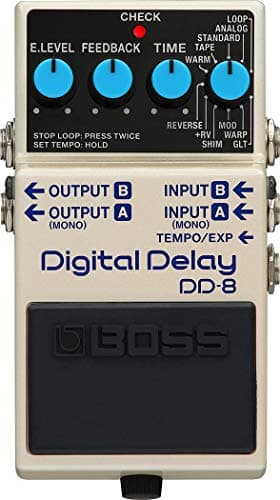 BOSS DD-8 Digital Delay A delay with a looper function is not the same as a looper, and buying it as one disappoints. Skip this one — see why below | Not a looper, though it has a Loop mode |
Rows link to the full write-up further down this page. Prices come from the live price layer only — where there is no live figure the button reads “Check price” rather than showing a remembered number.
02Published capacity, side by side
| Looper | Recording time | Memories | Extras | Current draw |
|---|---|---|---|---|
| TC Ditto | 5 minutes | 1 (not saved) | True bypass, analog dry path | Not published |
| BOSS RC-1 | Approx. 12 minutes, stereo | 1, retained on power-down | Undo/redo, loop position LED | 95 mA |
| BOSS RC-5 | Approx. 13 hours total | 99 | Rhythm patterns, USB, backlit display | Not published |
The gap between five minutes and thirteen hours sounds enormous and changes almost nothing about which pedal is right for you.
03What actually decides the choice
- How many footswitch actions you can perform without thinking. One is easy. Three requires practice. Menu diving mid-song is not viable.
- Whether you need to save loops. For practice, no — you record a progression, work over it, and clear it. For performance, yes.
- Whether you need a rhythm reference. Practicing over a loop without one drifts, and the drift compounds every pass.
- Whether the loop needs to survive power-down. The RC-1 retains the last loop; the Ditto does not.
- Whether you need stereo. Only if your rig is stereo, which most are not.
TC Electronic Ditto Looper
The looper you will actually use
One Level knob and one footswitch. Press to record, press to play, press to overdub, hold to clear. There is nothing to learn and nothing to get wrong at speed, which is why it stays on boards where more capable loopers get removed.
TC publishes 24-bit uncompressed recording with an analog dry-through path and true bypass, so your live signal is not being converted while the loop plays.
Five minutes of recording, no rhythm track, no USB, no saved loops, no stereo. Every one of those omissions is why the interface is this simple.
| Recording time | 5 minutes |
|---|---|
| Controls | One Level knob, one footswitch |
| Audio path | Analog dry-through with 24-bit uncompressed recording |
| Bypass | True bypass |
| Power | 9 V DC center-negative |
| What it does not do | No stereo, no rhythm, no USB, no saved loops, no undo on the original model. It is the smallest sensible looper and it is deliberately not more than that. |
Specs from TC Electronic Ditto Looper product page. We have not used this unit.
#ad How we’re funded · price as of October 17, 2026
BOSS RC-1 Loop Station
A visual indicator of where you are in the loop
The number95 mA, approximately 3 hours on an alkaline battery, 430 g.
BOSS publishes approximately 12 minutes of stereo recording time, undo and redo, and a memory that retains the most recent loop after power-down — so you do not lose your work when you unplug the board.
The circular multicolour LED indicator is the practical differentiator against a one-knob looper: you can see where you are in the loop, which makes catching the downbeat on an overdub much easier.
95 mA and a 3-hour battery life put this firmly in the powered-pedal category. One loop slot, no rhythm, no USB.
| Recording time | Approximately 12 minutes, stereo |
|---|---|
| Tracks | Single track with undo and redo |
| Controls | Level knob and the pedal switch — that is the entire interface |
| Current draw | 95 mA |
| Memory | Keeps the most recent loop after power-down |
| Weight | 430 g |
| What it does not do | One loop slot, no saved memories, no rhythm track and no USB. The circular LED indicator is your only visual feedback about where you are in the loop. |
Specs from BOSS RC-1 specifications. We have not used this unit.
#ad How we’re funded · price as of October 17, 2026
BOSS RC-5 Loop Station
Practice with a rhythm track and saved loops
BOSS publishes 99 phrase memories, approximately 13 hours of total recording time, built-in rhythm patterns and USB connectivity for moving loops on and off a computer.
The rhythm section is the real reason to step up. Practicing over a loop without a click drifts; practicing over a loop recorded against a rhythm pattern does not.
The catch is the menu system. This is not a pedal you learn during a soundcheck, and its single footswitch means switching between memories live requires an external footswitch you buy separately.
| Memories | 99 phrase memories |
|---|---|
| Recording time | BOSS states approximately 13 hours of total recording time |
| Rhythm | Built-in rhythm patterns with an assignable output |
| Display | Backlit LCD |
| Connectivity | USB for importing and exporting loops |
| What it does not do | One footswitch means multi-loop switching needs an external footswitch you buy separately. The menu depth is real — this is not a pedal you learn in a soundcheck. |
Specs from BOSS RC-5 product page. We have not used this unit.
BOSS DD-8 Digital Delay
Not a looper, though it has a Loop mode
We are not picking this as a looper. The DD-8 has a Loop mode among its eleven modes, and it works — but it is a delay pedal whose footswitch is doing a second job.
A dedicated looper's footswitch behavior is designed around record/play/overdub timing. A delay's footswitch is designed around turning a delay on and off, and the looper mode inherits that. Catching a downbeat accurately is noticeably harder.
If you want a delay and would occasionally like to loop something, this is fine. If looping is the reason you are buying a pedal, buy a looper — the Ditto costs less than the difference.
| Modes | 11 — Analog, Standard, Tape, Warm, Reverse, +RV, Shimmer, Mod, Warp, GLT, plus Loop |
|---|---|
| Maximum delay | Up to 10 seconds, with tap tempo |
| Controls | Mode, Time, Feedback, E.Level, Carryover switch, pedal switch |
| Current draw | 100 mA |
| Battery life | Approx. 3.5 hours on alkaline |
| I/O | True stereo in and out, with three selectable output modes |
| Weight | 440 g including battery |
| What it does not do | No adaptor included. At 100 mA it is not a pedal you daisy-chain casually, and the 3.5-hour battery figure means battery power is a backup, not a plan. |
Specs from BOSS DD-8 specifications. We have not used this unit.
04Where a looper goes
Last in the chain, after everything else including reverb and delay. You want the loop to capture your finished sound so that playing over it sounds like two guitars rather than one dry and one wet.
The exception is if you want to change your sound while the loop plays — a clean loop with a distorted lead over it. In that case the looper goes early, before the drives, and it records the dry signal. Both are valid and they are different setups.
05The practice case, which is most people
If you are buying a looper to practice over chord progressions, the honest recommendation is the simplest pedal on this page plus a metronome, or the RC-5 with its rhythm patterns. What does not work is a complex looper with no timing reference, because loops recorded without one drift and every subsequent overdub compounds the error. If you have not bought one yet, are looper pedals worth it? is the prior question and it has a free test in it. The two BOSS loopers almost everyone chooses between are compared directly in BOSS RC-5 vs RC-1, where the deciding figure is 95 mA against 170 mA.
Frequently asked questions
+ How much recording time do I need in a looper?
+ Where does a looper go in the signal chain?
+ Is a looper good for practice?
+ Can I use my delay pedal as a looper?
Sources
Related on Fret & Fuzz

Are looper pedals worth it?
The pedal most often bought for practice and used twice. A free test that predicts whether you are the exception.
Top pick: TC Electronic Ditto Looper
#ad How we’re funded · price as of October 17, 2026
BOSS RC-5 vs RC-1 Loop Station
One knob at 95 mA against 99 memories, a drum section and 170 mA. The draw decides more boards than the features.
Top pick: BOSS RC-1 Loop Station
#ad How we’re funded · price as of October 17, 2026
Best tuner pedals
Published accuracy from +/- 1 cent to +/- 0.02 cent, the buffer trade-off, and the tuner that quietly draws 100 mA.
Best Tuner pick: TC Electronic PolyTune 3
Best delay pedals
Maximum delay time and current draw settle most of this category. Four delays on their published figures.
Best Delay pick: BOSS DD-8 Digital Delay
Pedal order: what changes and what does not
Two placements are load-bearing and the rest are preference. Which is which, and the impedance figures behind the first one.
Top pick: Dunlop Fuzz Face Mini Silicon
#ad How we’re funded · price as of October 17, 2026
Best guitar pedals under $100
Budget pedals do not save money on the circuit — they save it on the switches and jacks. Here is exactly where, and what that costs you.
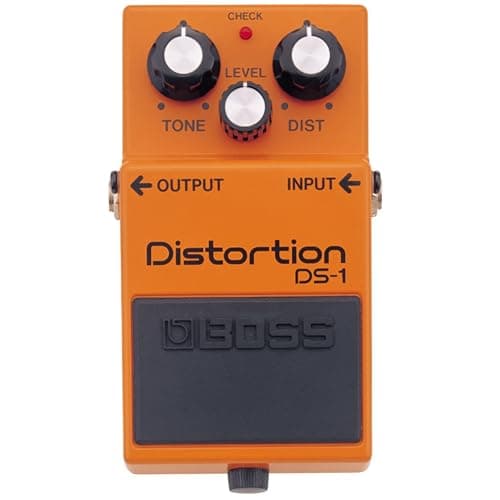
Best Under $100 pick: BOSS DS-1 Distortion