ISP Decimator X vs BOSS NS-2
The two noise gates on almost every high-gain shortlist, separated by a pair of jacks rather than by how quietly they run.
Fret & Fuzz earns a commission when you buy through the links on this page. It costs you nothing and it does not decide what we rank. How we’re funded.
We have not played this gear. Every pick below is chosen from published manufacturer specifications and the arithmetic set out in how we research, which you can re-run yourself.

Buy the BOSS NS-2 if your noise comes from the pedals on your board — its send/return loop lets the gate trigger from your clean guitar signal while muting the noisy chain, which is the only arrangement that gates quiet playing correctly. Buy the ISP Decimator X if your noise comes from a high-gain amp you are gating in one place, and you want its adaptive release to hold long notes without the tail chattering. The NS-2 draws 25 mA against 35 mA, and costs less.
Noise gate comparisons usually turn on which one sounds more transparent. That is very hard to establish from published specifications and it is not what decides most boards anyway. What decides them is where the gate gets its trigger from.
01What each maker publishes
| BOSS NS-2 | ISP Decimator X | |
|---|---|---|
| Send/return loop | Yes — Send, Return, Input, Output | No — one input, one output |
| Trigger source | Can listen to the guitar directly via the loop | The signal passing through the pedal |
| Controls | Mode switch, Decay, Threshold, pedal switch | Threshold control not detailed in the specification |
| Circuit | VCA with a high-speed envelope detector | Patented adaptive noise reduction, US Patent 11,641,183 |
| Release | Decay knob | Advanced adaptive release, plus Linearized Time Vector Processing |
| Current draw | 25 mA | 35 mA |
| Powers other pedals | Yes — 9 V DC OUT jack | No |
| Stereo / linking | Not published | Two units link over a 1/8-inch cord |
| Size | Standard BOSS compact | 2.3" x 2.7" x 5" |
| Weight | 415 g including battery | Not published |
Every figure is the manufacturer's own published specification. Where a row says not published, that is what the maker states — or does not.
Which gate
| # | Product | Best for | Price |
|---|---|---|---|
| 01 | 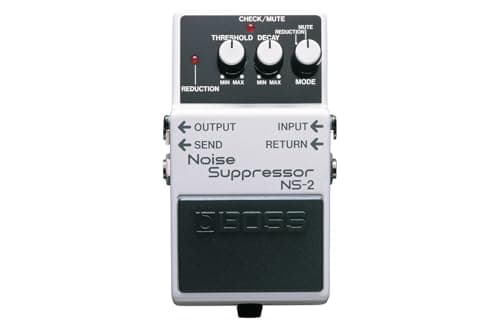 BOSS NS-2 Noise Suppressor The send/return loop lets the gate watch your guitar while muting the output of everything noisy. | Boards where the noise is made by the pedals, not the amp | $120.99 · Check price #ad How we’re funded · price as of October 18, 2026 |
| 02 | 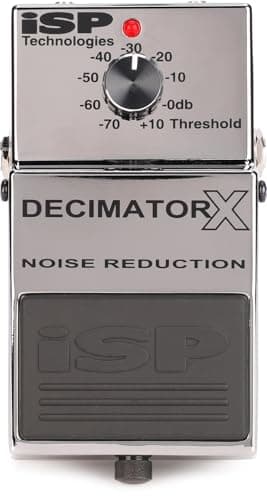 ISP Technologies Decimator X Noise Reduction Adaptive release and ISP's Linearized Time Vector Processing, aimed at holding long notes without the tail chattering. | A gate that tracks decay without you chasing the threshold | $146.72 · Check price #ad How we’re funded · price as of October 18, 2026 |
Rows link to the full write-up further down this page. Prices come from the live price layer only — where there is no live figure the button reads “Check price” rather than showing a remembered number.
03The send/return loop, and why it is the whole comparison
A noise gate is a switch that opens when the signal is loud enough and closes when it is not. Everything difficult about gates follows from one question: which signal is it measuring?
If the gate sits at the end of a noisy chain and measures what arrives there, the threshold has to be set above the hiss — otherwise the hiss holds the gate open and the pedal does nothing. Set it there and quiet playing falls below the threshold too, so soft passages get chopped and long notes die early. This is the complaint everyone has about gates, and it is a consequence of the wiring rather than the pedal.
The NS-2's loop breaks that link. Your guitar goes into the input, the gate's detector listens there, and the noisy pedals sit in the Send/Return path where the gate can mute their output. Now the threshold only has to clear your guitar's own noise floor, which is far lower, so the gate opens on a quiet note and still shuts the chain up between phrases. The Decimator X has no equivalent, which is not an oversight — ISP is solving the decay problem instead.
BOSS NS-2 Noise Suppressor
Boards where the noise is made by the pedals, not the amp
The number25 mA, send/return loop, 9 V DC OUT jack, 415 g. All published by BOSS.
The NS-2 is the one to buy for most players, and the reason is two jacks nobody talks about. BOSS publishes a Send and Return loop: you run your noisy pedals inside it, and the gate takes its trigger from the guitar signal arriving at the input rather than from the noisy signal leaving the loop. The gate therefore knows when you are actually playing, instead of guessing from a hiss-filled signal.
That distinction is the entire argument. A gate that listens to a noisy signal has to be set above the noise floor, which means quiet playing does not open it. A gate that listens to your guitar directly opens on the note and mutes the noise behind it. BOSS also publishes a 9 V DC OUT jack that powers other pedals from the same supply, a Mode switch, Decay and Threshold controls, a VCA circuit with a high-speed envelope detector, and a 25 mA draw — the lower of the two here.
The cons are real. Used in the simple in/out configuration, without the loop, it cuts your sustain as the note decays past the threshold — and that is how most people wire it, which is why the NS-2 has a reputation for killing sustain that the loop is designed to prevent. It also suppresses noise rather than removing it: a hum you can hear underneath a held note will still be there while the gate is open. And it needs four cables instead of two to do its best work, which is a real cost on a crowded board.
| Controls | Mode switch, Decay, Threshold, pedal switch |
|---|---|
| Jacks | Input, Output, Send, Return, DC IN, 9 V DC OUT |
| Send/Return loop | Lets the gate listen to the guitar directly while muting the output of the noisy pedals |
| Circuit | VCA with a high-speed envelope detector |
| Current draw | 25 mA |
| Weight | 415 g including battery |
| What it does not do | It suppresses noise, it does not remove it — a gate cannot clean up a hum you can hear through a held note. Used in the simple in/out configuration it also cuts your sustain, which is why the send/return loop exists. |
Specs from BOSS NS-2 specifications. We have not used this unit.
#ad How we’re funded · price as of October 18, 2026
ISP Technologies Decimator X Noise Reduction
A gate that tracks decay without you chasing the threshold
The number35 mA, one in and one out, 2.3 x 2.7 x 5 in, links to a second unit over 1/8 inch.
ISP's answer to the same problem is processing rather than routing. It publishes patented adaptive noise reduction (US Patent 11,641,183) with an advanced adaptive release that it says handles transitions between fast staccato notes and long sustained tones, plus Linearized Time Vector Processing for a sustained-note decay free of what ISP calls release rippling.
In plain terms, the claim is that the gate adjusts its own behavior to what you are playing, so a held note decays smoothly instead of the gate snapping shut and reopening as the signal wobbles around the threshold. Two units also link over a 1/8-inch cord for dual-channel or stereo noise reduction, which is how it gets used in a wet-dry or two-amp rig. Draw is 35 mA and it fits a compact footprint at 2.3 by 2.7 by 5 inches.
The cons start with what it does not have. There is no send/return loop — the Decimator X gates the signal passing through it, so it cannot separate what it listens to from what it mutes, and on a board whose noise comes from the pedals rather than the amp that is the harder problem to solve. ISP publishes no weight and no bypass type, and does not detail the threshold control in its specification. No power supply is included, and it costs more than the NS-2 while drawing slightly more current.
| Circuit | Patented adaptive noise reduction, US Patent 11,641,183, with other foreign patents pending |
|---|---|
| Release behavior | ISP publishes an advanced adaptive release for transitions between fast staccato notes and long sustained tones |
| Decay | Linearized Time Vector Processing, which ISP describes as smooth sustained-note decay free of release rippling |
| Linking | Two units link over a 1/8-inch cord for dual-channel or stereo noise reduction |
| Current draw | 35 mA |
| Power | 9 V DC supply, sold separately, or a 9 V battery |
| I/O | One 1/4-inch input and one 1/4-inch output |
| Size | 2.3" high, 2.7" wide, 5" deep |
| What it does not do | No power supply included, and there is no send/return loop — the Decimator X gates the signal passing through it rather than listening to your guitar separately. ISP publishes no weight and does not state a bypass type. |
Specs from ISP Technologies Decimator X product page. We have not used this unit.
#ad How we’re funded · price as of October 18, 2026
04Adaptive release against a Decay knob
The other half of a gate's behavior is how it closes. Close too fast and the note's natural decay is cut into an abrupt stop; close too slowly and noise leaks through between phrases.
BOSS hands you a Decay knob and lets you set it, which is simple and puts the compromise in your hands — one setting that has to suit both your staccato riffing and your held notes. ISP's published claim is that the Decimator X adapts instead, using its patented processing to handle both without a setting that splits the difference, and specifically to avoid the tail of a long note making the gate flutter. That is the strongest argument for paying more for it.
It is also a claim we cannot verify from a specification sheet, and we are not going to pretend otherwise. What is verifiable is the structural difference: one pedal gives you a manual control and one publishes an adaptive algorithm, and only one of them can watch a signal other than the one it mutes.
05Power and board space
Both are trivial loads. 25 mA for the NS-2 and 35 mA for the Decimator X are rounding errors next to a digital delay at 100 mA, so neither will trouble a supply.
The NS-2 tips it slightly anyway, because its 9 V DC OUT jack can power other pedals from the same supply — on a small board that occasionally removes the need for a brick. Against that, using the NS-2 properly costs you two extra patch cables and a routing decision, while the Decimator X is a straight in-and-out pedal you can drop anywhere. Pedalboard power requirements explained covers budgeting the rest of the board around them.
06Where a gate goes in the chain
After the noise source, not before it. A gate placed in front of a high-gain pedal is muting a signal that has not been made noisy yet, which achieves nothing — the pedal will happily amplify its own hiss downstream of the gate.
For amp noise, that means the effects loop. For pedal noise, it means after the drives — or, with the NS-2, wrapped around them using the send/return loop. A gate is also the wrong tool for a hum that is constant regardless of playing, which is a grounding or power problem. Best noise gate pedals covers the category, and compressor vs noise gate covers the confusion between the two pedals people most often buy for the wrong reason.
Frequently asked questions
+ Is the ISP Decimator better than the BOSS NS-2?
+ What happened to the ISP Decimator II?
+ Why does my noise gate kill my sustain?
+ Do I need a noise gate if my board already hums?
Sources
Related on Fret & Fuzz
Best noise gate pedals
Which signal the gate listens to is the entire specification. Three gates compared, and the wiring that makes one of them work.
Best Noise Gate pick: BOSS NS-2 Noise Suppressor
#ad How we’re funded · price as of October 18, 2026

Compressor vs noise gate
One lifts the quiet parts, the other removes them. Buying the compressor for a noise problem makes the noise worse.
Top pick: Keeley Compressor Plus
#ad How we’re funded · price as of October 18, 2026
Your pedalboard hums — which fix actually works
Five faults, one word. The two-minute diagnostic, then the one purchase that fixes the fault you actually have.
Top pick: Strymon Zuma
#ad How we’re funded · price as of October 18, 2026
Pedalboard power requirements explained
Two sums decide your power supply, and almost everyone only does the first. A worked example with real published figures.
Top pick: Strymon Zuma
#ad How we’re funded · price as of October 18, 2026