Best noise gate pedals
A gate has to decide whether you are playing. Which signal it uses to decide is the entire specification.
Fret & Fuzz earns a commission when you buy through the links on this page. It costs you nothing and it does not decide what we rank. How we’re funded.
We have not played this gear. Every pick below is chosen from published manufacturer specifications and the arithmetic set out in how we research, which you can re-run yourself.
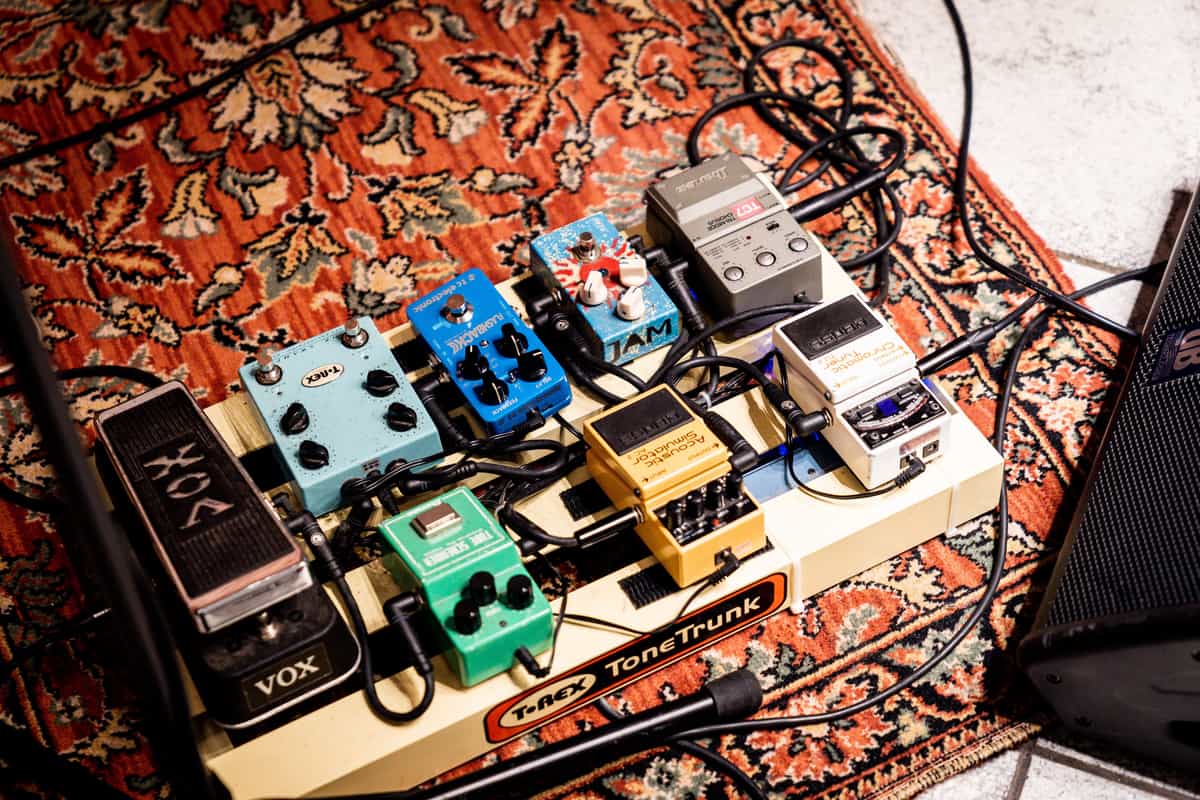
Buy a gate with a send/return loop. A gate mutes below a threshold, so it has to decide whether you are playing — and if it makes that decision from the distorted signal, the noise it is trying to remove is part of what it hears. The BOSS NS-2's Send and Return let the detector listen to your clean guitar while the muting happens after the noisy pedals. That is the whole design and it is why it works.
Almost every complaint about noise gates — 'it chops my sustain', 'it stutters', 'it does not close' — is a symptom of a gate deciding from the wrong signal. The pedal is usually fine; the wiring is not.
Best noise gates
| # | Product | Best for | Price |
|---|---|---|---|
| 01 | 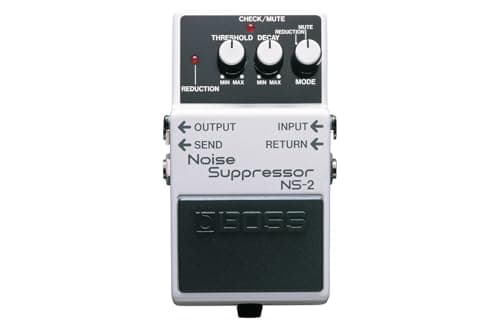 BOSS NS-2 Noise Suppressor Send and Return jacks let the detector listen to your clean guitar while the muting happens after the noisy pedals. | The gate that works the way a gate should | $120.99 · Check price #ad How we’re funded · price as of October 17, 2026 |
| 02 | No photo ISP Technologies Decimator II Noise Reduction Time-vector processing tracks the envelope of the note rather than using a fixed threshold. | One knob and no wiring decisions | |
| ! | 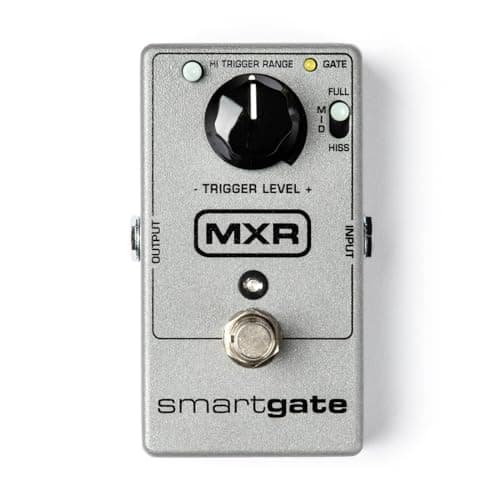 MXR Smart Gate Three gate modes and a Trigger control, with no loop — which limits where it can work properly. Skip this one — see why below | An amp effects loop, not a pedalboard chain | $159.99 · Check price #ad How we’re funded · price as of October 17, 2026 |
Rows link to the full write-up further down this page. Prices come from the live price layer only — where there is no live figure the button reads “Check price” rather than showing a remembered number.
02Why the loop matters, in one diagram's worth of words
Without a loop: guitar to distortion to gate to amp. The gate hears your note plus the distortion's hiss. To close between phrases it has to set a threshold above the hiss — but your note's decay tail drops below that threshold before it actually stops, so the tail gets cut. Set the threshold lower to preserve the tail and the gate never closes.
With the loop: guitar to gate Input, gate Send to distortion, distortion to gate Return, gate Output to amp. The detector now watches the Input — your clean guitar, with no hiss in it — and the muting happens on the Return path after the distortion. It can set the threshold just above your guitar's noise floor, which is very low, and still mute a very noisy signal.
| Wiring | What the gate listens to | Result |
|---|---|---|
| Plain in/out, gate after distortion | The distorted, noisy signal | Chopped tails or a gate that never closes |
| Plain in/out, gate before distortion | The clean guitar | Gates the clean signal — the distortion's own hiss passes through unaffected |
| Send/Return loop | Clean guitar at the input; mutes the distorted signal | The configuration that works |
| In the amp's effects loop | The already-distorted preamp output | Works well for amp gain, not for pedal gain |
BOSS NS-2 Noise Suppressor
The gate that works the way a gate should
The number25 mA, and it has its own 9 V DC OUT jack.
BOSS publishes Input, Output, Send, Return, DC IN and a 9 V DC OUT. The Send and Return are the reason to buy this pedal and the reason it costs more than a simple gate.
Wired correctly, your guitar goes to the Input, the Send feeds your distortion pedals, and the Return brings them back. The gate now makes its open/closed decision from the clean guitar signal at the Input, which contains your note and none of the hiss the distortion is generating.
The circuit is a VCA with a high-speed envelope detector, which is why the gating is fast enough not to clip the front of a note. Wire it plain in/out and you have bought the wrong pedal and installed it the wrong way.
| Controls | Mode switch, Decay, Threshold, pedal switch |
|---|---|
| Jacks | Input, Output, Send, Return, DC IN, 9 V DC OUT |
| Send/Return loop | Lets the gate listen to the guitar directly while muting the output of the noisy pedals |
| Circuit | VCA with a high-speed envelope detector |
| Current draw | 25 mA |
| Weight | 415 g including battery |
| What it does not do | It suppresses noise, it does not remove it — a gate cannot clean up a hum you can hear through a held note. Used in the simple in/out configuration it also cuts your sustain, which is why the send/return loop exists. |
Specs from BOSS NS-2 specifications. We have not used this unit.
#ad How we’re funded · price as of October 17, 2026
ISP Technologies Decimator II Noise Reduction
One knob and no wiring decisions
The Decimator tracks the note's decay envelope rather than simply muting below a fixed level, which means it can follow a decaying note down without chopping it off the way a hard gate does.
One Threshold knob and nothing else. For a player who wants the gate to disappear into the background, that is the right interface.
The base model has no send/return loop, so it is making its decision from whatever signal reaches it. In the effects loop of a high-gain amp, after the preamp, that works well. In front of a distortion pedal it is compromised.
| Controls | Single Threshold control |
|---|---|
| Method | Time-vector processing that tracks the envelope of the note rather than a fixed gate threshold |
| Power | 9 V DC |
| Electrical data | No current-draw or impedance figure is published for this pedal, so none is stated here. |
| What it does not do | One knob and no send/return loop on the base model — the two-unit G String version is what you need if you want the detector to listen to the guitar rather than the distorted signal. |
Specs from ISP Technologies Decimator II product page. We have not used this unit.
MXR Smart Gate
An amp effects loop, not a pedalboard chain
We are not picking this one for a pedalboard. It is a capable gate with three selectable modes (Hiss, Mid, Full) that target different frequency content, and in an amp's effects loop after the preamp it does its job.
The problem is the same one every simple gate has: without a send/return loop, it decides from the signal that contains the noise. On a pedalboard in front of or after a distortion pedal, that means it either chops note tails or fails to close between phrases.
If you already own one and it is cutting your sustain, moving it into the amp's effects loop is more likely to help than replacing it.
| Controls | Trigger knob, three-position gate mode switch (Hiss, Mid, Full) |
|---|---|
| Power | 9 V battery, Dunlop ECB003 adapter, or a DC Brick / Iso-Brick supply |
| Electrical data | No current-draw or impedance figure is published for this pedal, so none is stated here. |
| What it does not do | No send/return loop. Placed after a high-gain amp's preamp it works well; placed naively in front of everything it will chop your note tails. |
Specs from MXR Smart Gate product page. We have not used this unit.
03Setting the threshold
- Turn everything on at playing volume, mute the strings with your fretting hand, and listen to the noise floor.
- Bring the Threshold up until the noise just disappears. Stop there.
- Play a full chord and let it ring out. If the tail cuts off early, the threshold is too high.
- If you cannot find a setting that does both, the gate is deciding from the wrong signal — that is the wiring problem above, not a threshold problem.
- Set Decay so the gate closes at a speed that suits the music. Fast for staccato riffing, slower for sustained parts.
04What a gate cannot do
A gate cannot remove noise from a note you are playing. It mutes below a threshold and passes above it, so while you are holding a chord, whatever hum is in the signal is audible underneath it. If you can hear hum through a sustained note, the fix is upstream — a ground loop, a bad cable, a non-isolated power supply.
That last one is worth checking before you buy a gate at all. A daisy-chained power supply shared between a digital pedal and your analog dirt is a classic hum source, and an isolated supply is a better fix than gating the symptom.
05Do you need one
If you play at gain levels where the noise between phrases is audible in the room, yes. If you play clean or at moderate drive levels, a gate is a solution to a problem you do not have and it will only cost you note tails. Best pedals for metal is the context where this pedal is the first purchase rather than the last. The hum diagnostic covers what to buy instead for each of the five faults that get called hum. And if you are choosing between a gate and a compressor in the first place, compressor vs noise gate covers why they do opposite things. The two gates most often shortlisted against each other get a page of their own: ISP Decimator X vs BOSS NS-2 turns on the send/return loop rather than on which one is quieter.
Frequently asked questions
+ Where does a noise gate go in the chain?
+ Why does my noise gate cut off my sustain?
+ Do I need a noise gate?
+ Will a noise gate fix hum?
Sources
Related on Fret & Fuzz

Compressor vs noise gate
One lifts the quiet parts, the other removes them. Buying the compressor for a noise problem makes the noise worse.
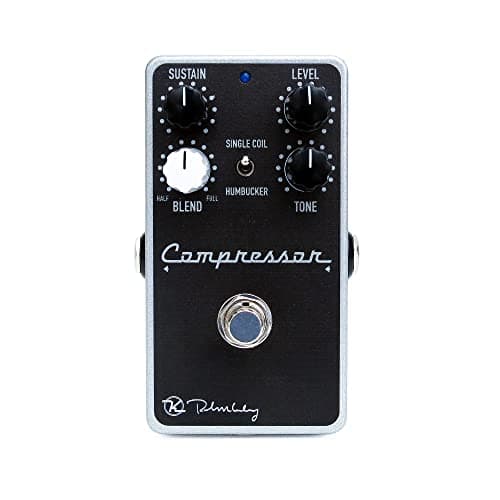
Top pick: Keeley Compressor Plus
#ad How we’re funded · price as of October 17, 2026

ISP Decimator X vs BOSS NS-2
One gates what passes through it; the other can listen to your guitar and mute everything else. The loop decides it.
Top pick: BOSS NS-2 Noise Suppressor
#ad How we’re funded · price as of October 17, 2026
Your pedalboard hums — which fix actually works
Five faults, one word. The two-minute diagnostic, then the one purchase that fixes the fault you actually have.
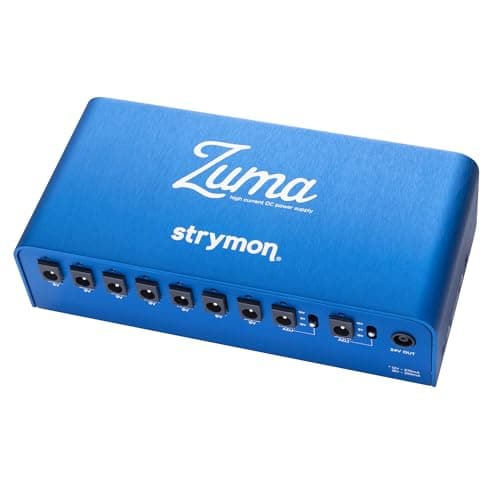
Top pick: Strymon Zuma
#ad How we’re funded · price as of October 17, 2026

Best guitar pedals for metal
The gate matters more than the distortion pedal. Picks judged on gate topology, EQ resolution and published current draw.
Best for Metal pick: BOSS NS-2 Noise Suppressor
#ad How we’re funded · price as of October 17, 2026
Isolated power supply vs daisy chain
Two topologies, two failure modes. The mechanism behind the hum, and the point at which a daisy chain stops being enough.
Top pick: Truetone 1 SPOT
#ad How we’re funded · price as of October 17, 2026
Best distortion pedals
Hard clipping is predictable; the tone control is where these pedals differ. Four distortions compared, plus one that is mislabelled.
Best Distortion pick: Pro Co RAT 2
#ad How we’re funded · price as of October 17, 2026
Pedal order: what changes and what does not
Two placements are load-bearing and the rest are preference. Which is which, and the impedance figures behind the first one.
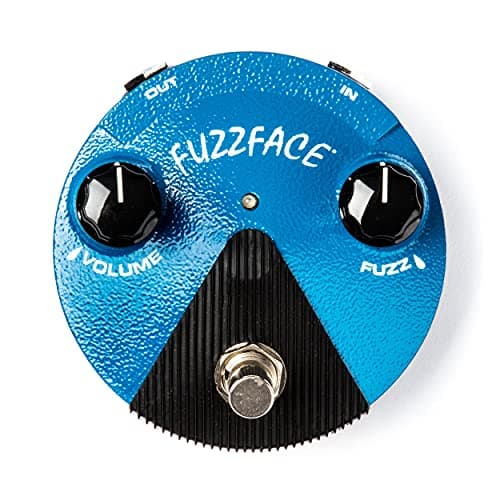
Top pick: Dunlop Fuzz Face Mini Silicon
#ad How we’re funded · price as of October 17, 2026