BOSS GE-7 review
The graphic EQ that has been on pedalboards for forty years, and the one published number that decides whether it can do the job you want.
Fret & Fuzz earns a commission when you buy through the links on this page. It costs you nothing and it does not decide what we rank. How we’re funded.
We have not played this gear. Every pick below is chosen from published manufacturer specifications and the arithmetic set out in how we research, which you can re-run yourself.
The GE-7 is worth buying if you want to cut a problem frequency out of an amp, or to build a switchable solo boost with a tone shape attached. Its seven bands run 100 Hz to 6.4 kHz at plus or minus 15 dB with a Level slider, and it draws 30 mA. Do not buy it to add low end: the lowest band is 100 Hz, above the 82 Hz fundamental of a guitar's low E. Buy an EQ with a lower band, or a different kind of pedal, for that job.
We have not played this pedal, and this is not a tone review. What follows is BOSS's published specification, what each figure means in practice, and who should buy something else. How we research sets out the method.
01What BOSS publishes
| Specification | Published figure | What it means in practice |
|---|---|---|
| Bands | 100 Hz, 200 Hz, 400 Hz, 800 Hz, 1.6 kHz, 3.2 kHz, 6.4 kHz | Seven fixed frequencies — you cannot move them |
| Range | +/- 15 dB per band | Enough to remove a problem frequency, not just nudge it |
| Filter type | First six peaking; 6.4 kHz shelving | The top slider lifts everything above it |
| Level slider | +/- 15 dB | This is what turns the pedal into a solo boost |
| Input impedance | 1 M ohm | Will not load a guitar pickup |
| Output impedance | 1 k ohm, 10 k ohm load or greater | Drives a normal amp input comfortably |
| Nominal level | -20 dBu in and out | Instrument level, not line level |
| Current draw | 30 mA | Trivial on any supply |
| Battery life | Approx. 9 h carbon-zinc, 19.5 h alkaline | Battery is a backup, not a plan |
| Size and weight | 73 x 129 x 59 mm, 400 g | Standard BOSS compact footprint |
Every figure is BOSS's own published specification.
The pedal
| # | Product | Best for | Price |
|---|---|---|---|
| 01 | 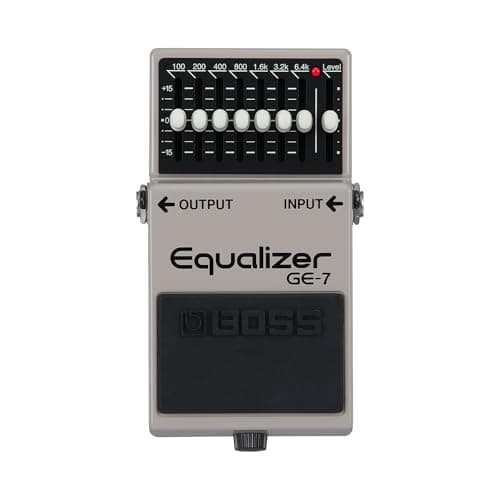 BOSS GE-7 Equalizer Seven bands at plus or minus 15 dB each, a Level slider with the same range, and 30 mA of draw. | Shaping a mid-heavy amp, or building a switchable solo boost | $129.50 · Check price #ad How we’re funded · price as of October 17, 2026 |
Rows link to the full write-up further down this page. Prices come from the live price layer only — where there is no live figure the button reads “Check price” rather than showing a remembered number.
03The 100 Hz problem, and the arithmetic behind it
This is the single most useful thing to know before buying a GE-7, and it is arithmetic rather than opinion.
A guitar in standard tuning has its lowest open string, the low E, at a fundamental of roughly 82 Hz. Drop D takes that to about 73 Hz. The GE-7's lowest slider is at 100 Hz. So the fundamental of your lowest notes sits below the bottom of this pedal's range, and no amount of pushing the 100 Hz slider will amplify it directly — you are lifting the region above the fundamental, which changes the character of the low end without adding weight underneath it.
That is not a fault. For most guitar work, 100 Hz is a sensible floor: it is where a guitar amp's useful body lives, and going lower mostly adds mud that a live sound engineer will remove again. But if you came looking for a pedal to give a thin amp some genuine low-end extension, this is the wrong tool and the specification tells you so before you spend the money.
BOSS GE-7 Equalizer
Shaping a mid-heavy amp, or building a switchable solo boost
The number100 Hz to 6.4 kHz in seven bands, +/- 15 dB, 30 mA, 1 M ohm in, 1 k ohm out, 400 g.
BOSS publishes seven bands at 100 Hz, 200 Hz, 400 Hz, 800 Hz, 1.6 kHz, 3.2 kHz and 6.4 kHz, each with plus or minus 15 dB of cut and boost, plus a Level slider covering the same range. The first six are peaking filters; the 6.4 kHz slider is a shelving filter, which means the top control lifts or drops everything above it rather than a band around it.
Fifteen decibels is a lot of authority — enough to take a honking upper midrange out of a solid-state amp, or to build a level boost with a tone shape baked into it and switch the whole thing in for a solo. The Level slider is what makes that second use work: set the bands for the voicing you want, push Level, and you have a shaped boost on a footswitch. Draw is 30 mA, impedances are 1 M ohm in and 1 k ohm out with a recommended load of 10 k ohms or greater, and BOSS publishes battery life at roughly 9 hours carbon-zinc or 19.5 hours alkaline.
The cons matter more than usual on this pedal. The lowest band is 100 Hz, and the low E of a guitar in standard tuning sits at about 82 Hz — so the fundamental of your lowest note is below anything this pedal can reach directly. If you bought it to add weight down there, it cannot do it; you can only lift the harmonic above. There is no adaptor in the box, no presets, and the stock unit has a long-standing reputation for added noise at high boost settings, which is the reason a modification market exists for it at all.
| Bands | 7 bands: 100 Hz, 200 Hz, 400 Hz, 800 Hz, 1.6 kHz, 3.2 kHz, 6.4 kHz |
|---|---|
| Filter type | The first six bands are peaking filters; the 6.4 kHz slider is a shelving filter |
| Range | +/- 15 dB per band, plus a Level slider with the same +/- 15 dB range |
| Input impedance | 1 M ohm |
| Output impedance | 1 k ohm, recommended load 10 k ohms or greater |
| Current draw | 30 mA |
| Battery life | Approx. 9 hours carbon-zinc, approx. 19.5 hours alkaline |
| Size / weight | 73 x 129 x 59 mm, 400 g including battery |
| What it does not do | No adaptor included and no low band below 100 Hz. The stock unit has a reputation for noise at high boost settings, which is why the modification market for it exists. |
Specs from BOSS GE-7 product page. We have not used this unit.
#ad How we’re funded · price as of October 17, 2026
04Cutting beats boosting, and 15 dB is why
The plus or minus 15 dB range is generous, and the useful half of it is the minus.
Boosting a band adds level and, with it, whatever noise already lives in that band. Cutting a band removes the problem and lowers the overall level, which you then make back up with the Level slider — same result, less noise. On the GE-7 specifically this matters because the pedal's weak point is noise at high boost settings, so the technique that suits it is: find the frequency that is bothering you, cut it, and bring the whole signal back up with Level.
That approach also explains the solo-boost use. Set a broad, gentle mid lift and push Level by a few decibels, and the pedal both raises your volume and moves your tone into a range that cuts through a band — which is a different and more reliable result than volume alone. Your solo disappears in a band — which pedal fixes it covers why level on its own usually is not enough.
05Where it goes, and why the answer is two places
In front of the amp, the GE-7 shapes what your preamp distorts — a mid boost in front of a driven amp pushes it harder in that region and changes the character of the distortion itself.
In the effects loop, it shapes what the amp has already distorted, which is the right place for fixing a frequency problem in the amp's voice rather than changing how it breaks up. Neither is correct in general; they do different jobs, and the pedal is cheap enough that people frequently try both. Pedal order covers what changes and what does not when you move it.
06Who should buy something else
Anyone who wants to add low-end weight, for the reason above. Anyone who wants to move the frequencies rather than accept seven fixed ones — that is a parametric EQ, a different pedal with a different control set.
And anyone whose real problem is dynamics rather than frequency. If your quiet notes vanish and your loud ones jump out, no EQ setting fixes that; a compressor does. Compressor vs boost covers telling those two problems apart before you buy for the wrong one.
Frequently asked questions
+ Is the BOSS GE-7 worth it?
+ What frequencies does the BOSS GE-7 cover?
+ Is the GE-7 noisy?
+ Should an EQ pedal go in the effects loop or in front of the amp?
Sources
Related on Fret & Fuzz
Best EQ pedals
Bands, decibel range and supply voltage. Three EQs compared, plus the 18 V requirement that strands power plans.
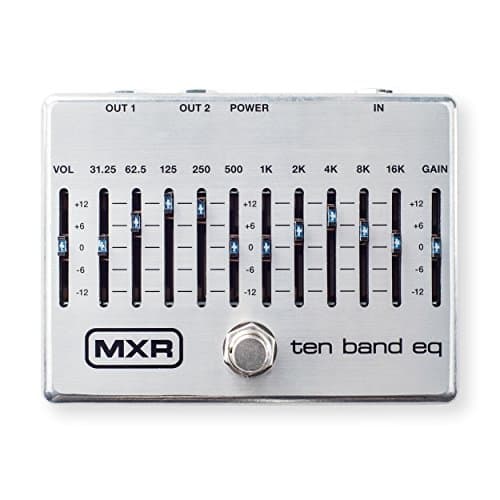
Best EQ Pedal pick: MXR 10 Band EQ
#ad How we’re funded · price as of October 17, 2026

Your solo disappears in a band — which pedal fixes it
Three different faults produce the same complaint. The diagnostic table first, then the pedal that fixes yours.
Top pick: BOSS GE-7 Equalizer
#ad How we’re funded · price as of October 17, 2026
Compressor vs boost
One narrows your dynamic range, the other shifts all of it up. Diagnose the problem first, because the common answer is neither.
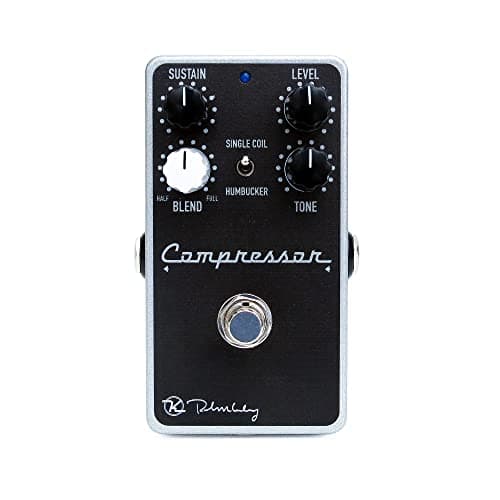
Top pick: Keeley Compressor Plus
#ad How we’re funded · price as of October 17, 2026
Pedal order: what changes and what does not
Two placements are load-bearing and the rest are preference. Which is which, and the impedance figures behind the first one.
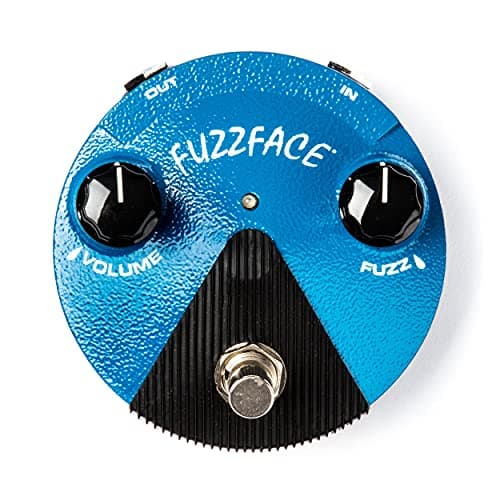
Top pick: Dunlop Fuzz Face Mini Silicon
#ad How we’re funded · price as of October 17, 2026