Best EQ pedals
The most underrated pedal on most boards, and the one whose spec sheet tells you almost everything.
Fret & Fuzz earns a commission when you buy through the links on this page. It costs you nothing and it does not decide what we rank. How we’re funded.
We have not played this gear. Every pick below is chosen from published manufacturer specifications and the arithmetic set out in how we research, which you can re-run yourself.
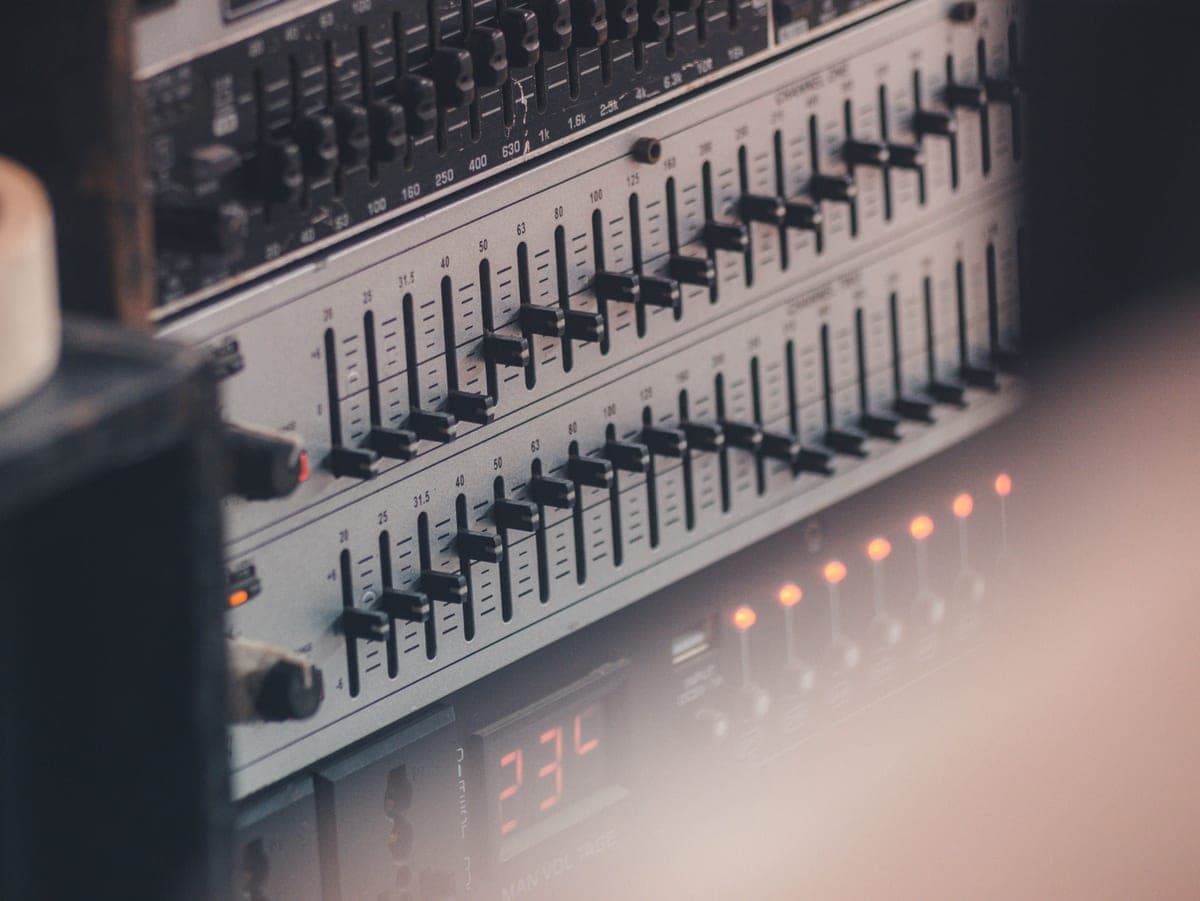
An EQ pedal fixes problems no gain pedal can, and the spec sheet tells you most of what you need: how many bands, what range per band, and — critically — what voltage it wants. The MXR 10 Band runs on 18 V, not 9 V, and that catches more people out than any other specification in this hub.
Three published numbers separate these pedals: band count (resolution), decibel range per band (authority), and supply voltage (whether it fits your board at all).
Best EQ pedals
| # | Product | Best for | Price |
|---|---|---|---|
| 01 | 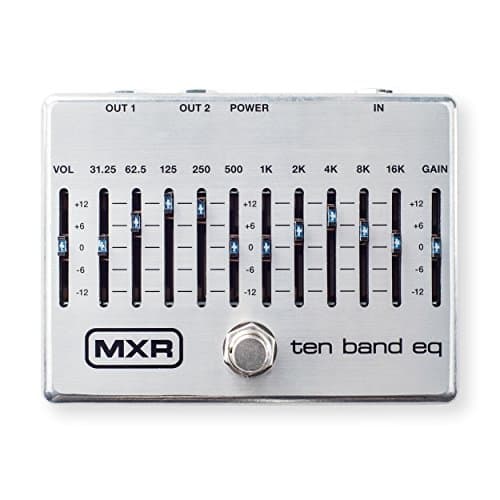 MXR 10 Band EQ Ten bands from 31.25 Hz to 16 kHz at +/- 12 dB, with two outputs. | The resolution to fix a specific frequency | $159.99 · Check price #ad How we’re funded · price as of October 17, 2026 |
| 02 | 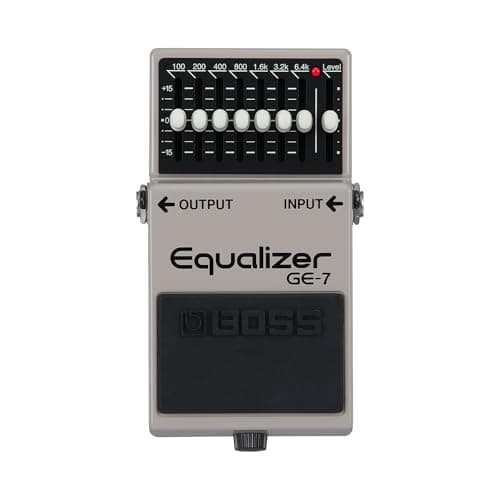 BOSS GE-7 Equalizer 100 Hz to 6.4 kHz at +/- 15 dB, plus a Level slider, on a standard 9 V supply. | Seven bands on 9 V, at the lowest price | $129.50 · Check price #ad How we’re funded · price as of October 17, 2026 |
| 03 | 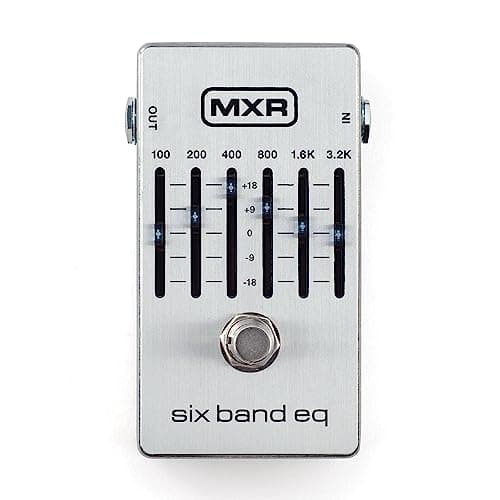 MXR Six Band EQ Six bands at +/- 18 dB, true bypass, on 9 V. | The widest range per band, in the smallest format | $125.99 · Check price #ad How we’re funded · price as of October 17, 2026 |
| ! | 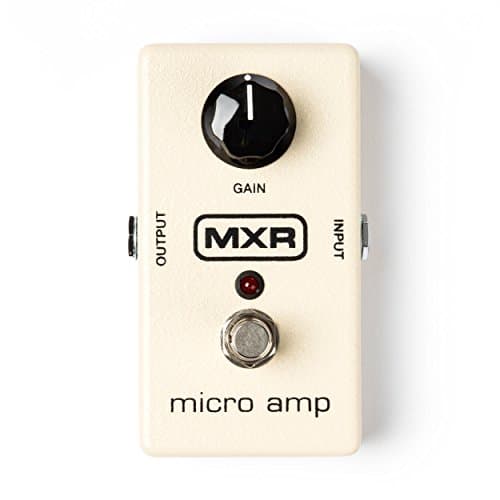 MXR Micro Amp A clean boost with no tone shaping — the pedal people reach for when they need EQ. Skip this one — see why below | Not an EQ, and often bought instead of one | $105.99 · Check price #ad How we’re funded · price as of October 17, 2026 |
Rows link to the full write-up further down this page. Prices come from the live price layer only — where there is no live figure the button reads “Check price” rather than showing a remembered number.
02Published specifications, side by side
| Pedal | Bands | Frequency range | Range per band | Voltage |
|---|---|---|---|---|
| MXR 10 Band EQ | 10 | 31.25 Hz to 16 kHz | +/- 12 dB | 18 V |
| BOSS GE-7 | 7 | 100 Hz to 6.4 kHz | +/- 15 dB | 9 V |
| MXR Six Band EQ | 6 | 100 Hz to 3.2 kHz | +/- 18 dB | 9 V |
More bands means finer control; more decibels per band means more authority over the bands you have. They are different things and both are published.
03Before or after the drives
This is the decision that makes an EQ pedal genuinely powerful, and it is not a preference — the two placements do different jobs.
| Placement | What it changes | Use it when |
|---|---|---|
| Before the drives | What the clipping stage is fed, so the distortion itself changes | The distorted tone is loose or flubby — cut lows here |
| After the drives | What you hear, without changing the distortion character | The tone is right but the amp or cab has a frequency problem |
| In the amp's effects loop | The power amp's input, after the preamp has distorted | High gain from the amp channel rather than from a pedal |
Cutting bass before a high-gain stage is how you get a tight low end rather than a loose one, and it is the same principle a Tube Screamer exploits when it tightens a cranked amp. Best pedals for metal covers that case.
MXR 10 Band EQ
The resolution to fix a specific frequency
The numberRuns on 18 V, not 9 V. This is the single most common power mistake made with this pedal.
Ten bands is enough resolution to cut a narrow problem area — the 100 to 300 Hz range that makes a high-gain tone flubby, for instance — without thinning everything around it. An amp's Bass control cannot do that.
Separate Gain and Volume sliders mean you can set the input level and the output level independently, which matters when you are using large boosts or cuts.
The 18 V requirement is not a preference. On a 9 V-only brick this pedal needs its own supply, an 18 V output, or a doubler cable. The power guide covers planning for it.
| Bands | 10 bands from 31.25 Hz to 16 kHz |
|---|---|
| Range | +/- 12 dB per band, plus Gain and Volume sliders |
| Outputs | Two outputs for running to two amps |
| Power | 18 V DC supply (included with the M108S) |
| Electrical data | No current-draw or impedance figure is published for this pedal, so none is stated here. |
| What it does not do | It runs at 18 V, not 9 V. If your board is a 9 V-only brick this pedal needs its own supply or an 18 V output — this is the single most common power mistake made with it. |
Specs from MXR 10 Band EQ product page. We have not used this unit.
#ad How we’re funded · price as of October 17, 2026
BOSS GE-7 Equalizer
Seven bands on 9 V, at the lowest price
Seven bands centered at 100 Hz, 200 Hz, 400 Hz, 800 Hz, 1.6 kHz, 3.2 kHz and 6.4 kHz, with +/- 15 dB per band — a wider range per band than the MXR 10 Band offers.
It runs on 9 V like everything else on a normal board, which is a real advantage over the 18 V MXR if your supply is already full.
No band below 100 Hz, and the stock unit has a longstanding reputation for noise at high boost settings — which is why a modification market exists for it.
| Bands | 7 bands: 100 Hz, 200 Hz, 400 Hz, 800 Hz, 1.6 kHz, 3.2 kHz, 6.4 kHz |
|---|---|
| Filter type | The first six bands are peaking filters; the 6.4 kHz slider is a shelving filter |
| Range | +/- 15 dB per band, plus a Level slider with the same +/- 15 dB range |
| Input impedance | 1 M ohm |
| Output impedance | 1 k ohm, recommended load 10 k ohms or greater |
| Current draw | 30 mA |
| Battery life | Approx. 9 hours carbon-zinc, approx. 19.5 hours alkaline |
| Size / weight | 73 x 129 x 59 mm, 400 g including battery |
| What it does not do | No adaptor included and no low band below 100 Hz. The stock unit has a reputation for noise at high boost settings, which is why the modification market for it exists. |
Specs from BOSS GE-7 product page. We have not used this unit.
#ad How we’re funded · price as of October 17, 2026
MXR Six Band EQ
The widest range per band, in the smallest format
The number+14 dBV maximum input and output level at 1 kHz with all sliders at 0 dB.
Six bands from 100 Hz to 3.2 kHz at +/- 18 dB each — the largest per-band range on this page, in the smallest enclosure.
True bypass and a 9 V supply, so it drops onto an existing board without a power rethink.
The range is the trade: nothing below 100 Hz and nothing above 3.2 kHz. For midrange shaping that is fine; for fixing a low-end problem it is not enough reach.
| Bands | 6 bands: 100 Hz, 200 Hz, 400 Hz, 800 Hz, 1.6 kHz, 3.2 kHz |
|---|---|
| Range | +/- 18 dB per band |
| Maximum input / output level | +14 dBV at 1 kHz with all sliders at 0 dB |
| Bypass | True bypass |
| Power | 9 V battery, Dunlop ECB003 adapter, or a DC Brick / Iso-Brick supply |
| What it does not do | No band below 100 Hz and none above 3.2 kHz, so it cannot reach either extreme. There is no separate output level slider, which the 10 Band has. |
Specs from MXR Six Band EQ product page. We have not used this unit.
#ad How we’re funded · price as of October 17, 2026
MXR Micro Amp
Not an EQ, and often bought instead of one
We are not picking this one on an EQ page. A Micro Amp adds flat gain and changes nothing about the frequency balance.
It gets bought for problems an EQ solves: a tone that is too thin, a solo that does not cut through, a rig that sounds boxy. A boost amplifies all of those unchanged.
If you want to be more audible in a mix, that is a midrange problem and an EQ addresses it directly. Compressor vs boost works through the diagnosis.
| Controls | Single Gain control |
|---|---|
| Function | Clean gain boost with no tone shaping |
| Power | 9 V battery, Dunlop ECB003 adapter, or a DC Brick / Iso-Brick supply |
| Electrical data | No current-draw or impedance figure is published for this pedal, so none is stated here. |
| What it does not do | No EQ of any kind and no power supply included. A clean boost cannot fix a thin tone; it makes whatever follows it work harder. |
Specs from MXR Micro Amp product page. We have not used this unit.
04Using an EQ as a boost
A graphic EQ with a Level slider is also a boost with tone control, which makes it one of the more efficient pedals on a board. Set the sliders flat, push the Level up, and you have a clean boost. Push the mids up instead and you have the lead boost that actually makes you audible in a mix.
That is the strongest argument for the GE-7 or the MXR 10 Band over a dedicated boost pedal: same board slot, more capability. Overdrive vs boost covers what a flat boost can and cannot do. The commonest reason to reach for either is a lead that vanishes in a band — that problem has its own diagnostic, and the answer is usually EQ rather than level. Note the supply requirement before you buy: the MXR 10 Band runs at 18 V, not 9 V, and 9V vs 18V pedals covers why an EQ needs the extra headroom and which supplies deliver it. The pedal most people end up choosing here has a page of its own: our BOSS GE-7 review covers the seven published band centers and the 100 Hz floor that sits above your low E.
05The 18 V problem
Frequently asked questions
+ Do I need an EQ pedal?
+ Should the EQ go before or after my drive pedals?
+ How many bands do I need?
+ Can I use an EQ pedal as a boost?
Sources
Related on Fret & Fuzz

Your solo disappears in a band — which pedal fixes it
Three different faults produce the same complaint. The diagnostic table first, then the pedal that fixes yours.
Top pick: BOSS GE-7 Equalizer
#ad How we’re funded · price as of October 17, 2026
BOSS GE-7 review
Seven bands at plus or minus 15 dB for 30 mA — and a 100 Hz floor that sits above your low E.
Top pick: BOSS GE-7 Equalizer
#ad How we’re funded · price as of October 17, 2026
9V vs 18V pedals
Voltage sets the clipping ceiling, not the volume. Which pedals want 18 V, which supplies deliver it, and the mistake that kills a pedal.
Top pick: MXR 10 Band EQ
#ad How we’re funded · price as of October 17, 2026
Compressor vs boost
One narrows your dynamic range, the other shifts all of it up. Diagnose the problem first, because the common answer is neither.
Top pick: Keeley Compressor Plus
#ad How we’re funded · price as of October 17, 2026

Best guitar pedals for metal
The gate matters more than the distortion pedal. Picks judged on gate topology, EQ resolution and published current draw.
Best for Metal pick: BOSS NS-2 Noise Suppressor
#ad How we’re funded · price as of October 17, 2026
Pedalboard power requirements explained
Two sums decide your power supply, and almost everyone only does the first. A worked example with real published figures.
Top pick: Strymon Zuma
#ad How we’re funded · price as of October 17, 2026
Overdrive vs boost
A boost has three different results depending on what follows it. Work out which case you are in before you buy one.
Top pick: EarthQuaker Devices Plumes