Best gigging amps
The amp that sounds best in a shop is frequently the wrong one to put on a stage, and the reasons are all on the spec sheet.
Fret & Fuzz earns a commission when you buy through the links on this page. It costs you nothing and it does not decide what we rank. How we’re funded.
We have not played this gear. Every pick below is chosen from published manufacturer specifications and the arithmetic set out in how we research, which you can re-run yourself.
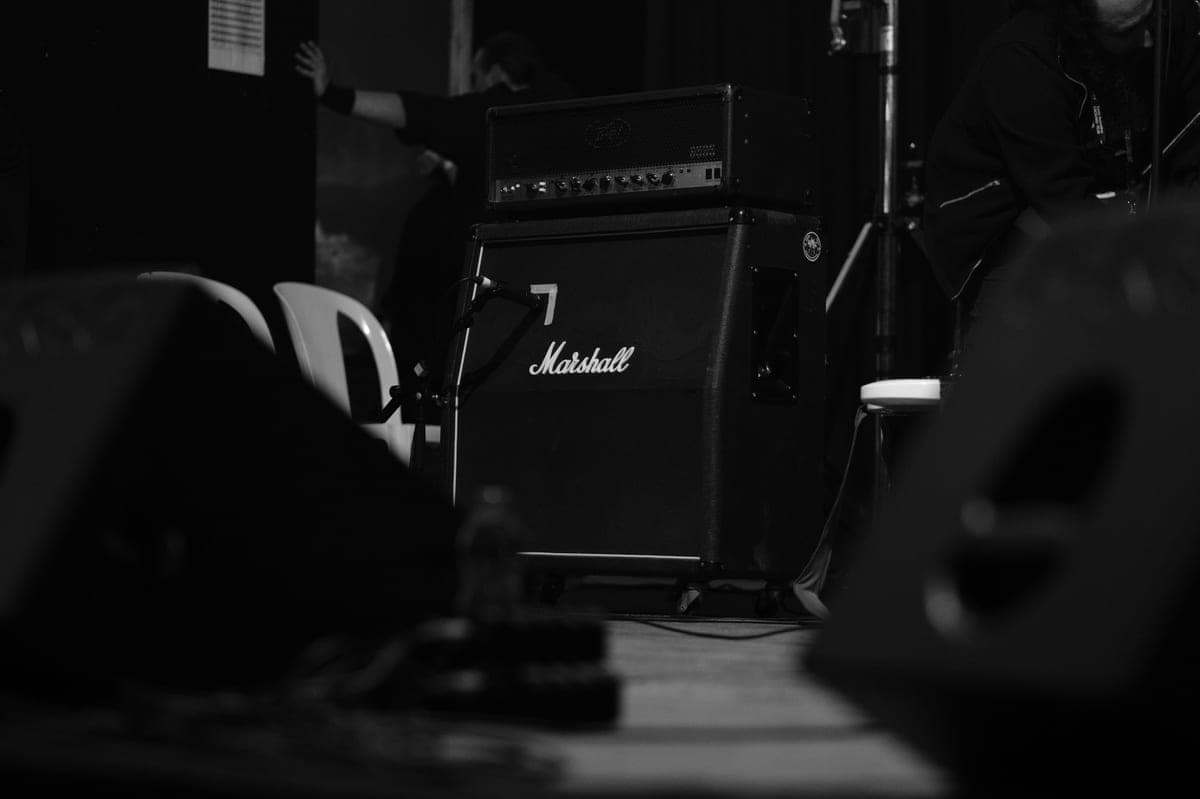
A gigging amp is judged on four published things: enough clean headroom to sit under a drummer, an effects loop, some way out to the PA, and a weight you will still accept at 1 a.m. The BOSS KATANA-100 GEN 3 is the one amp here that has all four, at 100 W with a Power Control that drops to 0.5 W. If you already own an amp you like, a load box with a DI solves the last two requirements for less than a new amp costs.
Almost every other amp page on this site — including ours — judges an amp on how it sounds at a volume you choose. A stage takes that choice away, and the specifications that matter change completely.
01The criteria, before any product
| Requirement | Why a stage specifically | What to look for |
|---|---|---|
| Clean headroom | A drummer is not a volume you can negotiate with | Published wattage, and a 12-inch speaker over an 8 or a 10 |
| Effects loop | A delay in front of a distorting preamp turns repeats to mush | Separate Send and Return jacks, not just a line out |
| A way out to the PA | Above a certain room size the amp is a monitor, not the sound | A line out, a speaker-emulated DI, or a load box you add |
| Channel or boost switching by foot | Your hands are busy | A footswitch, and check whether it is included or sold separately |
| A quiet setting | The same amp has to survive rehearsal and a bedroom | An output-stage power control, not only a master volume |
| Weight | You are carrying it twice per gig, up stairs, at night | Published kg or lb — the range on this page is 5.2 to 17.3 kg |
| Reliability | A failure is public and unfixable mid-set | A service record, and a spare fuse and cable in the bag |
Nothing on that list is about tone, and that is deliberate. Tone is the thing you already have an opinion about; these are the things that decide whether the opinion survives contact with a stage.
Best amps for gigging
| # | Product | Best for | Price |
|---|---|---|---|
| 01 | No photo BOSS KATANA-100 GEN 3 100 W with an effects loop, a Line Out and a Power Control that drops to 0.5 W for the rehearsal room. | One amp that covers the whole job | |
| 02 | No photo EVH 5150 Iconic Series 15W 1x10 combo Two footswitchable channels, an effects loop and a speaker-emulated DI on the rear panel. | Valve power with a way out to the desk | |
| 03 | No photo Fender Blues Junior IV 15 W of EL84 into a 12-inch Celestion — and no effects loop, which is the whole argument. | The sound, if you accept what it does not have | |
| 04 | No photo Two Notes Torpedo Captor X A reactive load box, attenuator, speaker simulator and DI in one unit — three attenuation steps and a stereo XLR out. | Making the amp you already own stage-ready | |
| 05 | No photo Line 6 HX Stomp Over 300 models with IR loading into the PA, in something that fits in a gig bag pocket. | Not carrying an amp at all | |
| ! | No photo Positive Grid Spark 40 An excellent practice amp with two 4-inch drivers and no external speaker output. Skip this one — see why below | Not this, and it is the most common mistake in the category |
Rows link to the full write-up further down this page. Prices come from the live price layer only — where there is no live figure the button reads “Check price” rather than showing a remembered number.
03How many watts, with the arithmetic
The usual answer — "you need at least 50 watts to keep up with a drummer" — is a rule of thumb standing in for a calculation. The calculation is that a change in level in decibels is ten times the base-ten logarithm of the power ratio, so doubling the power buys about 3 dB and a perceived doubling of loudness takes roughly ten times the power.
Run that both ways and the practical answer falls out. Going from 15 W to 100 W is about 8 dB — clearly louder, and nothing like the seven-times difference the numbers suggest. Going from 50 W to 100 W is about 3 dB, which is close to the smallest step most people reliably notice. That is why a 15 W valve combo in front of a microphone does most gigs, and why paying for 100 W buys you headroom and a quieter fan-free idle rather than a fundamentally louder rig.
BOSS KATANA-100 GEN 3
One amp that covers the whole job
The number100 W rated, 77 W consumed, 14.8 kg — all published by BOSS.
This is the amp that answers every requirement on the criteria list above without a compromise you have to think about. 100 W into a 12-inch speaker is more headroom than a loud drummer needs. There is an effects loop with separate Send and Return jacks, so time-based effects go where they belong instead of in front of a distorting preamp. There is a Line Out for the desk.
The Power Control is the feature that makes it one amp rather than two. Standby, 0.5 W, Half and Max means the same amp that keeps up on Friday is usable in a rehearsal room on Tuesday and at home on Wednesday — and the 0.5 W setting is a genuine output-stage reduction, not a master volume.
The cons are real and worth budgeting for. The Line Out is a 1/4-inch jack rather than an XLR, so a sound engineer needs a DI box to take it. There is no IR loading. And the GA-FC footswitch that unlocks channel and effects switching is sold separately — which is the purchase people forget when they buy this specifically to gig with. At 14.8 kg it is also the second-heaviest thing on this page.
| Rated power output | 100 W |
|---|---|
| Speaker | 30 cm (12") x 1 |
| Amp characters | Six — Acoustic, Clean, Pushed, Crunch, Lead and Brown — each with one selectable variation, which BOSS counts as 12 tones |
| Effects | Five independent sections — Booster, Mod, FX, Delay and Reverb — with three variations each |
| Power Control | Standby, 0.5 W, Half and Max |
| Effects loop | Send and Return jacks, plus a Power Amp In jack |
| Outputs | Line Out, stereo Phones, USB-C to a computer |
| Control jacks | Expression pedal (TRS) and GA-FC / CTL CH1 / CH2 SOLO (TRS) |
| Power consumption | 77 W |
| Weight | 14.8 kg (32 lb 11 oz) |
| What it does not do | No XLR output — the Line Out is a 1/4-inch jack, so a sound engineer needs a DI box to take it. No built-in IR loading. The GA-FC footswitch that unlocks channel and effects switching is sold separately, which is the purchase people forget when they buy this to gig with. |
Specs from BOSS KATANA-100 GEN 3 specifications. We have not used this unit.
EVH 5150 Iconic Series 15W 1x10 combo
Valve power with a way out to the desk
The number15 W with a quarter-power switch — about a 6 dB step down.
Fifteen watts of 6L6 is loud enough for most stages once it is in front of a microphone, and this is the valve amp on the page that was designed with the practical parts in mind. Two channels, each with an extra gain voicing, switched by the one-button footswitch included in the box — not sold separately. An effects loop. Dual parallel speaker outputs if you want to add a cabinet.
The specification that earns its place here is the speaker-emulated DI line out on the rear panel, which lets the amp reach a PA without a microphone in front of it. On a small stage with no mic available, or a venue where the engineer wants a clean feed, that is the difference between playing and improvising a solution.
The cons: the 10-inch speaker is the limiting factor on the low end, and this amp sounds materially different through a 4x12. There is no reverb at all, so a reverb pedal is not optional. At 38.2 lb it is the heaviest thing here, and the quarter-power switch buys about 6 dB — real, and less than people expect.
| Power | 15 W, with a quarter-power switch |
|---|---|
| Speaker | 1 x 10" |
| Tubes | 2 x ECC83 preamp, 1 x 6L6 power |
| Channels | Two, each with an extra gain voicing (Overdrive on green, Burn on red) |
| Extras | Effects loop, dual parallel speaker outputs, speaker-emulated DI with power amp mute |
| Weight | 38.2 lb |
| Included | One-button footswitch |
| What it does not do | The 10" speaker is the limiting factor on the low end — this amp sounds materially different through a 4x12. No reverb. |
Specs from EVH 5150 Iconic Series 15W 1x10 combo product page. We have not used this unit.
Fender Blues Junior IV
The sound, if you accept what it does not have
The number15 W all-tube, 3 x 12AX7, 2 x EL84, 31.5 lb.
Fender describes this as a 15-watt favorite for guitarists who need to hit the stage or the studio at a moment's notice, and the sound is not in dispute — a 12-inch Celestion A-Type driven by two EL84s is a genuinely excellent platform, and the spring reverb is the good kind. The FAT switch mid boost comes with a one-button footswitch in the box.
It is on this page because it is the amp most often carried to a first gig, and it deserves an honest account rather than exclusion.
The cons are the reason it is third and not first. There is no effects loop, so a delay or reverb pedal sits in front of a preamp that is distorting, which turns clean repeats to mush at exactly the settings you want live. There is no channel switching — the FAT switch is a mid boost, not a second channel, so a clean-to-lead change is a pedal or nothing. And 15 W of EL84 with no attenuator is loud enough to be a problem in a small room, with no way to turn the power section down. If those three do not bother you, it is a wonderful amp.
| Power | 15 W, all-tube |
|---|---|
| Speaker | 12" Celestion A-Type |
| Preamp tubes | 3 x 12AX7 |
| Power tubes | 2 x EL84 |
| Controls | Volume, Treble, Bass, Middle, Reverb, Master, FAT switch |
| Weight | 31.5 lb |
| Footswitch | One-button footswitch for the FAT mid boost, included |
| What it does not do | No effects loop and no channel switching — the FAT switch is a mid boost, not a second channel. 15 W of EL84 is loud enough to be a problem in a small room and it has no attenuator. |
Specs from Fender Blues Junior IV product page. We have not used this unit.
Two Notes Torpedo Captor X
Making the amp you already own stage-ready
The number100 W RMS maximum, and attenuation is stepped at 0, -20 and -38 dB.
The cheapest fix for a gigging problem is frequently not an amp. If your amp sounds right and its only failing is that it has no way to reach the PA and no way to be quiet, this solves both without changing the sound you already chose.
It is a reactive load rather than a resistive one, which matters because a purely resistive load does not behave like a speaker and the amp can hear the difference. The stereo XLR DI is what an engineer actually wants handed to them, and the headphone output makes the same rig a silent practice setup on the way home.
The cons: the attenuation is stepped rather than continuous — three positions, not a knob — so you get -20 dB or -38 dB and nothing in between. The load impedance is fixed at 8 ohm nominal, with the 16 ohm version sold as a separate product, so you must buy the right one. And 100 W RMS is the ceiling, which puts a 100 W head run flat out at the limit rather than comfortably inside it.
| Function | Reactive load box, attenuator, speaker simulator and DI in one unit |
|---|---|
| Load impedance | Fixed 8 ohm nominal (a 16 ohm version is sold separately) |
| Power handling | 100 W RMS maximum |
| Attenuation | Selectable 0 dB, -20 dB and -38 dB on the speaker output |
| Outputs | Speaker out, stereo XLR DI, headphone out, plus USB and Bluetooth for editing |
| What it does not do | The attenuation is stepped, not continuous — three positions, not a knob. 100 W is the ceiling, so a 100 W head run flat out is at the limit rather than comfortably inside it. |
Specs from Two Notes Torpedo Captor X product page. We have not used this unit.
Line 6 HX Stomp
Not carrying an amp at all
The numberUp to six simultaneous blocks; 9 V DC center-negative at 3 A.
The honest answer for a lot of working players is that the best gigging amp is no amp. Line 6 publishes over 300 amps, cabs and effects from the Helix family, IR loading, stereo I/O, an effects loop and six simultaneous blocks — enough to be the whole rig, going straight to the desk.
The practical case is unanswerable on some gigs: nothing to carry, nothing to mic, identical sound in every room, and no stage volume argument with the engineer. It also runs in front of a real amp's power section through the Power Amp In jack if you want the hybrid.
The cons are specific. It asks for 3 A at 9 V, which no standard isolated pedalboard brick supplies, so it needs its own supply — powering an HX Stomp has that arithmetic. Six blocks is a real ceiling once an amp, a cab and an IR are in the chain. And you are relying on the PA and on in-ears or a wedge to hear yourself, which is a different skill from standing in front of a speaker.
| Simultaneous blocks | Up to six simultaneously |
|---|---|
| Models | Over 300 amps, cabs and effects from the Helix family, with IR loading |
| Power | 9 V DC center-negative, DC-3 supply (3 A) included |
| Display / switches | 2.4" color LCD; three capacitive-touch footswitches with LED rings |
| Audio interface | 24-bit / 96 kHz multi-channel USB audio |
| Format | Compact pedalboard unit with stereo I/O and an effects loop |
| What it does not do | It asks for 3 A at 9 V. No standard isolated pedalboard brick output supplies that, so it needs its own supply — this is the mistake people make when they add one to an existing board. |
Specs from Line 6 HX Stomp owner's manual. We have not used this unit.
Positive Grid Spark 40
Not this, and it is the most common mistake in the category
We are not picking this one for gigs, and it is a genuinely good product — it wins our practice amp page.
Two 4-inch drivers cannot move air the way a 12-inch can, and no amount of wattage on the box changes the size of the cone. Positive Grid publishes no effects loop and no external speaker output, so there is no way to make it bigger and no way to send it anywhere. The USB interface is for recording, not for front of house.
It gets bought for this because 40 W sounds like a gigging number next to a 15 W valve combo. Wattage is not what is limiting it — amp wattage and volume has that arithmetic, and speaker area is the part the spec sheet does not put in a headline. Best practice amps is the page where this amp is the right answer.
| Power | 40 W class D |
|---|---|
| Speakers | 2 x 4" custom designed |
| Amp models | 33 |
| Effects | 43 — noise gate, compressor, distortion, modulation/EQ, delay, reverb |
| Connectivity | 1/4" guitar input, 1/8" aux in, 1/8" headphone, Bluetooth audio, USB recording interface |
| Size / weight | 350 x 180 x 190 mm, 5.2 kg |
| What it does not do | No effects loop and no external speaker output. The 4" drivers cannot move air the way a 12" can — this is a desk and sofa amp, not a rehearsal-room one. |
Specs from Positive Grid Spark 40 product page. We have not used this unit.
04The effects loop question, settled
You need a loop if your distortion comes from the amp. You do not need one if your distortion comes from pedals into a clean amp.
The reason is mechanical rather than a matter of taste. A delay creates distinct repeats; a distorting preamp compresses and clips whatever reaches it, including those repeats, which smears them into a wash. Put the delay after the preamp — which is what a loop is — and the repeats stay separate. If the amp is clean and the pedals are doing the distorting, the delay is already after the distortion and the loop is solving a problem you do not have.
That is the single specification most likely to make you regret an amp bought on sound alone. The Blues Junior IV above has no loop; the KATANA and the EVH both do. Pedal order covers the placement rules, and pedal gain vs amp gain covers which side your distortion should come from in the first place.
05Getting to the PA, three ways
- A microphone in front of the speaker. The default, it sounds like your amp because it is your amp, and it depends on the venue having a spare microphone, a stand and an input. Above a certain room size somebody will do this whether you planned for it or not.
- A line out or speaker-emulated DI on the amp. The EVH publishes one; the KATANA publishes a Line Out on a 1/4-inch jack, which means the engineer needs a DI box to take it. Check which of the two you have, because they are not interchangeable at the desk.
- A load box with a DI. The Two Notes above does this for any amp, adds attenuation, and gives you a stereo XLR feed plus a headphone output. It is the retrofit for an amp you already like.
Whichever route you take, the amp on stage stops being the sound the audience hears and becomes your monitor. That reframing is what makes a 15 W combo a perfectly serious gigging amp and a 100 W head an increasingly rare requirement.
06The purchases people forget
- The footswitch. Included with the Blues Junior IV and the EVH; sold separately for the KATANA, whose GA-FC unlocks channel and effects switching. Budget for it or you have bought a one-channel amp.
- A spare instrument cable and a spare fuse. Both fail, both are cheap, and both end a set if you do not have them.
- A reverb pedal, if the amp has none. The EVH publishes no reverb at all.
- A second power supply, if a modeler is in the rig — powering an HX Stomp covers why it will not share your brick.
- A cover or a bag. The amp is going in a car, repeatedly, at night.
07What we did not include, and why
No head-and-cabinet rigs. A head and a 4x12 is more flexible and sounds bigger, and for anyone who is not already gigging regularly a combo is the right answer — combo vs head and cab covers the cases where it is not.
No amp we could not confirm as currently in production on the manufacturer's own site. That check removed a well-regarded 20 W valve combo from this shortlist, and it is the reason the Katana here is the GEN 3 rather than the MkII that BOSS now lists under Discontinued. We would rather publish five picks you can buy than six with one you cannot.
Frequently asked questions
+ How many watts do I need to gig?
+ Do I need an effects loop for gigging?
+ What is the best gigging amp?
+ Can I gig with a practice amp?
Sources
Related on Fret & Fuzz
Best guitar amps
Wattage, speaker, tubes and power reduction — the four published figures that decide an amp, with five amps compared on them.
Best Amp Overall pick: BOSS KATANA-50 MkII
Discontinued
No longer in production. We do not link a buy option for it.
Amp wattage and volume
Halving the watts costs 3 dB. A perceived halving needs a tenth of the power. The table that settles it.
Top pick: BOSS KATANA-50 MkII
Discontinued
No longer in production. We do not link a buy option for it.
Combo vs head and cab
One box or two, and the impedance rule that matters more than the ergonomics. Plus the middle option most people miss.
Top pick: Marshall DSL20CR
Best amp attenuators
Load type, power rating and attenuation steps. Three specs that decide whether an attenuator works for your amp.
Best Attenuator pick: Two Notes Torpedo Captor X
Best pedal platform amps
Headroom, not gain. Why solid state is genuinely competitive here, and which amps have the jacks that matter.
Best Pedal Platform pick: BOSS KATANA-50 MkII
Discontinued
No longer in production. We do not link a buy option for it.