BOSS Katana-50 Gen 3 review
The amp that wins most shortlists on capability per dollar, and the two jacks it does not have that decide whether it suits you.
Fret & Fuzz earns a commission when you buy through the links on this page. It costs you nothing and it does not decide what we rank. How we’re funded.
We have not played this gear. Every pick below is chosen from published manufacturer specifications and the arithmetic set out in how we research, which you can re-run yourself.
Buy a Katana-50 Gen 3 if you want one amp that covers bedroom, rehearsal and most stages, and you are using pedals in front rather than in a loop. The published 0.5 W Power Control position is the reason it works at home, and the 12-inch speaker is the reason it scales up. Do not buy it if you need an effects loop or a line out to a desk, because it has neither.
We have not played this amp, and this is not a tone review. What follows is BOSS's published specification, what it means in a room, and who should buy something else. How we research sets out the method.
01What BOSS publishes
| Specification | Published figure | What it means in practice |
|---|---|---|
| Rated power output | 50 W | More than enough for a rehearsal room |
| Speaker | 30 cm (12") x 1 | The reason it scales beyond a desk |
| Amp characters | Six, each with a selectable variation — BOSS counts 12 tones | Acoustic, Clean, Pushed, Crunch, Lead, Brown |
| Effects | Five simultaneous sections, three variations each | Booster, Mod, FX, Delay, Reverb |
| Power Control | Standby, 0.5 W, Half, Max | Output-stage reduction, not a master volume |
| Input impedance | 1 M ohm (INPUT, -10 dBu) | A pedal chain in front is unloaded |
| Connectors | Input, Power Amp In, Stereo Phones, CTL CH1/CH2 SOLO, Exp Pedal, Aux In, USB-C, Bluetooth adaptor slot | No effects loop, no line out |
| Power consumption | 47 W | — |
| Size / weight | 470 x 238 x 398 mm, 11.6 kg | Carryable, and not light |
| In the box | Owner's manual and power cord | Footswitch and Bluetooth adaptor sold separately |
Every figure is BOSS's own published specification for the Gen 3. We have not measured any of them.
The amp
| # | Product | Best for | Price |
|---|---|---|---|
| 01 | 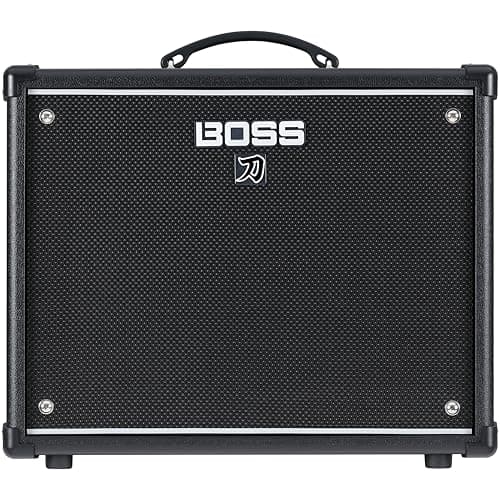 BOSS KATANA-50 GEN 3 Six amp characters and a four-position Power Control into a 12-inch speaker — with no effects loop and no line out. | One amp that works at 0.5 W and at rehearsal volume |
Rows link to the full write-up further down this page. Prices come from the live price layer only — where there is no live figure the button reads “Check price” rather than showing a remembered number.
03What a published 0.5 W setting is actually worth
Most amps that claim to be usable at home offer a master volume, which reduces level after the preamp and leaves the power section idling. A power control reduces the output stage itself, so the relationship between the controls and the sound stays the same as you turn it down.
The arithmetic makes the size of the step obvious. A change in level in decibels is ten times the base-ten logarithm of the power ratio, so 50 W down to 0.5 W is ten times the log of one hundredth — a 20 dB reduction. Roughly 10 dB reads as half as loud, so 20 dB is somewhere near a quarter of the perceived volume, from the same amp with the same settings. That is the largest published step of any amp on this site. Amp wattage and volume works the arithmetic through in full.
BOSS KATANA-50 GEN 3
One amp that works at 0.5 W and at rehearsal volume
The number50 W rated, 47 W consumption, 11.6 kg, 1 M ohm input. All published by BOSS.
The Power Control is the feature that makes this one amp rather than two. BOSS publishes four positions — Standby, 0.5 W, Half and Max — and that is an output-stage reduction rather than a master volume, so the amp behaves the same way at bedroom level as it does at rehearsal. A published 0.5 W setting is worth far more than a vague promise of reduced output.
The rest is documented in full: 50 W into a 30 cm (12-inch) speaker, six amp characters — Acoustic, Clean, Pushed, Crunch, Lead and Brown — each with a selectable variation that BOSS counts as 12 tones, five simultaneous effects sections with three variations each, a Power Amp In jack, 47 W consumption and 11.6 kg.
The cons are two missing jacks and a box that is emptier than you expect. There is no effects loop, so time-based pedals sit in front of the preamp. There is no line or Rec Out at all — the only ways off the amp are the Stereo Phones jack and USB-C, so a sound engineer gets nothing without a microphone. And the footswitch, the expression pedal and the Bluetooth adaptor are all sold separately; the box holds the amp, a manual and a power cord.
| Rated power output | 50 W |
|---|---|
| Speaker | 30 cm (12") x 1 |
| Amp characters | Six — Acoustic, Clean, Pushed, Crunch, Lead and Brown — each with one selectable variation, which BOSS counts as 12 tones |
| Effects | Five simultaneous sections — Booster, Mod, FX, Delay and Reverb — with three variations each |
| Power Control | Standby, 0.5 W, Half and Max |
| Input impedance | INPUT -10 dBu (1 M ohm); AUX IN -10 dBu (20 k ohm) |
| Connectors | Input, Power Amp In, Stereo Phones, CTL CH1/CH2 SOLO (TRS), Exp Pedal (TRS), Aux In, USB-C and a Bluetooth adaptor slot |
| Power consumption | 47 W |
| Size / weight | 470 x 238 x 398 mm, 11.6 kg (25 lb 10 oz) |
| What it does not do | No effects loop and no line or Rec Out — the KATANA-100 GEN 3 has both, and on the 50 the only way off the amp is the Stereo Phones jack or USB-C. Nothing but the manual and a power cord is in the box: the FS-5L, FS-6 and FS-7 footswitches, the expression pedals and the BT-DUAL Bluetooth adaptor are all sold separately. |
Specs from BOSS KATANA-50 GEN 3 specifications. We have not used this unit.
04The two missing jacks, and who they matter to
No effects loop. If your distortion comes from the amp's own characters, a delay or reverb pedal in front of it is being fed into a distorting preamp, which smears distinct repeats into a wash. If your distortion comes from pedals into a clean character, the delay is already after the distortion and the loop solves a problem you do not have. Which camp you are in decides whether this matters at all — pedal order covers the mechanism.
No line or Rec Out. This is the one that surprises people, because the Gen 3's larger sibling has one. The only outputs are Stereo Phones and USB-C, so getting this amp to a PA means a microphone in front of it. For bedroom and rehearsal use that is irrelevant; for anyone gigging into a desk it is decisive, and the KATANA-100 GEN 3 publishes both a Line Out and Send/Return. Best gigging amps covers what a stage actually requires.
05What is genuinely included, and what is not
- Included: the amp, an owner's manual and a power cord. That is the published list.
- Sold separately: footswitches (FS-5L, FS-6, FS-7). Without one you are changing channels by hand.
- Sold separately: expression pedals (EV-5, EV-30, FV-500L, FV-500H).
- Sold separately: the BT-DUAL Bluetooth Audio MIDI adaptor. The slot is there; the adaptor is not.
- Not available at all: an effects loop or a line out. No accessory adds these.
06Who should buy something else
- You gig into a PA. No line out. The 100 Gen 3 has one, and so does most of best gigging amps.
- Your distortion comes from the amp and you use delay. No effects loop, so the repeats get distorted.
- You want a valve power section. This is solid state with modeling — tube vs solid state covers what that actually changes.
- You only ever play at a desk with headphones. You are paying for a 12-inch speaker you are not using — practice amp vs audio interface covers that decision.
- You want deep editing from the front panel. The panel is the surface; BOSS Tone Studio on a computer is where the rest lives.
07Who should buy it
Someone who needs one amp to cover a flat, a rehearsal room and the occasional mic'd stage, and who runs pedals into a clean channel. The Power Control solves the volume problem honestly, the 12-inch speaker means it does not run out the moment a drummer starts, and the six characters mean you are not buying a drive pedal on day one.
It is also a strong pedal platform for its price, because the Power Amp In jack bypasses the preamp entirely for a modeler and the Acoustic character is in practice the flattest clean voice on the amp. Best pedal platform amps covers what that job needs, and best guitar amps puts it against the rest of the category.
Frequently asked questions
+ Does the Katana-50 Gen 3 have an effects loop?
+ Can I plug the Katana-50 Gen 3 into a PA?
+ How quiet does the Power Control make it?
+ Is the footswitch included?
Sources
Related on Fret & Fuzz
Best guitar amps
Wattage, speaker, tubes and power reduction — the four published figures that decide an amp, with five amps compared on them.
Best Amp Overall pick: BOSS KATANA-50 GEN 3
Best practice amps
Speaker size sets the ceiling and the headphone output decides the rest. Four practice amps on published specs.
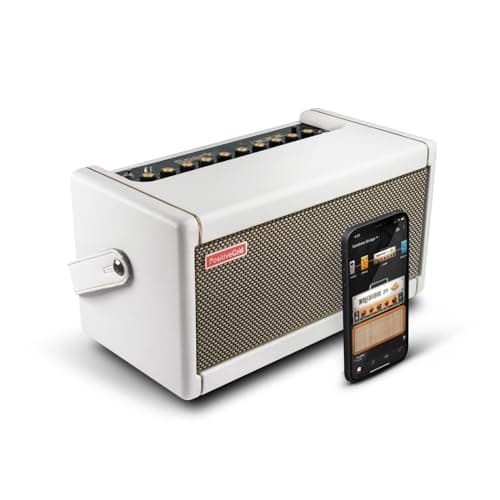
Best Practice Amp pick: Positive Grid Spark 40

Best pedal platform amps
Headroom, not gain. Why solid state is genuinely competitive here, and which amps have the jacks that matter.
Best Pedal Platform pick: BOSS KATANA-50 GEN 3
Amp wattage and volume
Halving the watts costs 3 dB. A perceived halving needs a tenth of the power. The table that settles it.
Top pick: BOSS KATANA-50 GEN 3
Best gigging amps
Headroom, an effects loop, a way out to the PA and a weight you will still accept at 1 a.m. Five picks, plus the amp not to gig with.
Best Gigging Amp pick: BOSS KATANA-100 GEN 3
#ad How we’re funded · price as of October 18, 2026