BOSS overdrive compared: BD-2 vs SD-1 vs OD-3
Three pedals from one maker that are frequently assumed to be the same circuit at three price points. They are not.
Fret & Fuzz earns a commission when you buy through the links on this page. It costs you nothing and it does not decide what we rank. How we’re funded.
We have not played this gear. Every pick below is chosen from published manufacturer specifications and the arithmetic set out in how we research, which you can re-run yourself.
They are three different circuits, not three price points. The SD-1 uses BOSS's asymmetrical clipping and is mid-forward — buy it to tighten an amp that is already breaking up. The BD-2 gets its gain from discrete stages and stays flat and open — buy it when you like your amp's clean tone and want it roughened. The OD-3 has the most low end of the three — buy it if your rig is bright or thin.
The assumption that a maker's three overdrives are a good/better/best ladder is reasonable and, here, wrong. BOSS publishes enough to show it.
01What BOSS publishes, side by side
| BD-2 Blues Driver | SD-1 Super OverDrive | OD-3 OverDrive | |
|---|---|---|---|
| Gain structure | Discrete gain stages | Asymmetrical clipping circuit | Not published |
| Mid response | Flat | Pronounced hump | Fuller, more low end |
| Input impedance | 1 M ohm | 1 M ohm | 1 M ohm |
| Output impedance | 1 k ohm | 1 k ohm | 1 k ohm |
| Current draw | 20 mA | 10 mA | 15 mA |
| Battery life | Not published | Approx. 60 h carbon / 90 h alkaline | Approx. 34.5 h carbon / 56 h alkaline |
| Controls | Gain, Tone, Level | Drive, Tone, Level | Level, Tone, Drive |
| Bypass | Buffered | Buffered | Buffered |
BOSS publishes a full sheet for all three of these. Where a cell says not published, that is what the manufacturer states — we have not substituted a figure from elsewhere.
All three can be budgeted exactly, and the figures are much closer together than the voicings are: 10 mA for the SD-1, 15 mA for the OD-3, 20 mA for the BD-2. On any supply that spread is a rounding error, so current draw is not a reason to choose between these three — which is worth knowing, because it genuinely is the deciding figure in other categories.
02Which one your amp wants
- Your amp is already distorting and sounds loose. SD-1. The mid hump and reduced bass are what tighten it.
- Your amp has a clean tone you like. BD-2. It adds grit without imposing an EQ curve.
- Your amp or guitar is bright or thin. OD-3. It has the most low end of the three.
- You want a lead boost that cuts through a band. SD-1, with the Drive low and the Level high. Being audible is a midrange problem, not a volume one.
- You want heavy distortion. None of them. See best distortion pedals.
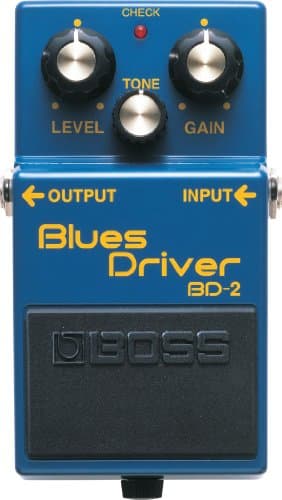
BOSS BD-2 Blues Driver
An amp whose clean tone you already like
The number1 M ohm in, 1 k ohm out, 20 mA — the highest draw of the three and still trivial.
The Blues Driver is the odd one out in this group and the reason the group is worth comparing. Its gain comes from discrete stages rather than from clipping diodes inside an op-amp's feedback loop, so the frequency response stays flat through the mids and the top end stays open.
The practical consequence is dynamic range. It responds to how hard you pick and it cleans up substantially when you roll the guitar volume back — more so than either of the other two here.
The cons: no mid hump, so it is a poor lead boost, and it will not tighten a loose overdriven amp because it does not cut the bass that causes the problem. At 20 mA it also draws twice what the SD-1 does, which matters only on a very tight supply.
| Controls | Gain, Tone, Level, pedal switch |
|---|---|
| Input impedance | 1 M ohm |
| Output impedance | 1 k ohm |
| Current draw | 20 mA |
| Power | 9 V battery (6F22 / 6LR61) or PSA-series adaptor |
| Size / weight | 73 x 129 x 59 mm, 360 g |
| What it does not do | No adaptor in the box, no true bypass, and no mid control. The BD-2 is deliberately flat through the mids — if you want a mid hump to push a solo, this is the wrong pedal. |
Specs from BOSS BD-2 specifications. We have not used this unit.
#ad How we’re funded · price as of October 21, 2026
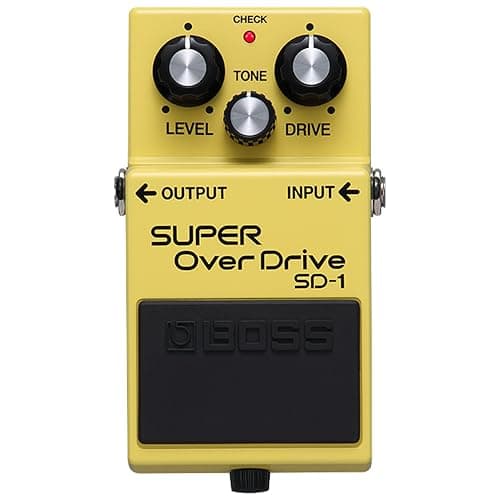
BOSS SD-1 Super Overdrive
Pushing an amp that is already breaking up
The number10 mA, and 60-90 hours of battery life. The lowest draw of the three.
BOSS describes an asymmetrical clipping circuit, which means the positive and negative halves of the waveform are treated differently and the result contains even-order harmonics a symmetrical circuit does not produce. Whether you hear that as warmth is subjective; that the circuit differs is not.
It shares the Tube Screamer's mid-forward shape while being noticeably less compressed, which makes it the most useful of the three as a stacking pedal in front of another drive or a dirty amp channel.
The cons: it is not transparent and does not pretend to be — the mid hump is the whole point, so it will not sit invisibly under a clean amp. Like all three, no adaptor is included and it is buffered rather than true bypass.
| Controls | Drive, Tone, Level, pedal switch |
|---|---|
| Clipping | BOSS describes an asymmetrical clipping circuit |
| Input impedance | 1 M ohm |
| Output impedance | 1 k ohm |
| Current draw | 10 mA |
| Battery life | Approx. 60 h carbon-zinc, approx. 90 h alkaline |
| Size / weight | 73 x 129 x 59 mm, 360 g |
| What it does not do | No adaptor included and no true bypass. It is not a transparent overdrive — the mid hump is the whole point, so it will not sit invisibly under a clean amp. |
Specs from BOSS SD-1 specifications. We have not used this unit.
#ad How we’re funded · price as of October 21, 2026
BOSS OD-3 OverDrive
More low end than the other two
The OD-3 sits between the other two in character and above both in low-end content. On a bright amp or a thin-sounding single-coil guitar that extra weight is exactly what is missing, and it is the most immediately satisfying of the three on its own.
It is the least specialized of the group: it neither stays out of the way like the BD-2 nor focuses the mids like the SD-1. For a player who wants one drive pedal that sounds good without thinking about it, that is a feature.
The cons are about voice rather than specification. BOSS publishes the full sheet for this pedal — 15 mA, 1 M ohm in, 1 k ohm out, 370 g — so there is nothing to guess at when you plan a board around it. The real con is the low end itself: the extra weight that rescues a bright rig is the same weight that turns a humbucker into an already-dark amp to mush. It is also buffered bypass with no way to switch that out, and no adaptor is included.
| Controls | Level, Tone, Drive, pedal switch |
|---|---|
| Input impedance | 1 M ohm |
| Output impedance | 1 k ohm, recommended load 10 k ohms or greater |
| Current draw | 15 mA |
| Battery life | Approx. 34.5 hours carbon-zinc, approx. 56 hours alkaline |
| Power | 9 V battery or PSA-series adaptor |
| Size / weight | 73 x 129 x 59 mm, 370 g including battery |
| What it does not do | No adaptor included, no true bypass. It has more low end than an SD-1, which is the reason to pick it and also the reason it can muddy a humbucker into an already-dark amp. |
Specs from BOSS OD-3 product page. We have not used this unit.
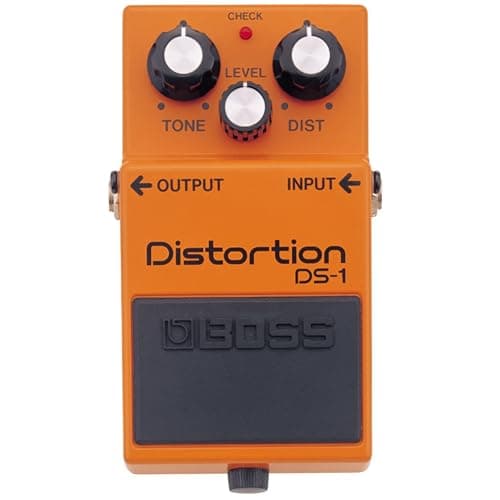
BOSS DS-1 Distortion
Not an overdrive, and cross-shopped as one constantly
We are not picking this one, because it is not in the category. The DS-1 is a distortion: diodes clip hard to ground, the result is consistent regardless of picking strength, and there is no low-gain setting where it behaves like an overdrive.
It sits in the same enclosure, at a similar price, on the same shop wall, which is why it lands on this shortlist. If what you want is grit on top of your amp's own sound, this is the wrong pedal and any of the three above is the right one.
If what you actually want is a distinct distortion voice, it is a genuinely good pedal with one design quirk worth knowing: the single Tone control scoops mids as it brightens. The distortion roundup covers it properly.
| Controls | Tone, Level, Dist, pedal switch |
|---|---|
| Input impedance | 1 M ohm |
| Output impedance | 1 k ohm |
| Current draw | 10 mA |
| Power | 9 V battery (6F22 / 6LR61) or PSA-series adaptor |
| Size / weight | 73 x 129 x 59 mm, 360 g |
| What it does not do | No adaptor included, no true bypass. The single Tone knob scoops as it brightens, so a DS-1 into an already-scooped amp is the classic recipe for disappearing in a band mix. |
Specs from BOSS DS-1 specifications. We have not used this unit.
03Stacking them
All three stack with each other and one order works better than the rest: BD-2 into SD-1. The Blues Driver supplies a full-range dirty signal and the SD-1 then focuses it, which is the same logic as a transparent drive into a mid-humped one. Reversed, the BD-2 has an already-narrowed signal to work with and mostly just adds level.
Two mid-humped pedals in series — SD-1 into a Tube Screamer, for instance — mostly compounds the hump and adds noise. Best overdrive pedals covers the four circuit families and which combinations are worth trying.
04The thing all three share
Buffered bypass, a five-year warranty, a die-cast enclosure and a switch mechanism that outlasts the guitar. That consistency is the actual reason these pedals have survived four decades of competition, and it is worth more on a gigging board than any tonal difference between them.
It also means all three are always in your signal path when switched off. On most boards that is helpful. In front of a vintage-style fuzz it is the thing that stops the fuzz cleaning up — see fuzz and buffers.
Frequently asked questions
+ What is the difference between the BOSS SD-1 and BD-2?
+ Which BOSS overdrive is best for a clean amp?
+ Is the DS-1 an overdrive?
+ Can I stack two BOSS overdrives?
Sources
Related on Fret & Fuzz
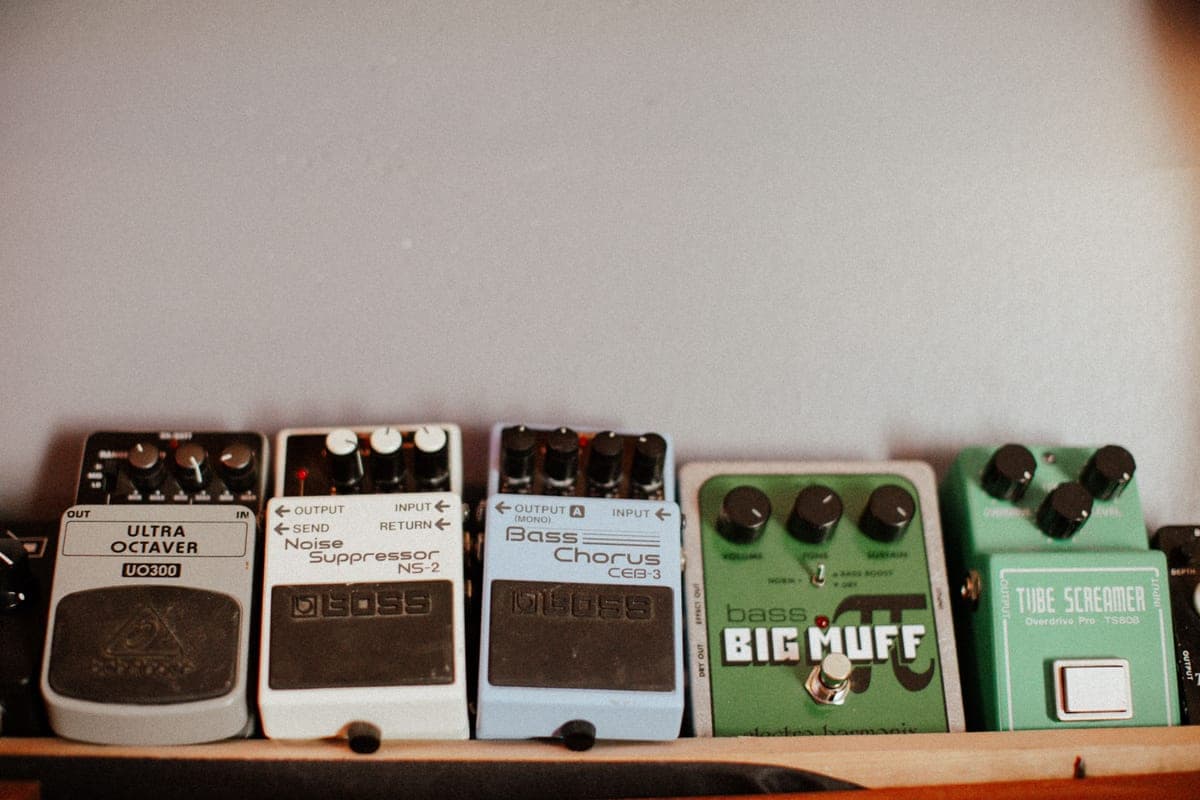
Best overdrive pedals
Six overdrives sorted by circuit family, with the published clipping topology and impedance figures that separate them.
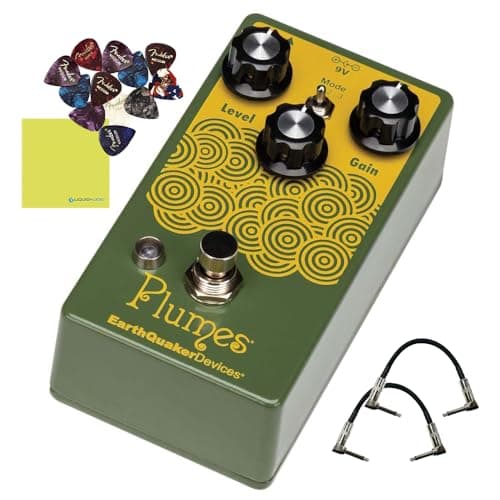
Best Overdrive pick: EarthQuaker Devices Plumes
Tube Screamer vs Blues Driver
Mid hump versus flat response, with both spec sheets side by side and a straight answer about which your amp wants.
Top pick: BOSS BD-2 Blues Driver
#ad How we’re funded · price as of October 21, 2026
Fulltone OCD vs BOSS Blues Driver
A modifier against a source. One roughens an amp you like; the other supplies the whole tone on a clean one.
Top pick: BOSS BD-2 Blues Driver
#ad How we’re funded · price as of October 21, 2026
Overdrive vs distortion vs fuzz
How hard, how symmetrically, and with what EQ around it. The real distinctions, and why the box labels are unreliable.
Top pick: BOSS BD-2 Blues Driver
#ad How we’re funded · price as of October 21, 2026