Best distortion pedals
Distortion is the most predictable dirt category — it clips hard, it does not care much what is in front of it, and the EQ section is where the pedals differ.
Fret & Fuzz earns a commission when you buy through the links on this page. It costs you nothing and it does not decide what we rank. How we’re funded.
We have not played this gear. Every pick below is chosen from published manufacturer specifications and the arithmetic set out in how we research, which you can re-run yourself.
Distortion clips hard and to ground, which produces a consistent, compressed result that does not depend much on what precedes it. That makes it the easiest dirt category to shop for: pick on how much EQ you get and how the tone control behaves, because the clipping is going to be predictable either way.
The distinction from overdrive is not a hard line and the labels are unreliable — the Fulltone OCD is filed as an overdrive and behaves like a distortion, while the RAT is filed as a distortion and is more articulate than most things wearing that label. Overdrive vs distortion vs fuzz works through where the boundaries actually sit.
Best distortion pedals
| # | Product | Best for | Price |
|---|---|---|---|
| 01 | 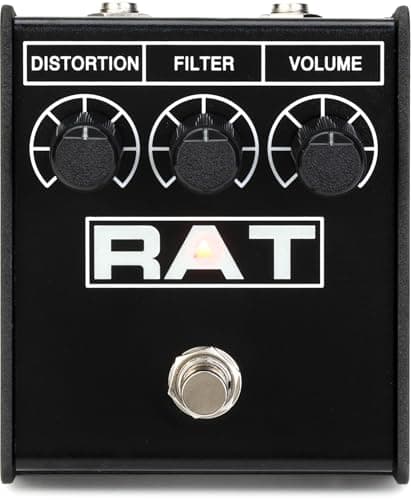 Pro Co RAT 2 Hard clipping to ground with a low-pass Filter, which is the right control for a circuit that generates this much harmonic content. | The most useful distortion voice on this page | $86.00 · Check price #ad How we’re funded · price as of October 18, 2026 |
| 02 | 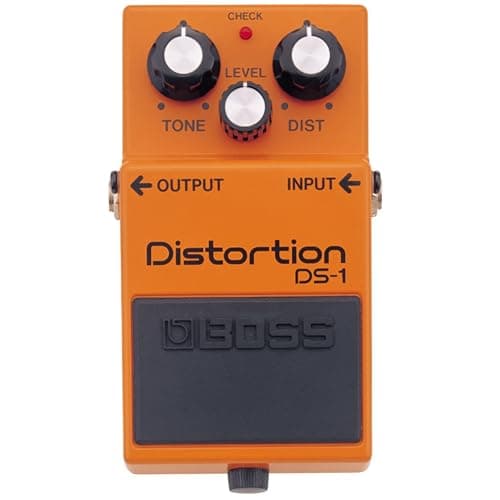 BOSS DS-1 Distortion 10 mA, a full published spec sheet, and a switch that will outlive the guitar. | The benchmark for what a cheap pedal should be | |
| 03 | 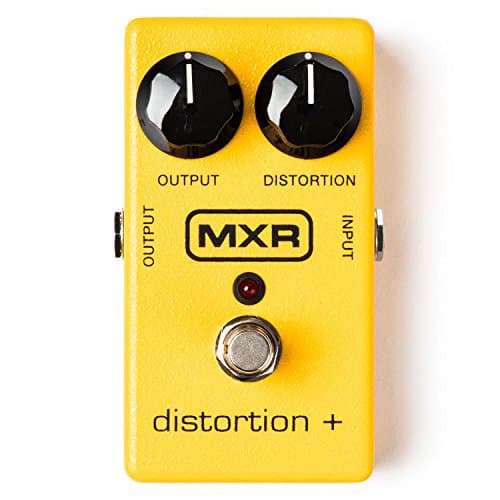 MXR Distortion+ Two knobs, germanium diodes to ground, and no way to shape what comes out. | Germanium clipping with no tone control at all | $99.99 · Check price #ad How we’re funded · price as of October 18, 2026 |
| 04 | 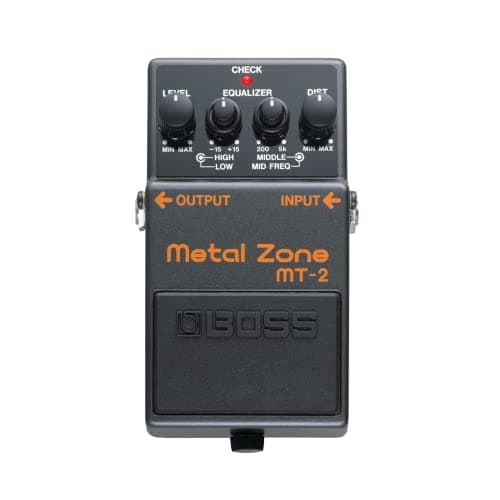 BOSS MT-2 Metal Zone Three bands plus a sweepable mid frequency — the control most owners never touch. | The most EQ on any compact distortion | $108.99 · Check price #ad How we’re funded · price as of October 18, 2026 |
| ! | 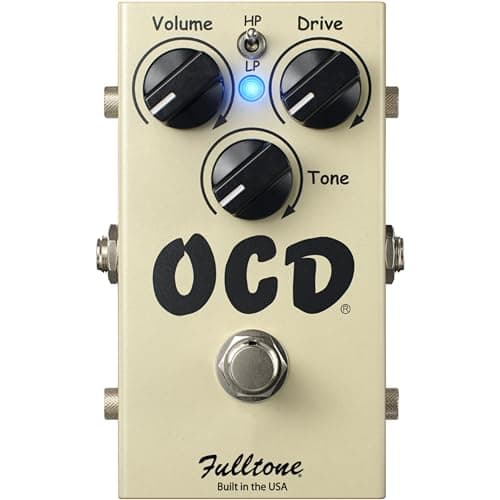 Fulltone OCD Obsessive Compulsive Drive A capable amp-voiced circuit that gets bought by people who wanted one of the two things it sits between. Skip this one — see why below | Not a distortion, and not an overdrive either |
Rows link to the full write-up further down this page. Prices come from the live price layer only — where there is no live figure the button reads “Check price” rather than showing a remembered number.
02How the tone controls differ, and why it matters most here
| Pedal | Tone control | What it does |
|---|---|---|
| Pro Co RAT 2 | Filter (low-pass) | Turning it UP removes treble. Choose how much top end survives |
| BOSS DS-1 | Tone (tilt with a mid dip) | Turning it up adds treble and scoops mids together |
| MXR Distortion+ | None | Output and Distortion only — shape it at the amp |
| BOSS MT-2 | High / Low / Middle / Middle Freq | Full three-band with a sweepable mid — the most control here |
Hard clipping generates a lot of high-order harmonic content. What the tone control does with that content is the practical difference between these pedals.
03Distortion pedal or amp gain channel
A distortion pedal clips at one point and then feeds the result into whatever the amp does next. An amp's gain channel distorts across a whole preamp with the amp's own EQ interleaved between stages. That is a structural difference and it is audible: pedal distortion into a clean amp tends to sound flatter and more one-dimensional at high gain.
It is not a verdict against pedals — plenty of records are pedal distortion into a clean amp, and a pedal is vastly cheaper and more portable than a second amp. But if your distorted tone feels thin no matter what you do to the pedal, this is the difference you are hearing, and pedal gain vs amp gain covers it properly.
Pro Co RAT 2
The most useful distortion voice on this page
The RAT sits between an overdrive and a fuzz: harder and more compressed than a Tube Screamer, far more articulate than a Muff. That middle position is why it turns up on records in genres that share nothing else.
The Filter control is a low-pass filter — turning it up removes treble. It confuses everyone once and then becomes the reason people keep the pedal, because choosing how much high-order harmonic content survives is more useful than boosting what is left.
Pro Co publishes very little electrical data. What you can plan around is a 9 V battery or a standard 9 V DC supply, in a steel enclosure with a tool-free battery compartment.
| Controls | Distortion, Filter, Volume |
|---|---|
| Filter control | Runs backwards from a normal tone knob — turning it up removes treble |
| Power | 9 V battery or a 9 V DC supply (adapter sold separately) |
| Enclosure | Steel, with the battery compartment accessible without tools |
| Electrical data | No current-draw or impedance figure is published for this pedal, so none is stated here. |
| What it does not do | No power supply included. There is no clean-boost side to it — at low Distortion the RAT is still a distortion, and the Filter control confuses everyone exactly once. |
Specs from Pro Co RAT 2 product page. We have not used this unit.
#ad How we’re funded · price as of October 18, 2026
BOSS DS-1 Distortion
The benchmark for what a cheap pedal should be
The number10 mA draw, 1 M ohm in, 1 k ohm out — published by BOSS.
The DS-1's reputation is worse than the pedal deserves, and the reason is one design decision: the single Tone control scoops as it brightens. Turn it up and you get treble and a mid dip. Into an already-scooped amp, that is how you disappear under a band.
Used with the Tone low and an EQ after it, it is a capable, tight distortion at a price nothing else matches on build quality. BOSS publishes the impedance figures, the current draw and the dimensions, which is more than most makers in this category do.
At 10 mA it costs nothing to power and it will sit on a daisy chain with three other pedals without complaint.
| Controls | Tone, Level, Dist, pedal switch |
|---|---|
| Input impedance | 1 M ohm |
| Output impedance | 1 k ohm |
| Current draw | 10 mA |
| Power | 9 V battery (6F22 / 6LR61) or PSA-series adaptor |
| Size / weight | 73 x 129 x 59 mm, 360 g |
| What it does not do | No adaptor included, no true bypass. The single Tone knob scoops as it brightens, so a DS-1 into an already-scooped amp is the classic recipe for disappearing in a band mix. |
Specs from BOSS DS-1 specifications. We have not used this unit.
MXR Distortion+
Germanium clipping with no tone control at all
Output and Distortion. That is the entire interface, and the absence of a tone control is a design position rather than an omission — you shape it at the amp or you do not shape it.
Germanium diode clipping is softer at the clipping threshold than silicon, which gives it a slightly rounder edge than the RAT's.
Dunlop publishes no electrical figures for it. It runs from a 9 V battery, a Dunlop ECB003 adapter or any standard supply, and that is the extent of what can be planned from published data.
| Controls | Output, Distortion |
|---|---|
| Clipping | Germanium diode clipping to ground |
| Power | 9 V battery, Dunlop ECB003 adapter, or a DC Brick / Iso-Brick supply |
| Electrical data | No current-draw or impedance figure is published for this pedal, so none is stated here. |
| What it does not do | There is no tone control at all. What comes out is what the circuit does — you shape it at the amp or not at all. |
Specs from MXR Distortion+ product page. We have not used this unit.
#ad How we’re funded · price as of October 18, 2026
BOSS MT-2 Metal Zone
The most EQ on any compact distortion
The MT-2 has more tone-shaping than any other BOSS compact dirt pedal: High, Low, Middle and a Middle Freq control that sweeps where that mid band sits. That is a parametric mid on a pedal at this price.
Used with the mids scooped at the factory setting, it is the pedal that vanishes the moment a bass player starts. Used with the Middle Freq swept to find what the amp is missing, it is genuinely versatile.
If you were going to leave the EQ flat, buy a DS-1 and save the money. The EQ is the pedal.
| Controls | Level, High, Low, Middle, Middle Freq (parametric), Dist |
|---|---|
| EQ | Three-band with a sweepable mid frequency — the most EQ on any BOSS compact dirt pedal |
| Power | 9 V battery or PSA-series adaptor |
| Electrical data | No current-draw or impedance figure is published for this pedal, so none is stated here. |
| What it does not do | No adaptor included. The factory mid-scooped setting is the one everybody hears and nobody should use — the parametric mid is the reason to own it, not an extra. |
Specs from BOSS MT-2 product page. We have not used this unit.
#ad How we’re funded · price as of October 18, 2026
Fulltone OCD Obsessive Compulsive Drive
Not a distortion, and not an overdrive either
We are not picking this one in a distortion roundup, and the reason is a labeling problem rather than a quality one. The OCD is sold as an overdrive, behaves like a distortion past halfway, and does neither job in the way someone shopping for a category expects.
If you want amp-like breakup that responds to your picking, it is excellent and it belongs in the overdrive roundup. If you want a consistent, controllable distortion voice, the RAT above does that better.
The HP/LP switch is a real circuit change rather than an EQ preset, and it is the feature worth the money. OCD vs RAT is the head-to-head.
| Controls | Volume, Drive, Tone, HP/LP toggle |
|---|---|
| HP/LP switch | Two voicings: LP with less low-mid emphasis, HP with more gain and upper-mid push |
| Input impedance | 1 M ohm on the v2, which Fulltone states was raised from 330 k on the previous version |
| Input section | Fulltone states a Class A configured discrete 2N5457 JFET input section |
| Bypass | An internal switch selects Fulltone's Enhanced Bypass or true bypass, which Fulltone states pops in neither mode; the v2 also adds an output buffer |
| Versions | Fulltone states that OCDs from serial 205811 upward are the newer, less compressed versions |
| Power | 9 V DC center-negative; Fulltone documents internal operation at a higher rail |
| Current draw | Not published by Fulltone |
| What it does not do | No power supply included, and Fulltone publishes no current-draw figure, so a shared supply output cannot be budgeted for it without measuring. It is not a subtle pedal at high Drive — past about two o'clock it behaves more like a distortion than an overdrive, and it will not clean up the way a Tube Screamer does. |
Specs from Fulltone OCDv2 product page. We have not used this unit.
04Stacking distortion
Two distortion pedals in series is almost always worse than one. Both compress, so the second one is clipping a signal that has already lost its dynamic range, and the result is flat and noisy rather than more aggressive.
What does work: a low-gain drive or a clean boost in front of the distortion, which pushes it into more saturation without adding a second clipping stage. And an EQ after it, which shapes the result without touching the clipping at all.
05The noise problem
Every pedal here amplifies its input by a large factor and cannot distinguish your note from the hum in the room. At high gain settings that residual noise is loud enough to matter between phrases, and the only pedalboard fix is a gate. The BOSS NS-2's send/return loop is the configuration that works, because it lets the gate decide from your clean signal rather than from the distorted one. If your shortlist has come down to the two pedals in this category people cross-shop most, Big Muff vs DS-1 compares them on clipping structure, sustain and chord definition. If it has come down to the two hard-clipping pedals instead, DS-1 vs RAT turns on which tone control scoops your midrange and which one cannot. DS-1 vs Metal Zone is that argument worked through on the two pedals it applies to most. DS-1 vs MXR Distortion+ runs the same pedal against a classic with no tone control at all.
Frequently asked questions
+ What is the best distortion pedal?
+ Why does the DS-1 get criticized so much?
+ Is distortion or overdrive better for metal?
+ Do I need a distortion pedal if my amp has a gain channel?
Sources
Related on Fret & Fuzz
BOSS DS-1 vs MXR Distortion+
Three knobs and a full spec sheet against two knobs and no tone control at all. Both still in production.
Top pick: BOSS DS-1 Distortion
BOSS DS-1 vs Pro Co RAT 2
Both clip hard. One control removes treble and one removes mids, and that is the whole difference in a band.
Top pick: Pro Co RAT 2
#ad How we’re funded · price as of October 18, 2026

BOSS DS-1 vs MT-2 Metal Zone
The same reputation problem and opposite amounts of control over it. One tone knob against a sweepable parametric mid.
Top pick: BOSS DS-1 Distortion
Big Muff vs BOSS DS-1
Cascaded clipping against one hard-clipping stage — and the mid scoop they both have, for different reasons.
Top pick: BOSS DS-1 Distortion
Fulltone OCD vs Pro Co RAT
Two pedals that are both further into distortion than their labels admit, and the backwards tone control that confuses everyone once.
Top pick: Fulltone OCD Obsessive Compulsive Drive
Overdrive vs distortion vs fuzz
How hard, how symmetrically, and with what EQ around it. The real distinctions, and why the box labels are unreliable.
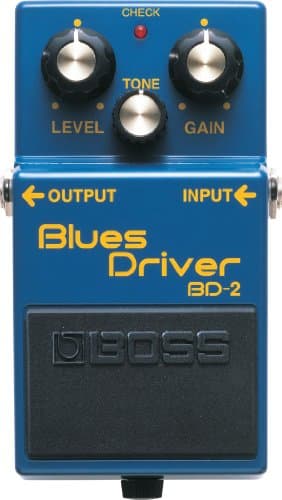
Top pick: BOSS BD-2 Blues Driver
#ad How we’re funded · price as of October 18, 2026
Best guitar pedals for metal
The gate matters more than the distortion pedal. Picks judged on gate topology, EQ resolution and published current draw.
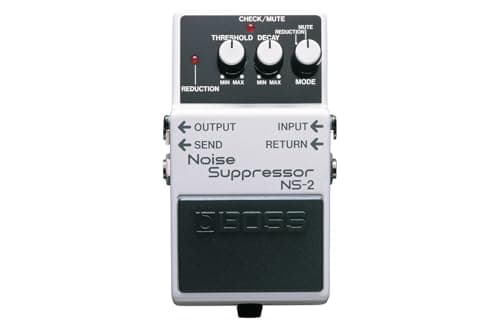
Best for Metal pick: BOSS NS-2 Noise Suppressor
#ad How we’re funded · price as of October 18, 2026
Best noise gate pedals
Which signal the gate listens to is the entire specification. Three gates compared, and the wiring that makes one of them work.
Best Noise Gate pick: BOSS NS-2 Noise Suppressor
#ad How we’re funded · price as of October 18, 2026