Pedal tuner vs clip-on tuner
The first pedal almost everyone is told to buy, against the twenty-five-dollar thing that is exactly as accurate.
Fret & Fuzz earns a commission when you buy through the links on this page. It costs you nothing and it does not decide what we rank. How we’re funded.
We have not played this gear. Every pick below is chosen from published manufacturer specifications and the arithmetic set out in how we research, which you can re-run yourself.
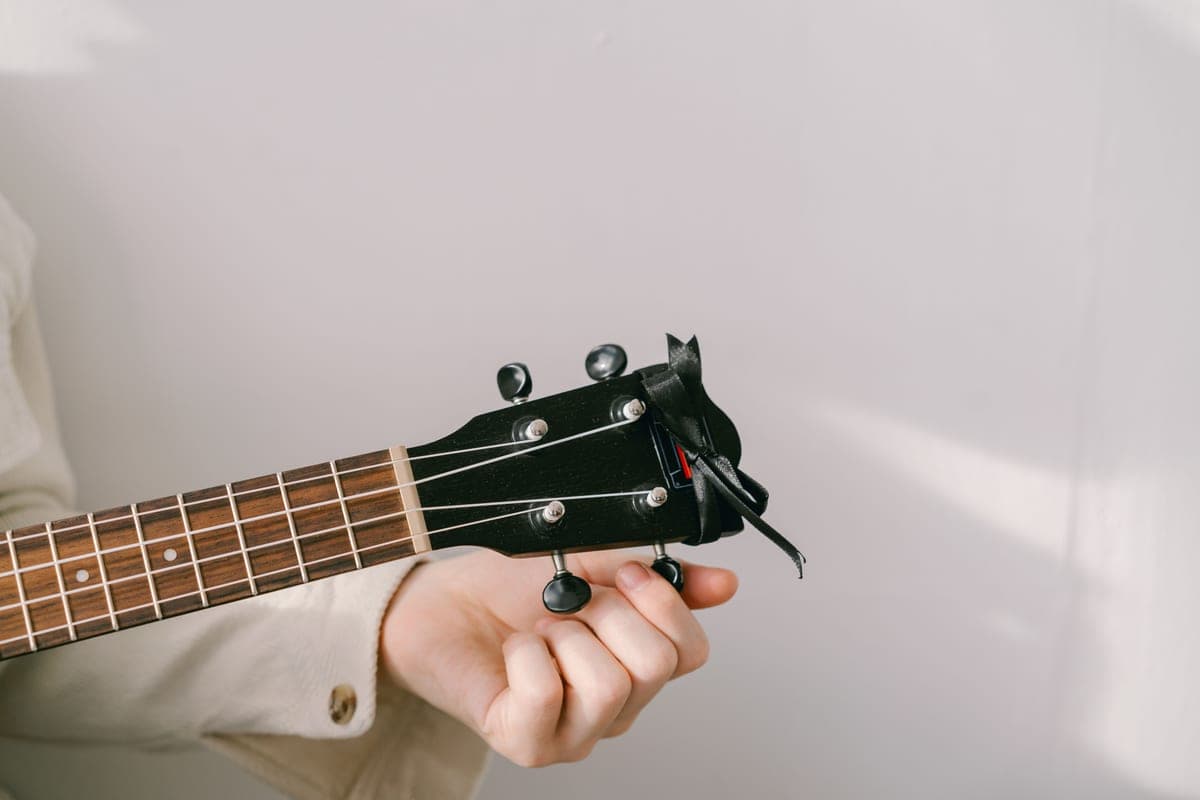
BOSS publishes +/- 1 cent accuracy for both its clip-on and its pedal tuner, so accuracy is not what separates them. A pedal tuner buys you three things: a mute so you can retune silently in front of people, a buffer for a long cable run, and on the TU-3 a DC output that powers other pedals. If you play at home, a clip-on does the job for a fraction of the money and we would rather you kept the difference.
This site recommends a tuner as the first pedal to buy more often than it recommends anything else. It is worth being straight about what the pedal version is actually for, because for a lot of readers the answer is that they do not need it yet.
01What each one publishes
| BOSS TU-02 (clip-on) | BOSS TU-3 (pedal) | |
|---|---|---|
| Accuracy | +/- 1 cent | +/- 1 cent |
| Tuning range | A0 (27.5 Hz) to C8 | C0 (16.35 Hz) to C8 |
| Modes | Chromatic, Guitar, Bass, Ukulele; flat to 2 semitones | Chromatic, Guitar, Bass; flat to 3 semitones on bass |
| Reference pitch | A4, 430-450 Hz | Not published in the same form |
| Mutes your output | No | Yes — the reason to buy it |
| Buffers your signal | No | Yes, always in circuit |
| Powers other pedals | No | Yes, via DC OUT |
| Power | One CR2032, approx. 24 hours | 9 V supply or battery; 20 mA (80 mA High Brightness) |
| Weight | 25 g | 390 g |
| How it hears you | Vibration through the headstock | Your cable signal |
Both figures come from BOSS's own published specification sheets for the two products.
Read the first row again, because it is the row that decides this. The accuracy figure is identical. Every argument for the pedal has to be made on the other rows, and all of them are about context rather than precision.
Which tuner do you actually need
| # | Product | Best for | Price |
|---|---|---|---|
| 01 | 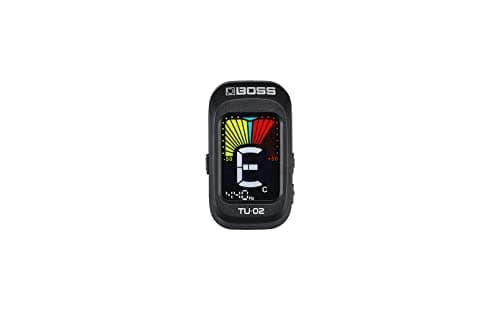 BOSS TU-02 Clip-On Tuner The same published +/- 1 cent as the pedal, at 25 g, with a battery that lasts about 24 hours. | Almost everyone who does not play in front of people | $24.49 · Check price #ad How we’re funded · price as of September 14, 2026 |
| 02 | 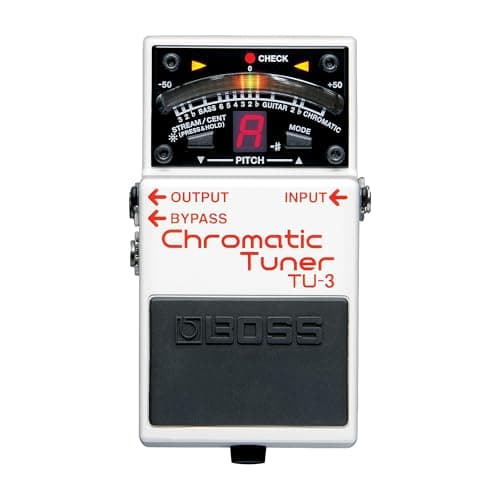 BOSS TU-3 Chromatic Tuner Mutes the output so you can retune silently — and buffers a long cable run and powers other pedals while it is there. | Playing in front of people, or a board that needs a buffer |
Rows link to the full write-up further down this page. Prices come from the live price layer only — where there is no live figure the button reads “Check price” rather than showing a remembered number.
03What the mute is actually worth
Everything. On a stage, tuning audibly between songs is the one mistake every person in the room notices, and it is entirely avoidable for the price of a pedal. If you play live at all — even at an open mic — this is not a close decision.
It also matters in a rehearsal room, where four people tuning audibly at once is the reason nobody can hear themselves. And it matters in a studio, where a clip-on cannot help you at all if you are tuning a DI'd or re-amped signal, because there is no headstock in the signal path.
BOSS TU-02 Clip-On Tuner
Almost everyone who does not play in front of people
The number+/- 1 cent, A0 (27.5 Hz) to C8, 7.5 mA, 25 g. All published by BOSS.
This is the honest first recommendation, and we are making it knowing it is the cheaper product. BOSS publishes +/- 1 cent accuracy for this clip-on, which is the identical figure they publish for the TU-3 pedal tuner. You are not buying accuracy when you step up — that part is already solved.
The rest is documented too: chromatic, guitar, bass and ukulele modes with flat tuning down to two semitones, a reference pitch adjustable from 430 to 450 Hz, a backlit color LCD, and roughly 24 hours of continuous use from one CR2032. It weighs 25 g and it lives in the case pocket rather than on a board.
The cons are real and they are the whole argument for the other pedal. It cannot mute your signal, so tuning is audible to whoever is in the room. It reads vibration through the headstock rather than your cable, so it is useless for tuning a silent or direct rig. There is no buffer and no DC output to power anything else. And it reads the loudest vibration it can find, which on a noisy stage can be the bass player.
| Modes | Chromatic, Guitar, Bass and Ukulele, with flat tuning down to 2 semitones |
|---|---|
| Accuracy | +/- 1 cent — the same figure BOSS publishes for the TU-3 pedal tuner |
| Tuning range | A0 (27.5 Hz) to C8 (4,186.0 Hz) |
| Reference pitch | A4 adjustable from 430 to 450 Hz |
| Display | Backlit color LCD |
| Power | One CR2032 lithium battery; approximately 24 hours of continuous use |
| Current draw | 7.5 mA |
| Auto power off | Approximately 5 minutes |
| Size / weight | 28 x 38 x 50 mm, 25 g including battery |
| What it does not do | It cannot mute your signal, so tuning is audible to the room — the single thing a pedal tuner buys you. There is no buffer and no DC output to power other pedals, and it reads vibration through the headstock rather than your cable, so it is no use for tuning a silent or direct rig. |
Specs from BOSS TU-02 Clip-On Tuner specifications. We have not used this unit.
#ad How we’re funded · price as of September 14, 2026
BOSS TU-3 Chromatic Tuner
Playing in front of people, or a board that needs a buffer
The number+/- 1 cent, C0 (16.35 Hz) to C8, 20 mA (80 mA in High Brightness), 390 g.
The accuracy is the same. What you are paying for is the mute: press the switch and your output goes silent while the display stays live, so you can retune between songs without the audience hearing it. That is the entire reason a pedal tuner exists, and on a stage it is worth the whole price on its own.
Two secondary features come along with it. The buffered bypass drives a long cable run without losing top end, which matters on any board with real cable length. And the DC OUT jack will power a small number of other pedals from the same supply, which on a three-pedal board can remove the need for a separate brick entirely.
The cons: it is 390 g and takes a board slot, it needs power, and High Brightness mode quadruples the draw from 20 mA to 80 mA — easy to forget when budgeting a supply. The buffer is also always in circuit with no way to switch it out, which is a problem in exactly one situation: in front of a vintage-style fuzz. Fuzz and buffers covers why.
| Tuning range | C0 (16.35 Hz) to C8 (4,186 Hz) |
|---|---|
| Accuracy | +/- 1 cent |
| Modes | Chromatic, Chromatic flat x2, Guitar, Guitar flat x2, Bass, Bass flat x3 |
| Bypass | Buffered bypass |
| Current draw | 20 mA; 80 mA with High Brightness mode on |
| Jacks | Output, Bypass, DC IN, DC OUT (powers other pedals) |
| Weight | 390 g including battery |
| What it does not do | +/- 1 cent is fine for a stage tuner and not enough for setting intonation — that is strobe territory. Turning on High Brightness quadruples the current draw, which matters on a shared supply. |
Specs from BOSS TU-3 specifications. We have not used this unit.
04The two features people forget they are buying
The buffer. A long cable run loses high frequencies, and a buffer restores the ability to drive it. Because a tuner sits first in the chain and is on all the time, it is the natural place to put one — which is why so many tuners are buffered. On most boards that is a free improvement. In front of a vintage-style fuzz it is the thing that stops the fuzz cleaning up on your guitar volume, which is the one scenario where you want the buffer gone. Buffer vs true bypass covers the general case.
The DC OUT. The TU-3 will power a small number of other pedals from its own supply. On a three-pedal board that can mean you never buy a power brick at all, which quietly makes the pedal tuner cheaper than it looks. Power requirements explained has the method for working out whether your board fits.
05Which one to buy
- You play at home and nowhere else. Clip-on. Keep the difference and put it toward a drive pedal or a compressor — your first pedalboard sets out a sensible order.
- You play live, even occasionally. Pedal tuner. The mute alone justifies it and nothing else does the job.
- You rehearse with a band. Pedal tuner, for the same reason at lower stakes.
- You record direct, or play silently through headphones. Pedal tuner, because a clip-on cannot read a signal that has no vibrating instrument behind it.
- You already have a board and long cables. Pedal tuner, for the buffer as much as the mute.
- You need to set intonation. Neither of these. +/- 1 cent is a tuning-up figure; intonation work wants strobe accuracy — TU-3 vs PolyTune 3 covers a tuner that publishes +/- 0.02 cent.
06Buy both, actually
This is what a lot of working players end up doing, and it is not indecision. The clip-on lives in the case and costs almost nothing, so it is the tuner you have when you are on a sofa, when the board is not out, or when the pedal tuner has developed a fault an hour before a show.
At 25 g and the price of a set of strings, a spare tuner that needs no cable and no power supply is a reasonable thing to own even when you already have a better one bolted to a board. The pedal is the primary; the clip-on is the one that is always there.
07What neither of them fixes
Tuning that does not hold. If the guitar drifts within a song, the cause is the nut, the strings, the bridge or a temperature change — not the tuner. A more accurate tuner measures the problem more precisely without changing it, and buying a second tuner to solve it is the most common wasted purchase in this category.
Nor does either one make you sound in tune with a band. Both tune to equal temperament against a reference pitch, and if the keyboard player is at A4 = 442 Hz and you are at 440 Hz you are both perfectly in tune and audibly wrong together. The TU-02 publishes a 430-450 Hz adjustment range for exactly that situation. The tuner roundup covers the rest of the category.
Frequently asked questions
+ Is a pedal tuner more accurate than a clip-on?
+ Do I need a pedal tuner if I only play at home?
+ Can a clip-on tuner tune an electric guitar?
+ Why does my clip-on tuner jump around on stage?
Sources
Related on Fret & Fuzz
Best tuner pedals
Published accuracy from +/- 1 cent to +/- 0.02 cent, the buffer trade-off, and the tuner that quietly draws 100 mA.
Best Tuner pick: TC Electronic PolyTune 3
BOSS TU-3 vs TC Electronic PolyTune 3
20 mA against 100 mA, and a buffer you can switch out against one you cannot. Neither difference is the accuracy figure.
Top pick: BOSS TU-3 Chromatic Tuner
Buffer vs true bypass
A trade-off, not an upgrade. What a buffer fixes, when it hurts, and a five-question rule for deciding.
Top pick: BOSS TU-3 Chromatic Tuner
Your first pedalboard
Four pedals, a supply and a board, in the order that makes each one useful — and what to leave until later.
Best First Board pick: BOSS TU-3 Chromatic Tuner
Pedalboard power requirements explained
Two sums decide your power supply, and almost everyone only does the first. A worked example with real published figures.
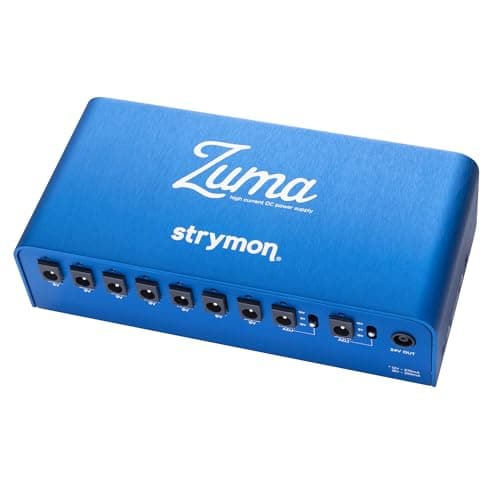
Top pick: Strymon Zuma
#ad How we’re funded · price as of September 14, 2026