Best guitar pedals for metal
The order of importance is not what most lists say. Tight low end and a gate that closes properly beat another distortion pedal, every time.
Fret & Fuzz earns a commission when you buy through the links on this page. It costs you nothing and it does not decide what we rank. How we’re funded.
We have not played this gear. Every pick below is chosen from published manufacturer specifications and the arithmetic set out in how we research, which you can re-run yourself.

For metal, buy the noise gate before you buy another distortion pedal. High gain raises the noise floor by definition, and a gate with a send/return loop — the BOSS NS-2 is the reference — is the only thing on a pedalboard that addresses it properly. After that, an EQ with real resolution does more for a tight low end than any drive pedal will.
Most 'best pedals for metal' lists are five distortion pedals and a chorus. That ordering has it backwards. The two problems that actually make a high-gain rig sound amateur are noise between phrases and a low end that is loose rather than tight, and neither is solved by more gain.
Best pedals for metal
| # | Product | Best for | Price |
|---|---|---|---|
| 01 | 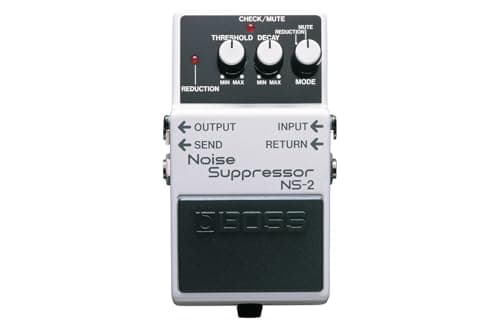 BOSS NS-2 Noise Suppressor The Send/Return loop lets the gate listen to your clean signal while muting the noisy pedals. | The pedal that actually fixes a metal rig | $120.99 · Check price #ad How we’re funded · price as of October 17, 2026 |
| 02 | 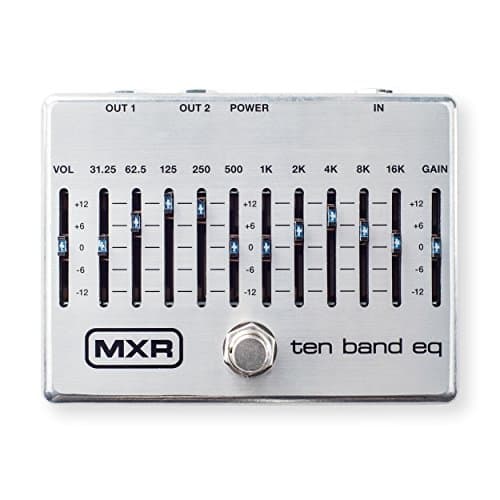 MXR 10 Band EQ Ten bands down to 31.25 Hz — enough resolution to cut the flub without losing the weight. | Getting the low end tight instead of loud | $159.99 · Check price #ad How we’re funded · price as of October 17, 2026 |
| 03 | 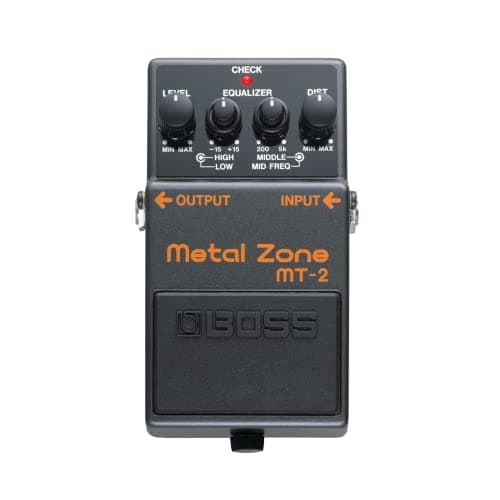 BOSS MT-2 Metal Zone The sweepable Middle Freq control is the reason to own it and the control most owners never touch. | High gain from a pedal, if you use the mid knob | $108.99 · Check price #ad How we’re funded · price as of October 17, 2026 |
| 04 | 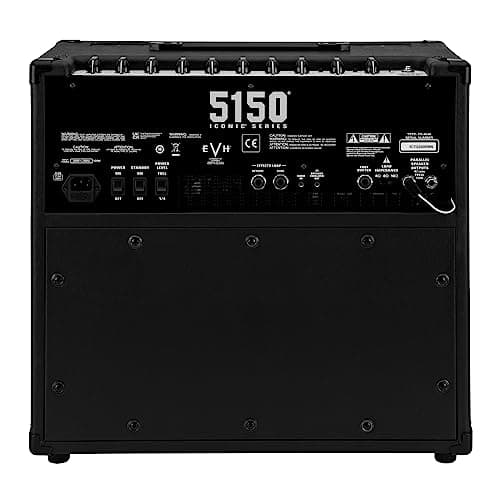 EVH 5150 Iconic Series 15W 1x10 combo Two channels with extra gain voicings, a quarter-power switch and a speaker-emulated DI. | When the answer is not a pedal at all | $699.99 · Check price #ad How we’re funded · price as of October 17, 2026 |
| ! | 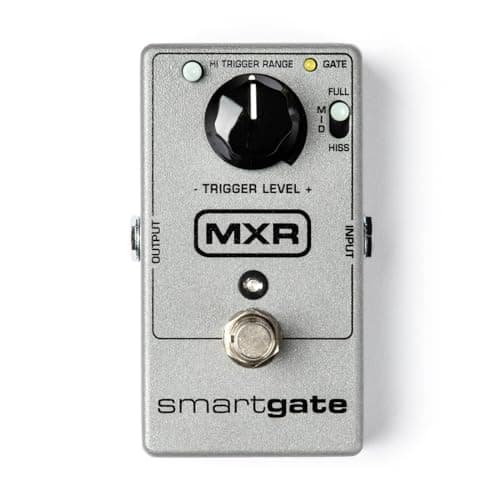 MXR Smart Gate A capable gate with no send/return loop, which is the feature that makes a gate work in this application. Skip this one — see why below | Not the gate to buy for a high-gain board | $159.99 · Check price #ad How we’re funded · price as of October 17, 2026 |
Rows link to the full write-up further down this page. Prices come from the live price layer only — where there is no live figure the button reads “Check price” rather than showing a remembered number.
02Why the gate comes first
A distortion circuit multiplies the signal at its input. It cannot distinguish between the note you played and the hum from a nearby light dimmer, so both get multiplied. At the gain levels metal uses, the residual noise between phrases is loud enough to be part of the performance.
A gate mutes the signal below a threshold. The difficulty is deciding where the threshold sits, and that decision depends on which signal the gate is listening to. If it listens to the output of your distortion, the noise it is trying to remove is part of what it hears. BOSS publishes Send and Return jacks on the NS-2 specifically so the detector can listen to your clean guitar at the input while the muting happens after the noisy pedals. That is the entire design and it is why the pedal costs what it does.
03Why EQ beats another drive pedal
The frequency range that makes a high-gain tone sound flubby is roughly 100-300 Hz, and it is narrow. An amp's Bass control is centered far lower and much wider — turning it down thins the whole low end rather than removing the specific problem. Ten bands at 31.25 Hz through 16 kHz, at +/- 12 dB each, has the resolution to cut a band and leave the rest.
| Placement | What it changes | When to use it |
|---|---|---|
| EQ before the distortion | What the circuit is clipping — cutting lows here tightens the distortion itself | Loose, farting low end under palm mutes |
| EQ after the distortion | What you hear, without changing the distortion character | Amp or cab has a frequency problem |
| EQ in the effects loop | The power amp's input, after the preamp has already distorted | High-gain amp channel, not a pedal |
All three are legitimate. They are not interchangeable.
BOSS NS-2 Noise Suppressor
The pedal that actually fixes a metal rig
The number25 mA, and it has a 9 V DC OUT jack that can feed another pedal.
High-gain rigs hiss. That is not a flaw in your distortion pedal, it is what happens when you amplify a signal by a very large factor: the noise floor comes up with it. A gate is the fix, and the NS-2 is the one to get because of a feature most players ignore.
In the plain in/out configuration a gate has to decide whether you are playing by listening to the distorted signal — which contains the noise it is trying to remove. It either chops your sustain or fails to close. The Send/Return loop solves this: your guitar goes to the NS-2's input, the Send feeds your distortion pedals, the Return brings them back, and the gate makes its decision from the clean guitar signal at the input.
That is the whole reason to spend more than the cheapest gate. If you buy an NS-2 and wire it in and out, you have bought the wrong pedal and wired it the wrong way.
| Controls | Mode switch, Decay, Threshold, pedal switch |
|---|---|
| Jacks | Input, Output, Send, Return, DC IN, 9 V DC OUT |
| Send/Return loop | Lets the gate listen to the guitar directly while muting the output of the noisy pedals |
| Circuit | VCA with a high-speed envelope detector |
| Current draw | 25 mA |
| Weight | 415 g including battery |
| What it does not do | It suppresses noise, it does not remove it — a gate cannot clean up a hum you can hear through a held note. Used in the simple in/out configuration it also cuts your sustain, which is why the send/return loop exists. |
Specs from BOSS NS-2 specifications. We have not used this unit.
#ad How we’re funded · price as of October 17, 2026
MXR 10 Band EQ
Getting the low end tight instead of loud
The numberRuns on 18 V, not 9 V. This is the single most common power mistake made with this pedal.
The complaint that a metal tone is 'muddy' is almost always a specific frequency problem somewhere between 100 Hz and 300 Hz, and no amount of the amp's three-band EQ has the resolution to fix it. Ten bands does.
Placed after the distortion it shapes what you hear. Placed before it, it changes what the distortion circuit is clipping — cutting lows before a high-gain stage is how you get a tight low end rather than a loose one. Both are useful and they are different moves.
The 18 V requirement is not optional and not a preference. If your board is a 9 V-only brick, this pedal needs its own supply, an 18 V output or a voltage doubler cable. The power guide covers how to plan for it.
| Bands | 10 bands from 31.25 Hz to 16 kHz |
|---|---|
| Range | +/- 12 dB per band, plus Gain and Volume sliders |
| Outputs | Two outputs for running to two amps |
| Power | 18 V DC supply (included with the M108S) |
| Electrical data | No current-draw or impedance figure is published for this pedal, so none is stated here. |
| What it does not do | It runs at 18 V, not 9 V. If your board is a 9 V-only brick this pedal needs its own supply or an 18 V output — this is the single most common power mistake made with it. |
Specs from MXR 10 Band EQ product page. We have not used this unit.
#ad How we’re funded · price as of October 17, 2026
BOSS MT-2 Metal Zone
High gain from a pedal, if you use the mid knob
Used the way it is usually used — mids scooped, gain high, straight into a clean amp — the MT-2 is the pedal that vanishes the moment a bass player starts. Used with the Middle Freq swept to find the frequency your amp is missing and the Middle level brought up, it is a genuinely capable high-gain pedal.
It has more EQ than any other BOSS compact dirt pedal: three bands plus the sweepable mid. That is the feature. If you were going to leave the EQ flat, a DS-1 costs less and does less badly.
Pair it with the gate above rather than instead of it. A high-gain pedal into a clean amp is the noisiest configuration in this list.
| Controls | Level, High, Low, Middle, Middle Freq (parametric), Dist |
|---|---|
| EQ | Three-band with a sweepable mid frequency — the most EQ on any BOSS compact dirt pedal |
| Power | 9 V battery or PSA-series adaptor |
| Electrical data | No current-draw or impedance figure is published for this pedal, so none is stated here. |
| What it does not do | No adaptor included. The factory mid-scooped setting is the one everybody hears and nobody should use — the parametric mid is the reason to own it, not an extra. |
Specs from BOSS MT-2 product page. We have not used this unit.
#ad How we’re funded · price as of October 17, 2026
EVH 5150 Iconic Series 15W 1x10 combo
When the answer is not a pedal at all
The number15 W with a quarter-power switch — about 6 dB down, which is a real reduction and still not quiet.
This is in a pedal roundup deliberately. The most common reason a metal tone sounds thin is that the gain is coming from a pedal into a clean amp, which distorts at one point in the chain instead of across a whole preamp. An amp with a real gain channel does not have that problem and no pedal fixes it.
EVH publishes two ECC83 preamp tubes and a single 6L6, two channels each with an additional gain voicing, an effects loop, dual parallel speaker outputs and a speaker-emulated DI with power amp mute. The DI is the practical part: you can record or go to a PA with the power section silent.
The 10-inch speaker is the limiting factor on low-end weight. Through an external 4x12 it is a materially different amp — see combo vs head and cab.
| Power | 15 W, with a quarter-power switch |
|---|---|
| Speaker | 1 x 10" |
| Tubes | 2 x ECC83 preamp, 1 x 6L6 power |
| Channels | Two, each with an extra gain voicing (Overdrive on green, Burn on red) |
| Extras | Effects loop, dual parallel speaker outputs, speaker-emulated DI with power amp mute |
| Weight | 38.2 lb |
| Included | One-button footswitch |
| What it does not do | The 10" speaker is the limiting factor on the low end — this amp sounds materially different through a 4x12. No reverb. |
Specs from EVH 5150 Iconic Series 15W 1x10 combo product page. We have not used this unit.
#ad How we’re funded · price as of October 17, 2026
MXR Smart Gate
Not the gate to buy for a high-gain board
We are not picking this one for a metal rig. The Smart Gate is a perfectly good gate with three selectable gate modes and one knob, and in an amp's effects loop after the preamp it works well.
But in the configuration most people buy a gate for — in front of, or after, a distortion pedal on a pedalboard — it has to make its decision from the signal that contains the noise. That is the problem the NS-2's Send/Return loop exists to solve, and the Smart Gate does not have one.
If you already own it and it is chopping your note tails, moving it into your amp's effects loop will usually help more than replacing it.
| Controls | Trigger knob, three-position gate mode switch (Hiss, Mid, Full) |
|---|---|
| Power | 9 V battery, Dunlop ECB003 adapter, or a DC Brick / Iso-Brick supply |
| Electrical data | No current-draw or impedance figure is published for this pedal, so none is stated here. |
| What it does not do | No send/return loop. Placed after a high-gain amp's preamp it works well; placed naively in front of everything it will chop your note tails. |
Specs from MXR Smart Gate product page. We have not used this unit.
04What we deliberately left off
No chorus, no phaser, no wah. They all appear on metal records and none of them is a fix for a rig that is not working. If the core tone is right, adding modulation is a taste decision and any of the pedals in the modulation roundup will do.
We also left off the cheap high-gain pedals that get recommended for this constantly. Not because they sound bad — several are the same circuits — but because the failure mode in a metal rig is noise and switching reliability, and that is exactly where budget hardware saves money. Best pedals under $100 is honest about which corners get cut.
05The order these should go in
- Tuner first, so you can tune silently and so nothing colors the signal before you do.
- Gate input next, with the Send feeding your dirt pedals and the Return bringing them back.
- Distortion inside the gate's loop.
- EQ after the distortion — or before it, if the problem is that the distortion itself sounds loose.
- Time-based effects last, or in the amp's effects loop. Pedal order explains why a delay in front of a high-gain amp turns to mush.
Frequently asked questions
+ Do I need a noise gate for metal?
+ Is a distortion pedal enough, or do I need a high-gain amp?
+ Where does the EQ go for a tight low end?
+ Why does my metal tone disappear in a band mix?
Sources
Related on Fret & Fuzz
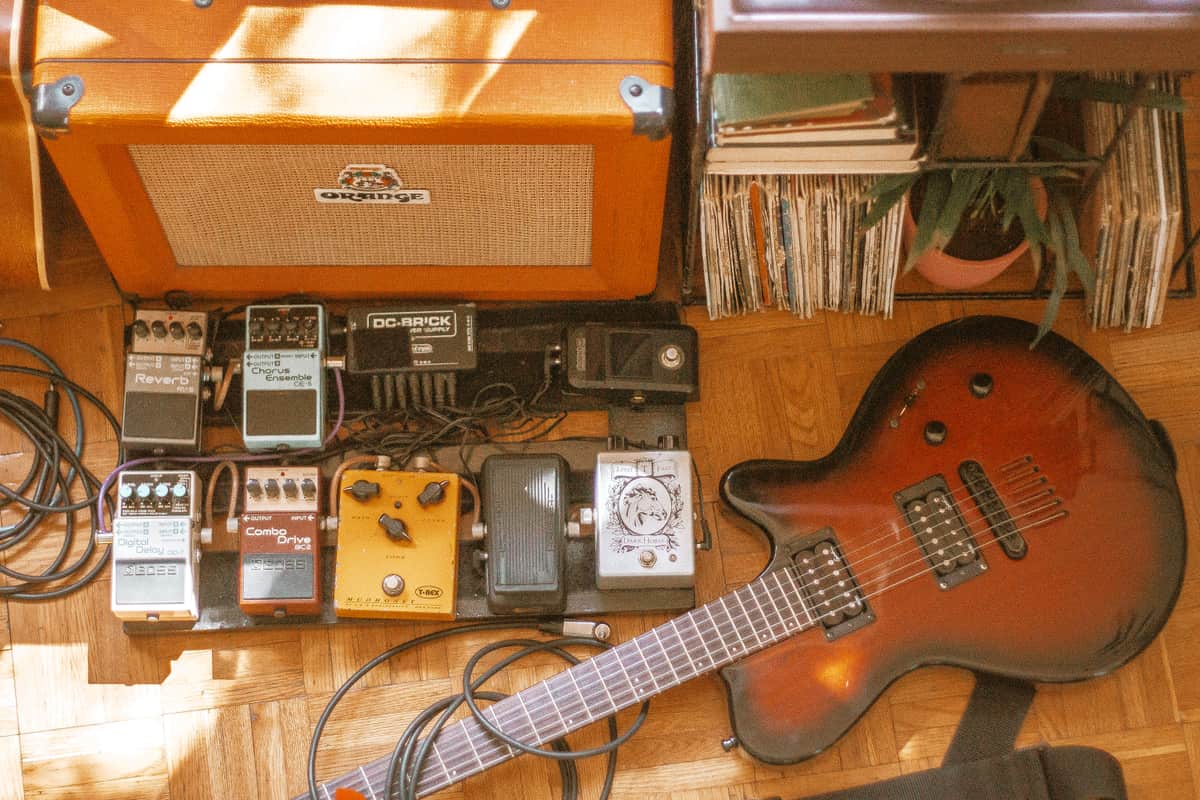
Best distortion pedals
Hard clipping is predictable; the tone control is where these pedals differ. Four distortions compared, plus one that is mislabelled.
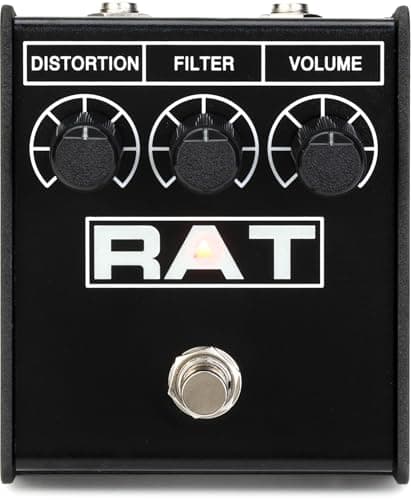
Best Distortion pick: Pro Co RAT 2
#ad How we’re funded · price as of October 17, 2026
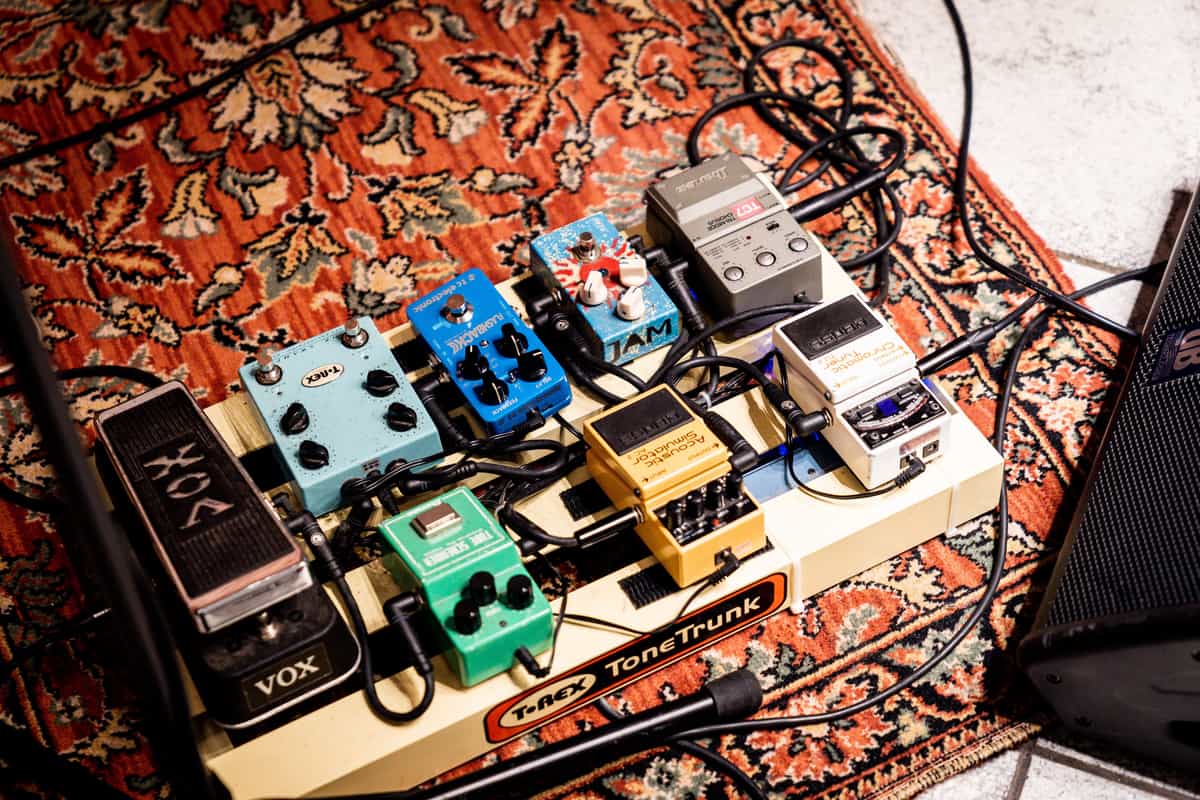
Best noise gate pedals
Which signal the gate listens to is the entire specification. Three gates compared, and the wiring that makes one of them work.
Best Noise Gate pick: BOSS NS-2 Noise Suppressor
#ad How we’re funded · price as of October 17, 2026

Best amps for metal
Cascaded preamp gain and control below 300 Hz. Why a pedal into a clean amp gets close and not there.
Best Amp for Metal pick: EVH 5150 Iconic Series 15W 1x10 combo
#ad How we’re funded · price as of October 17, 2026
Pedal order: what changes and what does not
Two placements are load-bearing and the rest are preference. Which is which, and the impedance figures behind the first one.
Top pick: Dunlop Fuzz Face Mini Silicon
#ad How we’re funded · price as of October 17, 2026