Big Muff versions compared
These are not color options. The Op-Amp version has less than half the input impedance of the standard one, and it behaves accordingly.
Fret & Fuzz earns a commission when you buy through the links on this page. It costs you nothing and it does not decide what we rank. How we’re funded.
We have not played this gear. Every pick below is chosen from published manufacturer specifications and the arithmetic set out in how we research, which you can re-run yourself.
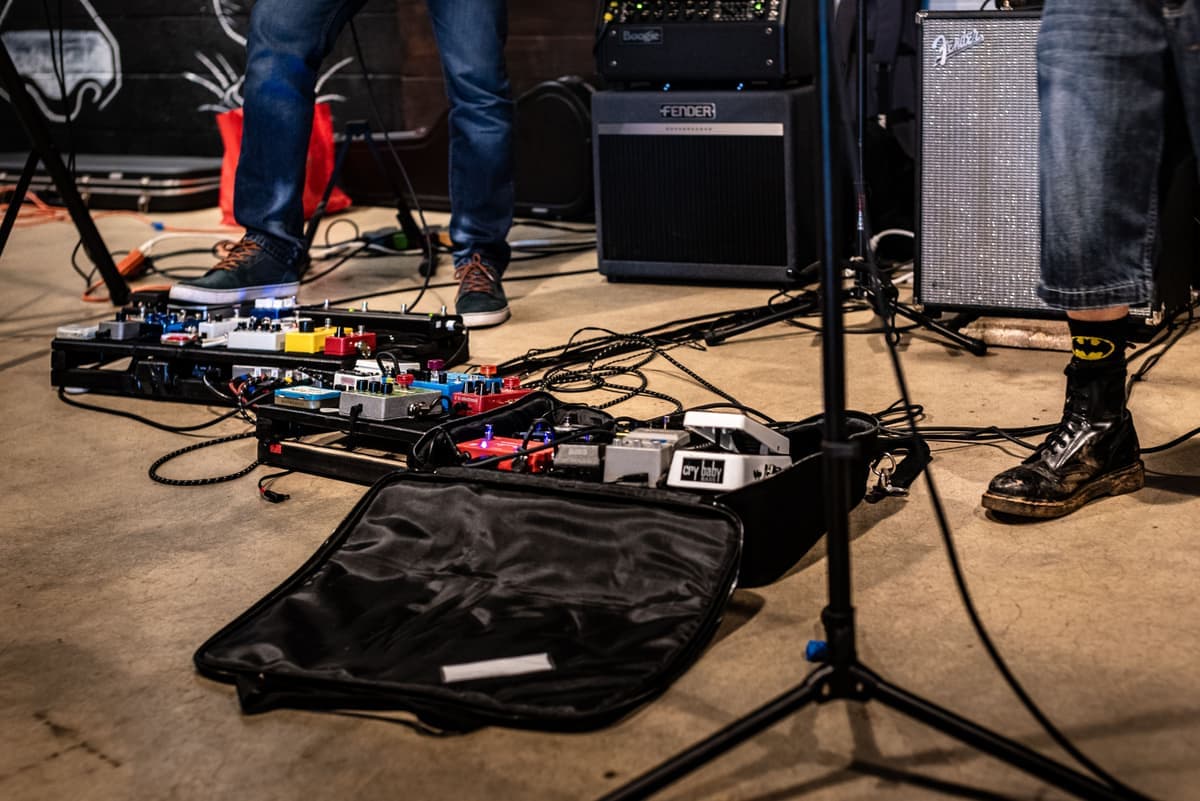
Buy the Nano Big Muff unless you have a reason not to — same circuit as the standard version, a third of the footprint, and EHX publishes its 130 k ohm input impedance. The Green Russian if you want more low end and less upper-mid bite. The Op-Amp version only if you specifically want its harder, flatter character, because at 55 k ohm input impedance it is the most placement-sensitive of the family.
There have been a great many Big Muffs over fifty years and much of what circulates about them is unsourceable. What follows sticks to what EHX publishes about the versions currently in production.
Which Big Muff to buy
| # | Product | Best for | Price |
|---|---|---|---|
| 01 | 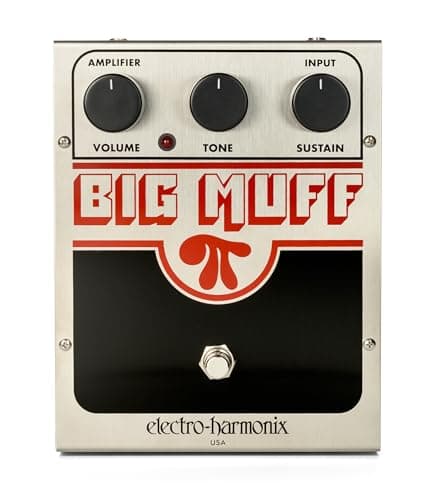 Electro-Harmonix Big Muff Pi The reference four-transistor circuit in the full-size enclosure. | The default answer | $101.60 · Check price #ad How we’re funded · price as of October 18, 2026 |
| 02 | 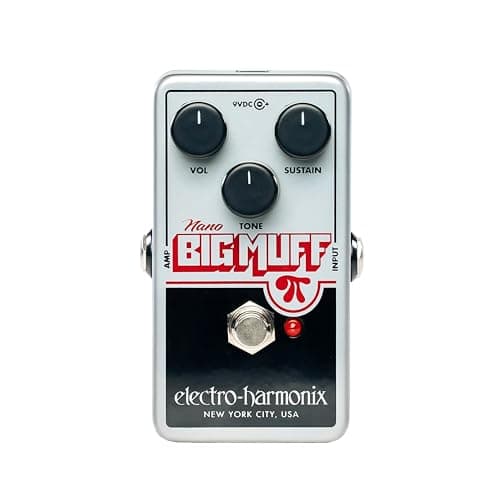 Electro-Harmonix Nano Big Muff Pi Identical topology in the smallest EHX housing, with the input impedance published. | The same circuit, a third of the space | $87.10 · Check price #ad How we’re funded · price as of October 18, 2026 |
| 03 | No photo Electro-Harmonix Green Russian Big Muff EHX's reissue of the mid-1990s Russian-made voicing — thicker, and less aggressive at the top. | More low end, less upper-mid bite | |
| 04 | 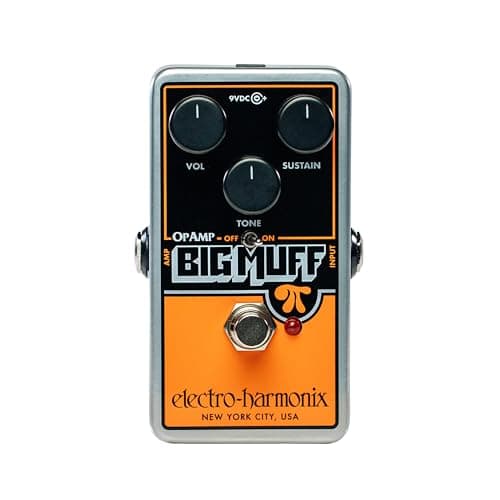 Electro-Harmonix Op-Amp Big Muff Pi Op-amp clipping instead of the four-transistor topology, and the lowest input impedance in the family. | A specific sound, not a general-purpose Muff | $96.20 · Check price #ad How we’re funded · price as of October 18, 2026 |
Rows link to the full write-up further down this page. Prices come from the live price layer only — where there is no live figure the button reads “Check price” rather than showing a remembered number.
02Published figures, side by side
| Version | Topology | Input impedance | Current draw |
|---|---|---|---|
| Big Muff Pi | Four transistors, two cascaded clipping stages | Not published for this version | About 3 mA at 9 V |
| Nano Big Muff Pi | Same as standard | 130 k ohm | About 3 mA at 9 V |
| Op-Amp Big Muff Pi | Op-amp clipping, plus a Tone Bypass switch | 55 k ohm | About 5 mA at 9 V |
| Green Russian Big Muff | Four transistors, Russian-era voicing | Not published | Not published |
Where a cell says not published, EHX does not state that figure for that version and we are not going to supply one from elsewhere.
03What input impedance means for a Muff
It decides how much the pedal loads whatever is in front of it. At 130 k ohm the Nano loads a guitar pickup noticeably — you lose a little top end and the pickup's resonant peak shifts. At 55 k ohm the Op-Amp version does so about twice as much.
Practically, that means the Op-Amp Muff sounds most like itself when something buffered is in front of it, and the standard versions are more tolerant either way. It is the opposite of the Fuzz Face situation, where a buffer in front is the thing to avoid.
Electro-Harmonix Big Muff Pi
The default answer
The numberAbout 3 mA at 9 V.
If someone says Big Muff without qualifying it, this is the pedal. Volume, Tone and Sustain; a boost stage, two cascaded clipping stages and a recovery stage; a passive tone stack with a fixed mid scoop.
It draws about 3 mA, which is negligible. Four of these would draw less current than a single BOSS RV-6.
The full-size enclosure is the main practical objection. On a crowded board it takes the space of two compacts.
| Controls | Volume, Tone, Sustain |
|---|---|
| Current draw | Approximately 3 mA at 9 V DC |
| Power | 9 V battery or a 9 V DC center-negative supply |
| Circuit | Four-transistor design with two cascaded clipping stages between a boost stage and a recovery stage |
| What it does not do | The tone stack has a fixed mid scoop with no way to defeat it, and there is no gain-cleanup behavior — rolling your guitar volume down mostly just gets quieter, not cleaner. |
Specs from Electro-Harmonix Big Muff Pi manual (PDF). We have not used this unit.
#ad How we’re funded · price as of October 18, 2026
Electro-Harmonix Nano Big Muff Pi
The same circuit, a third of the space
The number130 k ohm input impedance, about 3 mA at 9 V.
This is the version to buy unless you specifically want the large enclosure. Same circuit, same three controls, and EHX publishes the 130 k ohm input impedance so you can reason about placement.
That 130 k figure is worth internalizing: it is low compared with a modern pedal's 1 M or 10 M ohm input, which is why a Muff after a long cable or a passive volume pedal sounds slightly different from one placed further down a buffered chain.
Nothing is lost against the full-size version except the footprint and the visual presence.
| Controls | Volume, Tone, Sustain |
|---|---|
| Input impedance | 130 k ohm |
| Current draw | Approximately 3 mA at 9 V DC |
| Power | 9 V battery or a 9 V DC center-negative supply |
| Format | Nano enclosure — the same circuit in the smallest EHX housing |
| What it does not do | The 130 k ohm input impedance is low by modern standards, which is why a Big Muff placed straight after a passive volume pedal or a long cable run can sound different from the same pedal further down the chain. |
Specs from Electro-Harmonix Nano Big Muff Pi product page. We have not used this unit.
#ad How we’re funded · price as of October 18, 2026
Electro-Harmonix Green Russian Big Muff
More low end, less upper-mid bite
EHX describes this as a reissue of the Russian-made circuit from the mid-1990s, with more low end and less upper-mid presence than the US version.
That extra low end is the appeal and the problem in equal measure. On a bright amp it fills the sound out; on a bass-heavy one it turns to mush, and there is no bass control to walk it back.
No electrical figures are published for this version specifically, so plan its power the same way you would the standard one.
| Controls | Volume, Tone, Sustain |
|---|---|
| Voicing | EHX describes this as a reissue of the mid-1990s Russian-made circuit, with more low end and less upper-mid bite than the US version |
| Power | 9 V battery or a 9 V DC center-negative supply |
| Electrical data | No current-draw or impedance figure is published for this pedal, so none is stated here. |
| What it does not do | The extra low end is the point and the problem: on a bass-heavy amp it turns to mush, and there is no bass control to walk it back. |
Specs from Electro-Harmonix Green Russian Big Muff product page. We have not used this unit.
Electro-Harmonix Op-Amp Big Muff Pi
A specific sound, not a general-purpose Muff
The number55 k ohm input impedance, about 5 mA at 9 V.
This is the version that is genuinely a different circuit rather than a different voicing. Op-amp clipping produces a harder, flatter, more compressed result than the cascaded transistor stages of the standard Muff.
The Tone Bypass switch is the feature that most differentiates it in use: it takes the scooping tone stack out of circuit, which is the one thing the standard Muff will not let you do.
The 55 k ohm input impedance is the lowest here by a wide margin, so it is the most sensitive of the family to whatever precedes it.
| Controls | Volume, Tone, Sustain, Tone Bypass switch |
|---|---|
| Input impedance | 55 k ohm |
| Current draw | Approximately 5 mA at 9 V DC |
| Circuit | Op-amp clipping rather than the four-transistor topology of the standard Big Muff |
| What it does not do | The 55 k ohm input impedance is the lowest of the Muff family, so what sits in front of it matters more than usual. There is no germanium warmth here — this is the harder, more compressed version of the sound. |
Specs from Electro-Harmonix Op-Amp Big Muff Pi product page. We have not used this unit.
#ad How we’re funded · price as of October 18, 2026
04The mid scoop, and the one version that lets you defeat it
Every Big Muff's tone stack scoops the mids, and that scoop is why the pedal sounds enormous alone and disappears in a band. On the standard, Nano and Green Russian versions there is no way to turn it off — the Tone control moves the balance between a low-pass and a high-pass filter, but the dip between them stays.
The Op-Amp version's Tone Bypass switch removes the tone stack from the circuit entirely. That is a genuine functional advantage in a band context and it is the strongest argument for that version despite its placement sensitivity.
The alternative, and the one most players actually use, is an EQ pedal after the Muff with the mids brought up. It costs a board slot and it works on any version. For how that scoop compares against a distortion pedal's very different one, Big Muff vs DS-1 sets the two side by side. Best fuzz for doom covers which version to buy when the riff is downtuned and has to ring for bars.
05Which to buy, decided quickly
- Want the standard sound and have board space? Nano — it is the same circuit and smaller.
- Want more weight and less bite? Green Russian.
- Need to defeat the mid scoop at the pedal? Op-Amp version, and put something buffered in front of it.
- Want the large enclosure for its own sake? The full-size Big Muff Pi.
- Want a fuzz that cleans up on your volume knob? None of these — that is a Fuzz Face.
Frequently asked questions
+ What is the difference between the Big Muff and the Nano Big Muff?
+ Is the Op-Amp Big Muff a different circuit?
+ Which Big Muff has the most low end?
+ How do I stop a Big Muff disappearing in a mix?
Sources
Related on Fret & Fuzz

Best fuzz pedals for doom and stoner rock
Sustain is a topology question, not a gain question. Cascaded clipping is why a chord hangs for bars instead of beats.
Best Fuzz for Doom pick: Electro-Harmonix Green Russian Big Muff
Big Muff vs BOSS DS-1
Cascaded clipping against one hard-clipping stage — and the mid scoop they both have, for different reasons.
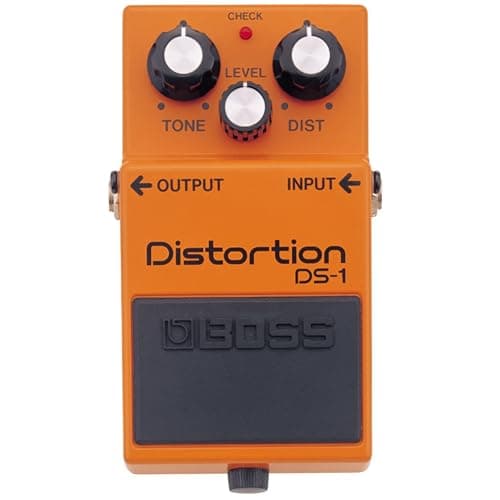
Top pick: BOSS DS-1 Distortion
Best fuzz pedals
Input impedance predicts your fuzz experience better than any adjective. Five fuzzes compared on the published figures.
Best Fuzz pick: Electro-Harmonix Big Muff Pi
#ad How we’re funded · price as of October 18, 2026
Big Muff vs Fuzz Face
Sustain versus response, four transistors versus two, and the buffer problem that decides whether a Fuzz Face works on your board.
Top pick: Electro-Harmonix Big Muff Pi
#ad How we’re funded · price as of October 18, 2026
Best guitar pedals for shoegaze
Fuzz, modulation and reverb in the order that decides the sound — with the input-impedance figures that explain why fuzz goes first.
Best for Shoegaze pick: Electro-Harmonix Big Muff Pi
#ad How we’re funded · price as of October 18, 2026
The best guitar pedals of all time
Seven circuits everything else gets compared to, what each one does to the signal, and which current version is the real thing.
The Canon pick: Ibanez TS9 Tube Screamer
#ad How we’re funded · price as of October 18, 2026