Big Muff vs BOSS DS-1
Two pedals that both scoop the midrange, for different reasons, with different consequences. That shared flaw is the most useful thing about the comparison.
Fret & Fuzz earns a commission when you buy through the links on this page. It costs you nothing and it does not decide what we rank. How we’re funded.
We have not played this gear. Every pick below is chosen from published manufacturer specifications and the arithmetic set out in how we research, which you can re-run yourself.
The DS-1 clips hard at one point and stays consistent, so chords keep their definition — buy it for rhythm playing. The Big Muff cascades two clipping stages and re-clips the note as it decays, producing sustain a single-stage circuit cannot — buy it for sustained lead lines and wall-of-sound textures. Both scoop the midrange, and that is the thing that will cost you a place in a band mix if you do not correct it.
These two get compared because they occupy a similar price bracket and both get described as "heavy". Mechanically they are doing different things, and the one property they share is the one that causes the most trouble.
Which one belongs on your board
| # | Product | Best for | Price |
|---|---|---|---|
| 01 | 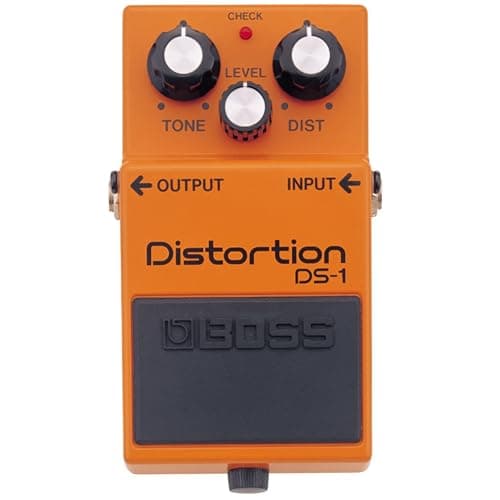 BOSS DS-1 Distortion One hard-clipping stage — consistent note to note, and it keeps its place in a mix better than the Muff. | Chords that stay legible | |
| 02 | 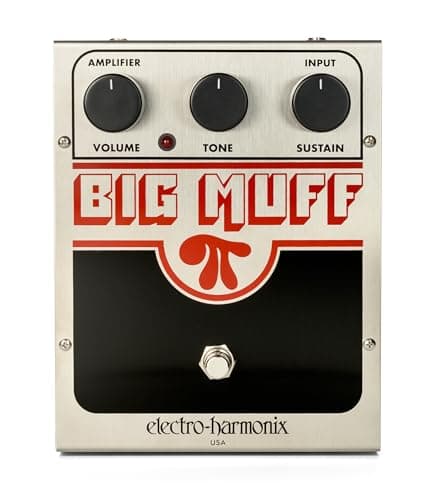 Electro-Harmonix Big Muff Pi Two cascaded clipping stages re-clip the note as it falls, so it barely decays at all. | Sustain that does not decay | $101.60 · Check price #ad How we’re funded · price as of October 20, 2026 |
Rows link to the full write-up further down this page. Prices come from the live price layer only — where there is no live figure the button reads “Check price” rather than showing a remembered number.
02The shared problem: two different mid scoops
The Big Muff's scoop is structural. Its passive tone stack sits between a low-pass and a high-pass filter and the dip between them is always present — the Tone knob moves the balance, not the dip. There is no setting with flat mids.
The DS-1's scoop is a consequence of how its single Tone control is wired: turning it up adds treble and cuts mids together. Unlike the Muff, you can avoid it — keep the Tone low and the mids largely survive, at the cost of a darker sound than most people want.
| EHX Big Muff Pi | BOSS DS-1 | |
|---|---|---|
| Clipping | Two cascaded transistor stages | Diodes clipping hard to ground, once |
| Sustain | Very long — the note is re-clipped as it decays | Natural decay |
| Chord definition | Low — chords blur into one mass | High — individual notes stay legible |
| Mid scoop | Structural, not defeatable on the standard model | A consequence of the Tone control; avoidable |
| Controls | Volume, Tone, Sustain | Tone, Level, Dist |
| Published draw | About 3 mA at 9 V | 10 mA |
| Published impedance | 130 k ohm input on the Nano version | 1 M ohm in, 1 k ohm out |
| Placement sensitivity | Moderate — low input impedance | None |
BOSS DS-1 Distortion
Chords that stay legible
The number10 mA, 1 M ohm in, 1 k ohm out — all published by BOSS.
Hard clipping to ground flattens peaks abruptly and does it the same way every time, regardless of how hard you pick. That consistency is what keeps a chord legible: play a full open chord through a DS-1 and you can still hear the individual strings.
It is also the cheaper pedal, the one with a published spec sheet, a five-year warranty and a switch that will outlast the guitar. At 10 mA it will run off anything.
The con is the Tone control. It scoops mids as it brightens, so the setting that sounds exciting alone is the setting that vanishes under a band. Used with the Tone low and an EQ after it, the DS-1 is considerably better than its reputation.
| Controls | Tone, Level, Dist, pedal switch |
|---|---|
| Input impedance | 1 M ohm |
| Output impedance | 1 k ohm |
| Current draw | 10 mA |
| Power | 9 V battery (6F22 / 6LR61) or PSA-series adaptor |
| Size / weight | 73 x 129 x 59 mm, 360 g |
| What it does not do | No adaptor included, no true bypass. The single Tone knob scoops as it brightens, so a DS-1 into an already-scooped amp is the classic recipe for disappearing in a band mix. |
Specs from BOSS DS-1 specifications. We have not used this unit.
Electro-Harmonix Big Muff Pi
Sustain that does not decay
The numberAbout 3 mA at 9 V — a third of the DS-1's draw.
Four transistor stages with two of them cascaded clipping stages. The note is being re-clipped as it decays, which is why a held chord sustains far longer than the guitar's own decay allows. Nothing a single-stage distortion does resembles this.
That sustain is the entire reason to own one. It is a lead and texture pedal, and on records it is usually doing one sustained thing rather than playing rhythm.
The cons are the same scoop problem, worse. The Muff's mid scoop is built into a passive tone stack and the Tone control cannot remove it — it moves the balance between a low-pass and a high-pass filter but the dip between them stays. Chords also blur into a single mass, which is the flip side of the sustain.
| Controls | Volume, Tone, Sustain |
|---|---|
| Current draw | Approximately 3 mA at 9 V DC |
| Power | 9 V battery or a 9 V DC center-negative supply |
| Circuit | Four-transistor design with two cascaded clipping stages between a boost stage and a recovery stage |
| What it does not do | The tone stack has a fixed mid scoop with no way to defeat it, and there is no gain-cleanup behavior — rolling your guitar volume down mostly just gets quieter, not cleaner. |
Specs from Electro-Harmonix Big Muff Pi manual (PDF). We have not used this unit.
#ad How we’re funded · price as of October 20, 2026
03Where each one goes
The DS-1 goes wherever a distortion goes: after any fuzz, before your time effects. Its 1 M ohm input means nothing in front of it gets loaded and nothing about its placement is delicate.
The Muff wants slightly more thought. EHX publishes 130 k ohm at the Nano version's input, which is low enough that what precedes it is audible — a long cable run or a passive volume pedal directly in front will change it. It is nowhere near as sensitive as a Fuzz Face, but it is not a 1 M ohm input either. Pedal order covers the chain.
04Running both
Switch between them rather than stacking them. Both compress heavily, so the second one in line is clipping a signal that has already lost most of its dynamic range, and the result is noise rather than more of anything.
As a two-pedal dirt rig they cover the range well: the DS-1 as the rhythm sound and the Muff as the lead or texture sound. Budget for a noise gate if you run both into a high-gain amp — three stages of gain in series raise the noise floor considerably.
Frequently asked questions
+ Is a Big Muff heavier than a DS-1?
+ Which is better for rhythm playing?
+ Why do both of them disappear in a band?
+ Can I stack a Big Muff and a DS-1?
Sources
Related on Fret & Fuzz

BOSS DS-1 vs MT-2 Metal Zone
The same reputation problem and opposite amounts of control over it. One tone knob against a sweepable parametric mid.
Top pick: BOSS DS-1 Distortion
Big Muff vs RAT
Cascaded clipping versus one hard-clipping stage — sustain against articulation, and which survives a mix.
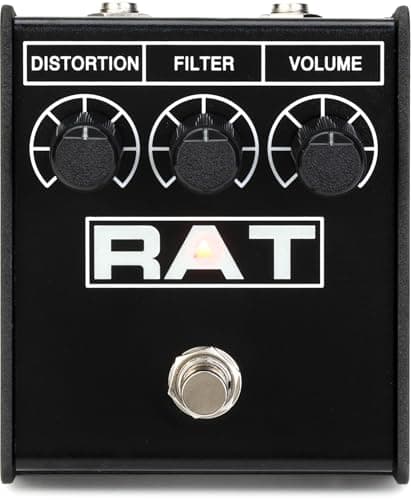
Top pick: Pro Co RAT 2
#ad How we’re funded · price as of October 20, 2026
Best distortion pedals
Hard clipping is predictable; the tone control is where these pedals differ. Four distortions compared, plus one that is mislabelled.
Best Distortion pick: Pro Co RAT 2
#ad How we’re funded · price as of October 20, 2026
Big Muff versions compared
Four versions, four different circuits. Published impedance and current draw for each, and which one to buy.
Top pick: Electro-Harmonix Big Muff Pi
#ad How we’re funded · price as of October 20, 2026
Best fuzz pedals
Input impedance predicts your fuzz experience better than any adjective. Five fuzzes compared on the published figures.
Best Fuzz pick: Electro-Harmonix Big Muff Pi
#ad How we’re funded · price as of October 20, 2026
Best EQ pedals
Bands, decibel range and supply voltage. Three EQs compared, plus the 18 V requirement that strands power plans.
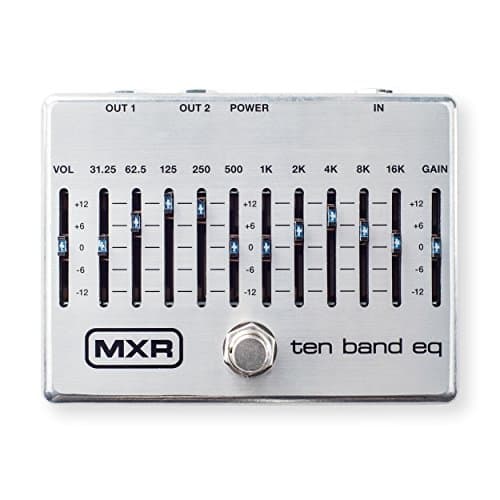
Best EQ Pedal pick: MXR 10 Band EQ
#ad How we’re funded · price as of October 20, 2026