Big Muff vs RAT
One sustains forever and vacates the midrange. The other keeps every note distinct and imposes a voice. That is the whole trade.
Fret & Fuzz earns a commission when you buy through the links on this page. It costs you nothing and it does not decide what we rank. How we’re funded.
We have not played this gear. Every pick below is chosen from published manufacturer specifications and the arithmetic set out in how we research, which you can re-run yourself.
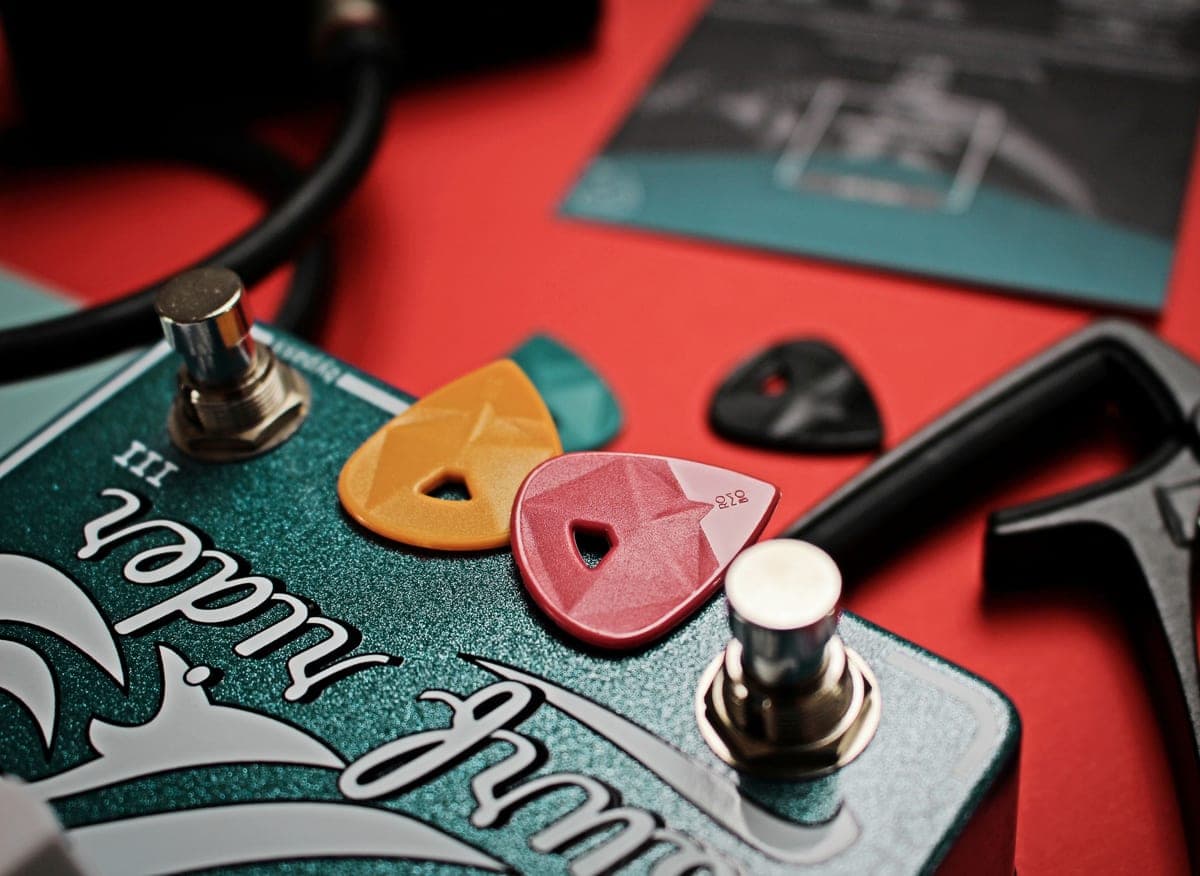
A Big Muff uses two cascaded transistor clipping stages, which produces enormous sustain and a fixed mid scoop. A RAT clips hard to ground once, which keeps notes distinct and leaves the midrange occupied. Buy the Muff for sustained single notes and wall-of-sound chords; buy the RAT for rhythm playing that has to stay legible.
Both are filed under distortion by somebody, and they do fundamentally different things to a chord. That is the useful comparison, rather than which is heavier.
Which one belongs on your board
| # | Product | Best for | Price |
|---|---|---|---|
| 01 | 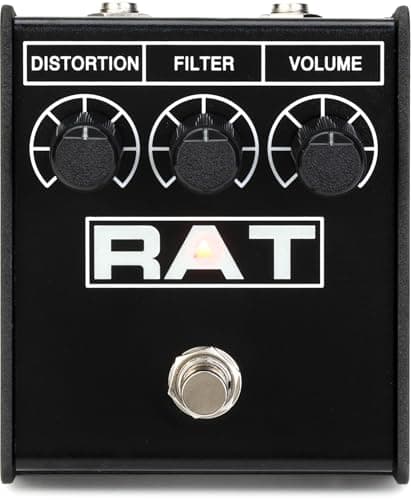 Pro Co RAT 2 Hard clipping to ground, with a low-pass Filter that decides how much top end survives. | Chords that stay defined | $86.00 · Check price #ad How we’re funded · price as of October 18, 2026 |
| 02 | 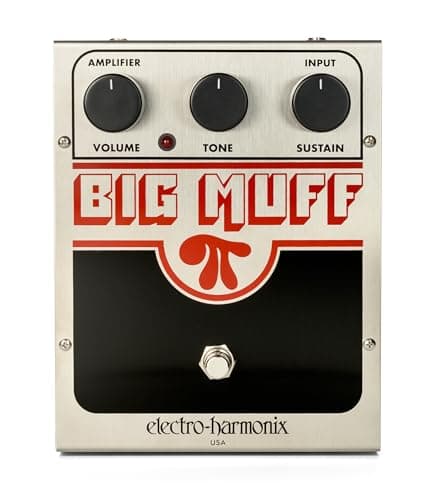 Electro-Harmonix Big Muff Pi Two cascaded clipping stages and a fixed mid scoop you cannot defeat. | Sustain that does not decay | $101.60 · Check price #ad How we’re funded · price as of October 18, 2026 |
Rows link to the full write-up further down this page. Prices come from the live price layer only — where there is no live figure the button reads “Check price” rather than showing a remembered number.
02What each does to a chord
Play a full open chord through a RAT and you can still hear the individual strings. Play the same chord through a Big Muff and you hear one sustained, saturated event. Neither is a defect — they are the intended outcomes of two different clipping architectures.
The mechanism: a single hard-clipping stage flattens peaks but leaves the relative structure of the signal broadly intact. Two cascaded stages compress so heavily that the note's internal detail is gone and what remains is sustain.
| Big Muff Pi | Pro Co RAT 2 | |
|---|---|---|
| Clipping | Two cascaded transistor stages | Diodes clipping hard to ground, once |
| Chord definition | Low — chords blur into one mass | High — individual notes stay legible |
| Sustain | Very long | Natural decay |
| Midrange | Scooped by a fixed tone stack | Present |
| Tone control | Volume, Tone, Sustain | Filter (low-pass, runs backwards) |
| In a band mix | Can disappear without an EQ after it | Holds its place |
| Published draw | About 3 mA at 9 V | Not published by Pro Co |
Pro Co RAT 2
Chords that stay defined
Hard clipping is consistent note to note, which is why a chord through a RAT stays legible where the same chord through a Muff turns into a single sustained mass.
The Filter runs backwards from a normal tone control — turning it up removes treble. For a circuit generating this much high-order harmonic content, choosing how much survives is more useful than adding more.
It also sits in the midrange rather than vacating it, which is why it holds its place in a band mix without an EQ pedal behind it.
| Controls | Distortion, Filter, Volume |
|---|---|
| Filter control | Runs backwards from a normal tone knob — turning it up removes treble |
| Power | 9 V battery or a 9 V DC supply (adapter sold separately) |
| Enclosure | Steel, with the battery compartment accessible without tools |
| Electrical data | No current-draw or impedance figure is published for this pedal, so none is stated here. |
| What it does not do | No power supply included. There is no clean-boost side to it — at low Distortion the RAT is still a distortion, and the Filter control confuses everyone exactly once. |
Specs from Pro Co RAT 2 product page. We have not used this unit.
#ad How we’re funded · price as of October 18, 2026
Electro-Harmonix Big Muff Pi
Sustain that does not decay
The numberAbout 3 mA at 9 V.
The Muff re-clips the note as it decays, which is why a held chord sustains far longer than the guitar's own decay would allow. That is the reason to own one and it is not something a RAT will do.
The fixed mid scoop is the cost. Alone it sounds enormous; in a band it can disappear entirely, and there is no tone control setting that puts the mids back.
At about 3 mA it costs nothing to power, which is a genuine practical advantage on a crowded supply.
| Controls | Volume, Tone, Sustain |
|---|---|
| Current draw | Approximately 3 mA at 9 V DC |
| Power | 9 V battery or a 9 V DC center-negative supply |
| Circuit | Four-transistor design with two cascaded clipping stages between a boost stage and a recovery stage |
| What it does not do | The tone stack has a fixed mid scoop with no way to defeat it, and there is no gain-cleanup behavior — rolling your guitar volume down mostly just gets quieter, not cleaner. |
Specs from Electro-Harmonix Big Muff Pi manual (PDF). We have not used this unit.
#ad How we’re funded · price as of October 18, 2026
03Fixing the Muff's mix problem
The scoop is in the passive tone stack and the Tone control cannot remove it. Two real fixes: an EQ pedal after the Muff with the mids brought up, or the Op-Amp version, which has a Tone Bypass switch that takes the stack out of circuit entirely. Big Muff versions covers the second.
A RAT does not need either, which is the practical argument for it if you play with other people.
04Running both
Common and useful: the RAT as the rhythm sound and the Muff as a lead or texture sound, switched rather than stacked. Stacking them puts a heavily compressed signal into another clipping stage and produces noise rather than more of anything.
If you run both plus a high-gain amp, budget for a noise gate — three stages of gain in series raise the noise floor considerably. Big Muff vs DS-1 is the other Muff comparison worth reading, and it is the one where the two pedals share a flaw rather than differing on one. Best fuzz for doom covers the genre where that sustain is the entire requirement.
Frequently asked questions
+ Is a Big Muff a fuzz or a distortion?
+ Which is better for rhythm playing?
+ Why does my Big Muff vanish in a band?
+ Can I stack a Big Muff and a RAT?
Sources
Related on Fret & Fuzz
BOSS DS-1 vs Pro Co RAT 2
Both clip hard. One control removes treble and one removes mids, and that is the whole difference in a band.
Top pick: Pro Co RAT 2
#ad How we’re funded · price as of October 18, 2026

Best fuzz pedals for doom and stoner rock
Sustain is a topology question, not a gain question. Cascaded clipping is why a chord hangs for bars instead of beats.
Best Fuzz for Doom pick: Electro-Harmonix Green Russian Big Muff
Big Muff vs BOSS DS-1
Cascaded clipping against one hard-clipping stage — and the mid scoop they both have, for different reasons.
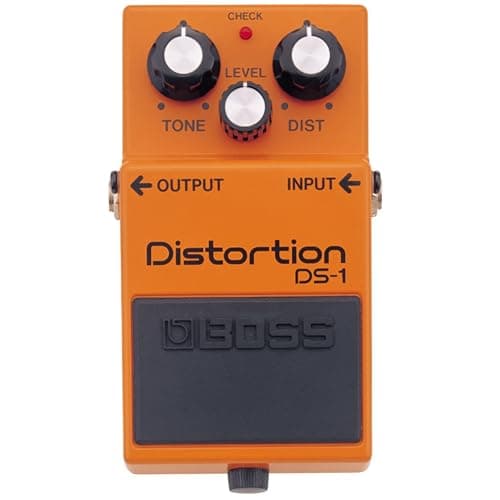
Top pick: BOSS DS-1 Distortion
Best fuzz pedals
Input impedance predicts your fuzz experience better than any adjective. Five fuzzes compared on the published figures.
Best Fuzz pick: Electro-Harmonix Big Muff Pi
#ad How we’re funded · price as of October 18, 2026
Best distortion pedals
Hard clipping is predictable; the tone control is where these pedals differ. Four distortions compared, plus one that is mislabelled.
Best Distortion pick: Pro Co RAT 2
#ad How we’re funded · price as of October 18, 2026
Big Muff versions compared
Four versions, four different circuits. Published impedance and current draw for each, and which one to buy.
Top pick: Electro-Harmonix Big Muff Pi
#ad How we’re funded · price as of October 18, 2026
Best noise gate pedals
Which signal the gate listens to is the entire specification. Three gates compared, and the wiring that makes one of them work.
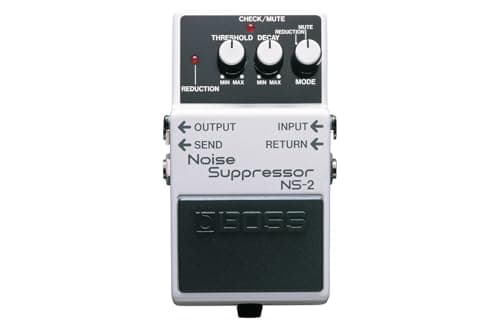
Best Noise Gate pick: BOSS NS-2 Noise Suppressor
#ad How we’re funded · price as of October 18, 2026