EarthQuaker Devices Plumes review
One of the most-bought overdrives of the last few years, and unusually, its maker publishes exactly what each position of its toggle switch does.
Fret & Fuzz earns a commission when you buy through the links on this page. It costs you nothing and it does not decide what we rank. How we’re funded.
We have not played this gear. Every pick below is chosen from published manufacturer specifications and the arithmetic set out in how we research, which you can re-run yourself.
Buy a Plumes if you want one drive pedal that covers a crunchy compressed voice, a more transparent loose voice and a clean boost, with a published 10 M ohm input that will not load your pickups. Do not buy it expecting three distortion sounds — EarthQuaker is explicit that mode 2 is a clean boost — and remember its relay bypass means no power, no signal.
We have not played this pedal and this is not a tone review. What follows is what EarthQuaker publishes, what those published figures mean on a board, and who should buy something else — the only kind of review this site writes. How we research sets out the method in full.
01What EarthQuaker publishes
| Specification | Published figure | What it means in practice |
|---|---|---|
| Controls | Level, Gain, Tone, three-way clipping toggle | A single tone knob plus a switch that changes the circuit |
| Tone control | Bass left, midrange center, treble right | One knob sweeps emphasis across the spectrum rather than cutting treble |
| Mode 1 | Symmetrical LED clipping — more crunch and compression | The heavier, more saturated of the two drive voices |
| Mode 2 | No clipping — wide-open op-amp drive for clean boost | Not a drive at all: a boost with no diodes |
| Mode 3 | Asymmetrical silicon diode clipping — more transparency with a loose feel | The lighter-touch drive voice |
| Input impedance | 10 M ohm | Effectively no load on a passive pickup |
| Output impedance | 100 ohm | Drives long cables and whatever follows without trouble |
| Current draw | 25 mA | Fits any isolated output with room to spare |
| Power | 9 V DC, 2.1 mm center-negative | Standard pedal supply; no battery option |
| Bypass | Flexi-Switch relay-based true bypass, momentary or latching | Needs power to pass signal |
| Circuit | JFET op-amps rather than a 4558; internal +/- 9 V conversion | More headroom than a straight 9 V rail |
| Size | 121 x 64 x 57 mm with knobs | Standard compact footprint |
Every figure and every mode description is EarthQuaker Devices' own published specification. We have not measured any of them.
The pedal
| # | Product | Best for | Price |
|---|---|---|---|
| 01 | 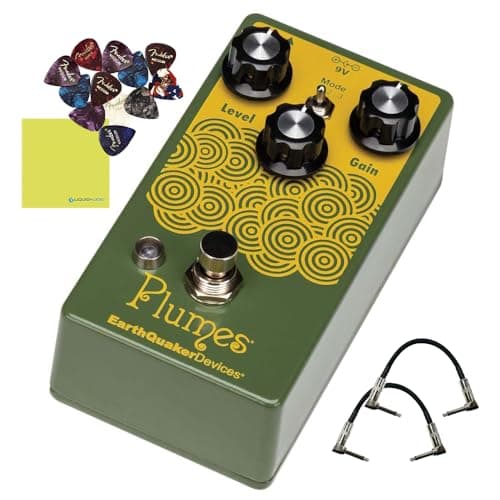 EarthQuaker Devices Plumes Three published clipping modes, a 10 M ohm input and relay true bypass — and one of the three modes is not a drive. | One drive slot that has to cover three jobs |
Rows link to the full write-up further down this page. Prices come from the live price layer only — where there is no live figure the button reads “Check price” rather than showing a remembered number.
03The three modes, in EarthQuaker's words
It is worth quoting the manufacturer here rather than paraphrasing, because a great deal of what gets written about this pedal describes the modes the wrong way round. EarthQuaker publishes mode 1 as symmetrical LED clipping giving more crunch and compression, mode 2 as no clipping at all — a wide-open op-amp drive for clean boost — and mode 3 as asymmetrical silicon diode clipping giving more transparency with a loose feel.
Read that way, the switch is not three levels of the same thing. Mode 1 and mode 3 are two drive characters that differ in how compressed and how saturated they are, and mode 2 removes the clipping diodes entirely so the op-amp stage runs clean. That third position is the one people overlook and the one that makes the pedal more versatile than a two-mode drive would be.
EarthQuaker Devices Plumes
One drive slot that has to cover three jobs
The number25 mA; 10 M ohm in, 100 ohm out; 121 x 64 x 57 mm with knobs.
EarthQuaker describes the Plumes as an overdrive based around the classically overdone tube-like circuit, and the three-way toggle is the reason it stands out from the dozens of pedals built on that same family. Each position changes the clipping element rather than applying an EQ curve, and EarthQuaker publishes what each one does — which most makers do not.
The electrical figures are unusually complete. A 10 M ohm input impedance means it loads a passive pickup essentially not at all, a 100 ohm output drives whatever follows it, and 25 mA is trivial on any supply. EarthQuaker also states it uses JFET op-amps rather than the traditional 4558 chip, with the 9 V supply internally converted to +/- 9 V for more headroom.
The cons are three, and one of them is a misunderstanding waiting to happen. Mode 2 is a clean boost, not a third flavor of dirt — if you bought it expecting three drive voices, you have two. There is no battery compartment and no supply in the box. And the relay bypass that makes the Flexi-Switch possible means the pedal needs power to pass any signal at all: pull the supply and your chain goes silent, not bypassed.
| Controls | Level, Gain, Tone (bass left, midrange center, treble right), 3-way clipping toggle |
|---|---|
| Clipping modes | Mode 1 symmetrical LED clipping, which EarthQuaker describes as more crunch and compression; mode 2 no clipping, a wide-open op-amp clean boost; mode 3 asymmetrical silicon diode clipping, described as more transparency with a looser feel |
| Circuit | EarthQuaker states it uses JFET op-amps rather than the traditional 4558 IC, with the 9 V supply internally converted to +/- 9 V for more headroom |
| Current draw | 25 mA |
| Input impedance | 10 M ohm |
| Output impedance | 100 ohm |
| Bypass | Flexi-Switch relay-based true bypass, momentary or latching |
| Size | 4.75 x 2.50 x 2.25 in (121 x 64 x 57 mm) with knobs |
| Power | 9 V DC, 2.1 mm center-negative barrel |
| What it does not do | No power supply included and no battery compartment. Mode 2 is a clean boost, not a second drive voicing — if you expected three flavors of dirt, one of them is not dirt. |
Specs from EarthQuaker Devices Plumes product page. We have not used this unit.
04The tone knob works differently from most
EarthQuaker publishes the Tone control as bass to the left, midrange at center and treble to the right. That is a sweep of emphasis across the spectrum, not the treble cut most single tone knobs apply, and it means the center position is a deliberate midrange setting rather than a neutral one.
In practice that is useful for the problem this site keeps coming back to: a drive that sounds fine alone and disappears in a band usually needs more midrange, and here the midrange position is a named spot on the knob rather than something you hunt for. Your solo disappears in a band covers why that frequency range matters so much.
05The relay bypass: a real feature with a real catch
Flexi-Switch is EarthQuaker's relay-based true bypass, and it supports both latching and momentary operation. Tap the switch and it latches on as normal; hold it and the pedal engages only while your foot is down. For a boost you want for four bars — which is exactly what mode 2 is — momentary operation means you cannot forget to switch it off.
The catch is that a relay needs power to route the signal. Unplug the supply, or let a daisy-chain connector work loose, and the Plumes does not fall back to a passive bypass — the signal stops. That is not a defect, and it is shared by every relay-switched pedal, but it is a failure mode a mechanical true-bypass switch does not have. Buffer vs true bypass covers the wider trade-offs.
06Against a Tube Screamer
This is the comparison most buyers are really making, because EarthQuaker's own description points at that circuit family. The practical differences on paper are the switchable clipping, the published 10 M ohm input — Ibanez publishes no impedance figure for the TS9 — and relay true bypass where the TS9 is buffered.
What a Tube Screamer offers in return is the single voice everybody already knows, at a lower draw — Ibanez publishes 8 mA for the TS9 against the Plumes' 25 mA — and a battery option the Plumes does not have. If you want that one sound and nothing else, the Plumes' extra modes are features you are paying for and will not use. Tube Screamer models compared covers that family, and best overdrive pedals covers the four circuit families this pedal sits among.
07Who should buy something else
- You want high gain. This is an overdrive. Even mode 1 is crunch and compression, not distortion — best distortion pedals is the right page.
- You run on batteries. There is no battery compartment at all.
- Your board sometimes loses power mid-set. A relay bypass fails silent. A mechanical true-bypass pedal would keep passing signal.
- You want three drive voices. You get two, plus a clean boost. EarthQuaker says so plainly, and the mistake is still common.
- You want the flattest, most transparent drive available. The Plumes is a voiced circuit even in mode 3 — transparent overdrives compared covers pedals built specifically to stay out of the way.
08Who should buy it
Someone with one slot on the board for drive, who wants that slot to cover more than one job. The combination of two drive characters and a clean boost in a compact enclosure, with a published input impedance high enough that placement barely matters, is genuinely hard to match at this size.
It is also an easy recommendation for single-coil guitars in particular, because that 10 M ohm input preserves the top-end detail a passive single coil loses to a low-impedance load. Best overdrive for a Stratocaster covers why that figure earns a place in the decision.
Frequently asked questions
+ What do the three Plumes modes do?
+ Is the Plumes a Tube Screamer clone?
+ Why did my signal stop when the Plumes lost power?
+ Does the Plumes take a battery?
Sources
Related on Fret & Fuzz
Best overdrive pedals
Six overdrives sorted by circuit family, with the published clipping topology and impedance figures that separate them.
Best Overdrive pick: EarthQuaker Devices Plumes
Tube Screamer models compared
Which Tube Screamer differences are real, which are folklore, and the one that actually changes how you use the pedal.
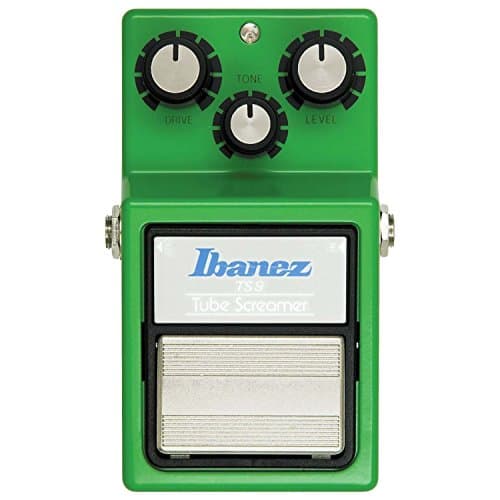
Top pick: Ibanez TS9 Tube Screamer
#ad How we’re funded · price as of October 18, 2026
Best overdrive pedals for a Stratocaster
Single coils are brighter, lower output and short of mids. That rules some famous overdrives in and others straight out.
Best Overdrive for Single Coils pick: Ibanez TS9 Tube Screamer
#ad How we’re funded · price as of October 18, 2026
Transparent overdrives compared
Four drives sold as transparent, and the two different mechanisms they use to get there.
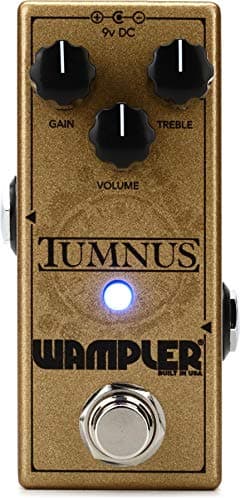
Top pick: Wampler Tumnus
#ad How we’re funded · price as of October 18, 2026
Buffer vs true bypass
A trade-off, not an upgrade. What a buffer fixes, when it hurts, and a five-question rule for deciding.
Top pick: BOSS TU-3 Chromatic Tuner