BOSS DS-1 vs Pro Co RAT 2
Two hard-clipping distortions at a similar price, separated by one control that works the opposite way round on each.
Fret & Fuzz earns a commission when you buy through the links on this page. It costs you nothing and it does not decide what we rank. How we’re funded.
We have not played this gear. Every pick below is chosen from published manufacturer specifications and the arithmetic set out in how we research, which you can re-run yourself.
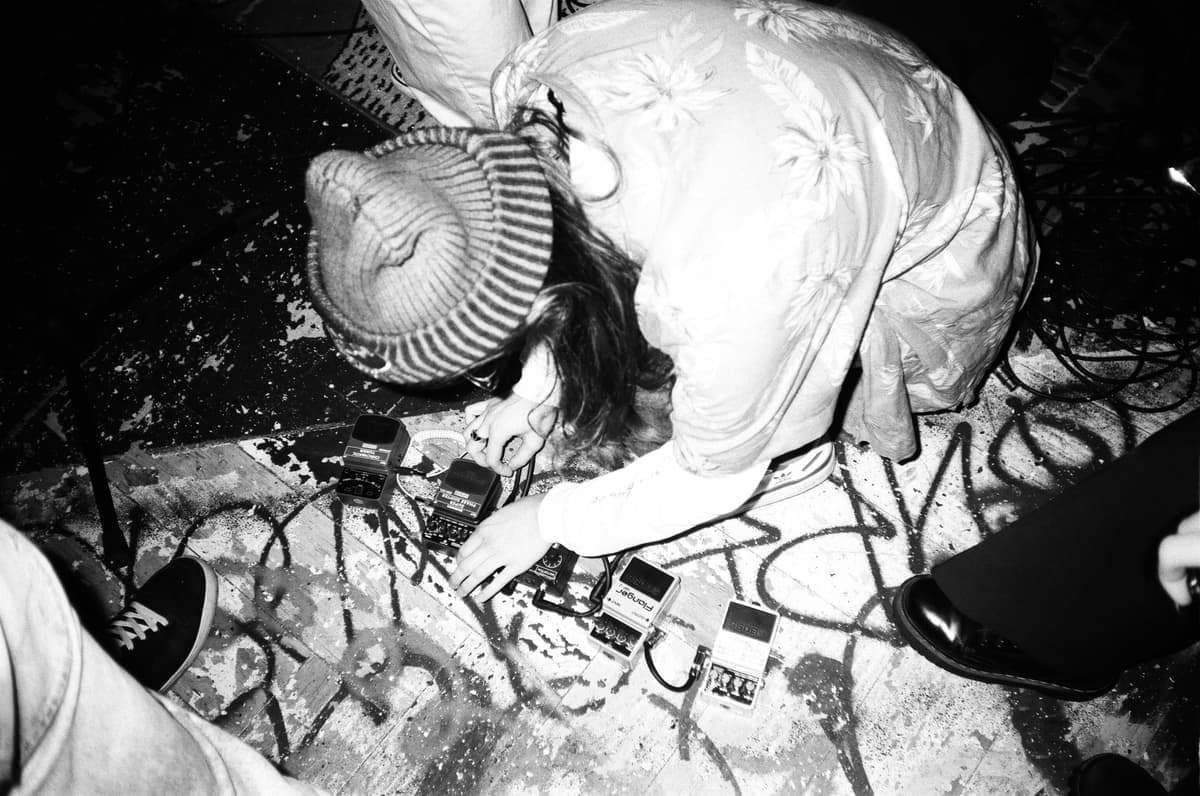
Both are hard-clipping distortions in the same price bracket, and the deciding difference is the tone control. The RAT's Filter is a low-pass — it removes treble and never touches your midrange, so the pedal stays audible in a band at any setting. The DS-1's Tone knob cuts mids as it adds treble, so the bright setting is also a scooped one. Buy the RAT if you play with other people; buy the DS-1 if you want the cheaper pedal with a published spec sheet and you are willing to keep the Tone low.
These two get cross-shopped constantly because they are the same category, roughly the same money, and both have a reputation for sounding smaller in a band than in a bedroom. Only one of them deserves that reputation, and the reason is a single control.
Which hard-clipping distortion
| # | Product | Best for | Price |
|---|---|---|---|
| 01 | 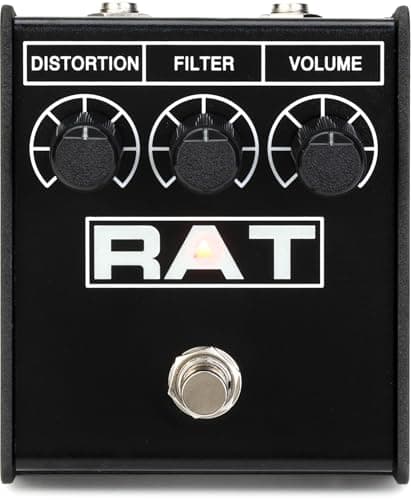 Pro Co RAT 2 The Filter is a low-pass that removes treble — it cannot scoop your mids, because it does not touch them. | Keeping your midrange when the band starts | $87.39 · Check price #ad How we’re funded · price as of September 14, 2026 |
| 02 | 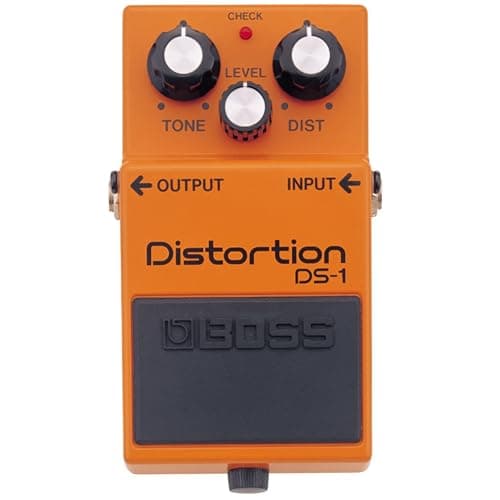 BOSS DS-1 Distortion Three knobs, hard clipping, and a Tone control that cuts mids as it brightens — the whole reputation problem in one knob. | A documented spec sheet and a lower price | $66.99 · Check price #ad How we’re funded · price as of September 14, 2026 |
Rows link to the full write-up further down this page. Prices come from the live price layer only — where there is no live figure the button reads “Check price” rather than showing a remembered number.
02What each maker publishes
| Pro Co RAT 2 | BOSS DS-1 | |
|---|---|---|
| Controls | Distortion, Filter, Volume | Dist, Tone, Level |
| Tone control type | Low-pass filter — turning it up removes treble | Treble tilt that cuts mids as it brightens |
| Can the tone control scoop your mids? | No | Yes, and that is the default direction |
| Input impedance | Not published | 1 M ohm |
| Output impedance | Not published | 1 k ohm |
| Current draw | Not published | 10 mA |
| Weight | Not published | 360 g |
| Enclosure | Steel, battery accessible without tools | Die-cast, screw-access battery compartment |
| Bypass | Not published | Buffered |
| Supply in the box | No | No |
Where a cell says not published, that is what the manufacturer states — Pro Co publishes almost no electrical data for the RAT, and no figure has been substituted from elsewhere.
That publication gap is a real difference rather than a debating point. If you are budgeting a shared power supply, the DS-1 can be planned exactly and the RAT cannot — you either measure it or leave headroom for it. Power requirements explained covers the method.
03The one control that decides it
A guitar competes with vocals and snare in the midrange. Remove your mids and you are occupying frequencies the rest of the band has already filled, which is heard as the guitar disappearing the moment everyone else starts playing.
The DS-1's Tone knob is wired so that brightness and mid-cut move together. Turn it up for cut and clarity, and you are also digging a hole exactly where you needed to be heard. It is avoidable — keep the Tone below halfway — but it means the most attractive-sounding setting in a shop is the worst setting on a stage.
The RAT's Filter cannot do that, because it is not a tone stack at all. It is a low-pass: fully counter-clockwise is maximum treble, and turning it clockwise progressively rolls the top end off. There is no midrange notch anywhere in its travel. You can make a RAT dark or bright, and at every position the mids are intact.
Pro Co RAT 2
Keeping your midrange when the band starts
The RAT clips hard, to ground: diodes shunt everything above a threshold, flattening the top of the waveform abruptly and generating a lot of harmonic content. That is where the aggression comes from, and it is why a low-pass filter is a more sensible tone control here than a treble boost would be.
The Filter runs backwards from a normal tone knob — turning it up removes treble rather than adding it. That sounds like a quirk and it is the single most useful thing about the pedal, because it means the control cannot scoop your midrange. Whatever you do to the Filter, the mids are still there, which is why a RAT tends to stay audible in a band when other distortions do not.
The cons: Pro Co publishes essentially no electrical data — no current draw, no impedance — so you cannot budget a supply output for it without measuring, and no adaptor is included. There is no clean-boost side to it either: at low Distortion the RAT is still a distortion, not an overdrive. And the Filter confuses everyone exactly once.
| Controls | Distortion, Filter, Volume |
|---|---|
| Filter control | Runs backwards from a normal tone knob — turning it up removes treble |
| Power | 9 V battery or a 9 V DC supply (adapter sold separately) |
| Enclosure | Steel, with the battery compartment accessible without tools |
| Electrical data | No current-draw or impedance figure is published for this pedal, so none is stated here. |
| What it does not do | No power supply included. There is no clean-boost side to it — at low Distortion the RAT is still a distortion, and the Filter control confuses everyone exactly once. |
Specs from Pro Co RAT 2 product page. We have not used this unit.
#ad How we’re funded · price as of September 14, 2026
BOSS DS-1 Distortion
A documented spec sheet and a lower price
The number10 mA, 1 M ohm in, 1 k ohm out, 360 g. All published by BOSS.
The DS-1 clips hard too, and consistently — the result is the same regardless of how hard you pick, which is what keeps a chord legible. Play a full open chord through one and the individual strings are still distinguishable, which is not true of most higher-gain pedals.
It is the better-documented product by a distance. BOSS publishes 10 mA, a 1 M ohm input, a 1 k ohm output and a 360 g weight, so it can be planned onto a shared supply exactly. It is also the cheaper of the two and carries BOSS's usual switch and enclosure.
The con is the Tone knob, and it is the reason this comparison exists. Turning it up adds treble and cuts mids together, so the setting that sounds exciting alone is the setting that vanishes under a band. Keep the Tone low and the mids largely survive, at the cost of a darker sound than most people want. No adaptor included, and it is buffered rather than true bypass.
| Controls | Tone, Level, Dist, pedal switch |
|---|---|
| Input impedance | 1 M ohm |
| Output impedance | 1 k ohm |
| Current draw | 10 mA |
| Power | 9 V battery (6F22 / 6LR61) or PSA-series adaptor |
| Size / weight | 73 x 129 x 59 mm, 360 g |
| What it does not do | No adaptor included, no true bypass. The single Tone knob scoops as it brightens, so a DS-1 into an already-scooped amp is the classic recipe for disappearing in a band mix. |
Specs from BOSS DS-1 specifications. We have not used this unit.
#ad How we’re funded · price as of September 14, 2026
04Where they genuinely sound different
- Chord legibility. Both keep chords more defined than a Big Muff does, because a single hard-clipping stage is consistent note to note. This is the main thing both have over the Muff family — Big Muff vs DS-1 covers that contrast.
- Top-end character. The RAT's harmonic content above the clipping threshold is aggressive and the Filter lets you tame it without losing body. The DS-1's brightness comes with the mid cut attached.
- Low gain settings. Neither is an overdrive. The RAT is still a distortion at low Distortion, and the DS-1 is still a distortion at low Dist — if you want grit that cleans up on the volume knob, both are the wrong category. Overdrive vs distortion vs fuzz sorts that out.
- Stacking behavior. A RAT in front of a driven amp adds aggression without much EQ change. A DS-1 in front of the same amp brings its tone-stack shape along with it.
05Which one for which player
- You play with a band. RAT. The Filter cannot scoop you out of the mix.
- You want the cheapest credible distortion. DS-1, and keep the Tone low.
- You need to plan a tight power supply. DS-1 — it is the one with published figures.
- You already own an EQ pedal. Either. An EQ after the DS-1 gives you most of the RAT's advantage, and best EQ pedals covers the options.
- You want the pedal to be your only dirt sound. RAT, for the midrange reason, unless you are certain the Tone discipline will hold.
- You play alone, into headphones. DS-1. The scooped setting that fails in a band sounds excellent on its own, and there is no band to fail in front of.
06Running both
There is little point. Both compress heavily, so the second in line is clipping a signal that has already lost most of its dynamic range, and what you get is more noise rather than more of anything useful. Two hard-clipping stages in series also raise the noise floor noticeably.
As a two-pedal dirt rig they make more sense switched than stacked — the DS-1 as one voice and the RAT as another. If you do run either into a high-gain amp, work out what kind of noise you actually have before buying a gate: your pedalboard hums covers the five faults that get described with the same word.
Frequently asked questions
+ Is the RAT better than the DS-1?
+ Why does the RAT's Filter knob work backwards?
+ Why does my DS-1 disappear when the band starts?
+ Can a RAT or a DS-1 work as an overdrive?
Sources
Related on Fret & Fuzz
Best distortion pedals
Hard clipping is predictable; the tone control is where these pedals differ. Four distortions compared, plus one that is mislabelled.
Best Distortion pick: Pro Co RAT 2
#ad How we’re funded · price as of September 14, 2026
Big Muff vs BOSS DS-1
Cascaded clipping against one hard-clipping stage — and the mid scoop they both have, for different reasons.
Top pick: BOSS DS-1 Distortion
#ad How we’re funded · price as of September 14, 2026

BOSS DS-1 vs MT-2 Metal Zone
The same reputation problem and opposite amounts of control over it. One tone knob against a sweepable parametric mid.
Top pick: BOSS DS-1 Distortion
#ad How we’re funded · price as of September 14, 2026
Fulltone OCD vs Pro Co RAT
Two pedals that are both further into distortion than their labels admit, and the backwards tone control that confuses everyone once.
Top pick: Fulltone OCD Obsessive Compulsive Drive
Best EQ pedals
Bands, decibel range and supply voltage. Three EQs compared, plus the 18 V requirement that strands power plans.
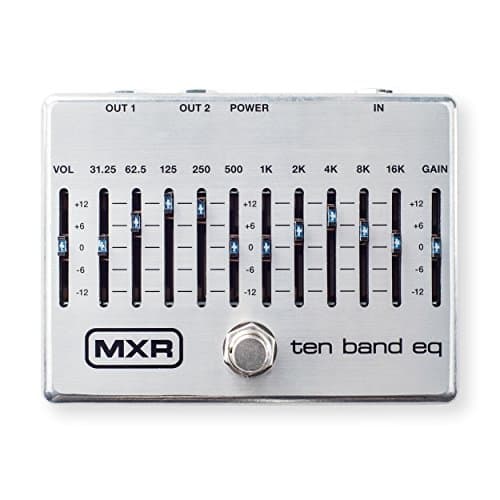
Best EQ Pedal pick: MXR 10 Band EQ
#ad How we’re funded · price as of September 14, 2026