BOSS DS-1 review
The most argued-about distortion pedal ever made, and almost every complaint about it traces to one knob.
Fret & Fuzz earns a commission when you buy through the links on this page. It costs you nothing and it does not decide what we rank. How we’re funded.
We have not played this gear. Every pick below is chosen from published manufacturer specifications and the arithmetic set out in how we research, which you can re-run yourself.
The DS-1 is worth buying if you want a hard-edged distortion to run into an amp that has midrange of its own, or if you are willing to pair it with an EQ pedal. Its three controls are Tone, Level and Dist, it draws 10 mA, and its input impedance is 1 M ohm so it is safe first in a chain. The single thing to know before buying: the Tone knob scoops the midrange as it brightens, so the control you reach for to cut through a band is the one that makes you disappear in it. Do not buy it as a metal pedal — it has no mid control and no low-end authority, and a DS-1 into a scooped high-gain amp is the most common way this pedal gets a bad reputation it does not entirely deserve.
We have not played this pedal, and this is not a tone review. What follows is BOSS's published specification, what each figure means in practice, and who should buy something else. How we research sets out the method.
01What BOSS publishes
| Specification | Published figure | What it means in practice |
|---|---|---|
| Controls | Tone, Level, Dist, pedal switch | Three knobs — there is no mid control to find |
| Input impedance | 1 M ohm | Safe first in a chain; will not load a passive pickup |
| Output impedance | 1 k ohm | Drives a normal amp input and a long cable comfortably |
| Current draw | 10 mA | Trivial on any supply, including a daisy chain |
| Power | 9 V battery (6F22 / 6LR61) or PSA adaptor | Adaptor sold separately |
| Bypass | Buffered, not true bypass | In your signal path when off — usually good, occasionally not |
| Size / weight | 73 x 129 x 59 mm, 360 g | Standard BOSS compact footprint |
Every figure is BOSS's own published specification. BOSS publishes no frequency response or gain-range figure for this pedal, so none is stated here.
The pedal
| # | Product | Best for | Price |
|---|---|---|---|
| 01 | 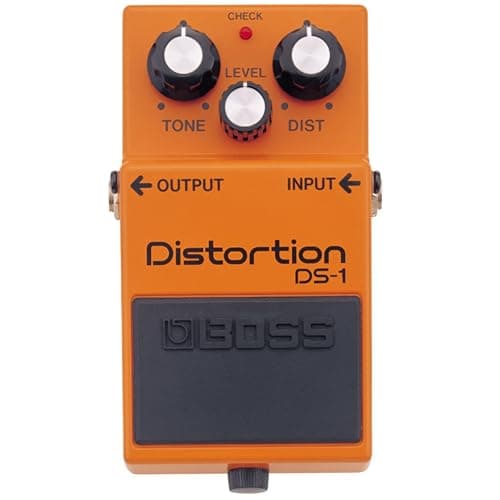 BOSS DS-1 Distortion Three knobs, 10 mA and a Tone control that takes midrange out as it adds treble. | A hard-edged distortion into an amp with mids to spare, or a platform for one EQ pedal |
Rows link to the full write-up further down this page. Prices come from the live price layer only — where there is no live figure the button reads “Check price” rather than showing a remembered number.
03The Tone knob, which explains almost every complaint
If you read one section, read this one. The DS-1 has a single Tone control, and it is not a treble knob — it is a tilt control that trades midrange for treble.
Turn Tone up and you get more high frequency and less midrange. Turn it down and you get more midrange and a duller top. There is no position that gives you both, because there is only one control and it is doing two jobs on opposite ends of a see-saw.
That matters because midrange is what makes a guitar audible in a band. A bass guitar occupies the bottom, cymbals and vocals occupy the top, and the space a guitar has to itself is in the middle. So the player who finds the DS-1 harsh turns Tone up to cut through, which removes exactly the frequencies that would have let them cut through, and ends up louder and less audible at the same time. Why does my DS-1 disappear in a mix? covers the same mechanism from the comparison side.
BOSS DS-1 Distortion
A hard-edged distortion into an amp with mids to spare, or a platform for one EQ pedal
The numberTone, Level, Dist. 1 M ohm in, 1 k ohm out, 10 mA, 73 x 129 x 59 mm, 360 g.
BOSS publishes a deliberately small specification for this pedal, and every figure in it is unremarkable except by implication: Tone, Level and Dist controls, 1 M ohm input and 1 k ohm output impedance, 10 mA current draw, a 9 V battery (6F22 / 6LR61) or PSA-series adaptor, and 73 x 129 x 59 mm at 360 g — the standard BOSS compact footprint.
The 1 M ohm input is worth noting because it means the DS-1 is a safe thing to put first in a chain: it will not load a passive pickup. 10 mA is almost nothing, so it never causes a power-supply problem. And the enclosure is the one everybody already knows is indestructible.
The cons are the pedal's whole reputation, and they are real. There is no adaptor in the box and no true bypass — the DS-1 is buffered, which is usually an advantage and occasionally not. The decisive one is the tone stack: the single Tone knob scoops as it brightens, so there is no way to add treble without removing midrange, and a DS-1 into an already mid-scooped amp is the classic recipe for disappearing in a band mix. There is no mid control, no gain-structure choice, and nothing on the pedal that can put back what the Tone knob takes.
| Controls | Tone, Level, Dist, pedal switch |
|---|---|
| Input impedance | 1 M ohm |
| Output impedance | 1 k ohm |
| Current draw | 10 mA |
| Power | 9 V battery (6F22 / 6LR61) or PSA-series adaptor |
| Size / weight | 73 x 129 x 59 mm, 360 g |
| What it does not do | No adaptor included, no true bypass. The single Tone knob scoops as it brightens, so a DS-1 into an already-scooped amp is the classic recipe for disappearing in a band mix. |
Specs from BOSS DS-1 specifications. We have not used this unit.
04Why it works so well into some amps and so badly into others
The DS-1's reputation varies more by amp than by player, and the tone stack above is why.
Into an amp with a strong midrange of its own — a small valve combo, a classic British voicing, anything that sounds mid-forward clean — the DS-1 works well, because the amp supplies the midrange the pedal does not emphasize. Into a modern high-gain amp already voiced with a mid scoop, the pedal removes midrange from a signal that had little, and the result is the thin, buzzy sound people describe.
This is also the practical test before buying: play the amp clean and listen to whether it sounds mid-forward or scooped. If it is scooped, a DS-1 is the wrong pedal for it unless you are also buying an EQ. Is a solid state amp good for pedals? covers the related question of what different amp types do to a pedal's voicing.
05Distortion, not overdrive, and why that distinction is the point
The DS-1 is a distortion pedal in the strict sense: it clips hard and it produces its own voice rather than amplifying your amp's. That is a different product from an overdrive, and buying one expecting the other is a common disappointment.
An overdrive's job is usually to push an amp that is already near breakup, so it leaves a lot of your original signal intact and adds a gentle compression. A distortion replaces your signal's character with its own — which is exactly what you want if your amp is clean and staying clean, and exactly what you do not want if you were hoping to make a good amp sound more like itself. At low Dist settings the DS-1 is still a distortion rather than a boost; it does not have a clean side.
Overdrive vs distortion vs fuzz sets out the three categories properly if that distinction is new, and Best distortion pedals covers the alternatives within this category.
06The cost question, and the one that matters more
The DS-1 has been continuously in production for decades and is one of the cheapest pedals of its type from a major maker. That is a genuine argument in its favor and it is also the reason it is argued about: a pedal this cheap gets bought as a first distortion by players who have no amp to pair it with and no EQ to fix it, and the pedal takes the blame.
The more useful way to think about the cost is as a pair. A DS-1 plus a graphic EQ is still less than most single boutique distortion pedals, and that combination addresses the one real limitation in the specification. If the budget is for exactly one pedal and your amp is mid-scooped, spend it on something with a mid control instead — the MT-2 Metal Zone publishes a parametric mid, which is the specification the DS-1 lacks.
07Who should buy something else
Anyone playing modern metal. The DS-1 has no mid control, no low-end authority and no gate, and the sounds that style depends on are built out of exactly those things. Best amps for metal and Best distortion pedals are the relevant pages.
Anyone who wants a pedal that cleans up on the guitar's volume knob, because the DS-1 does not do that in any useful way. And anyone whose amp is already mid-scooped and who is only buying one pedal, for the reasons above.
Everyone else is buying a durable, cheap, well-understood distortion with one documented weakness and a known fix. That is a reasonable thing to buy, and it is roughly why it has been on sale this long.
Frequently asked questions
+ Is the BOSS DS-1 any good?
+ Why does my DS-1 sound thin?
+ Is the DS-1 good for metal?
+ Does the BOSS DS-1 have true bypass?
+ How much current does the DS-1 draw?
+ What pedal fixes the DS-1's midrange problem?
Sources
Related on Fret & Fuzz
BOSS DS-1 vs Pro Co RAT 2
Both clip hard. One control removes treble and one removes mids, and that is the whole difference in a band.
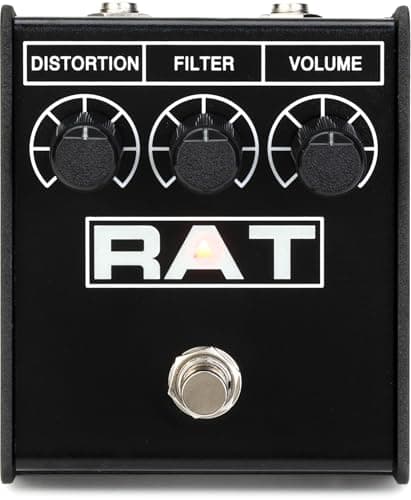
Top pick: Pro Co RAT 2

BOSS DS-1 vs MT-2 Metal Zone
The same reputation problem and opposite amounts of control over it. One tone knob against a sweepable parametric mid.
Top pick: BOSS DS-1 Distortion
Best distortion pedals
Hard clipping is predictable; the tone control is where these pedals differ. Four distortions compared, plus one that is mislabelled.
Best Distortion pick: Pro Co RAT 2
Big Muff vs BOSS DS-1
Cascaded clipping against one hard-clipping stage — and the mid scoop they both have, for different reasons.
Top pick: BOSS DS-1 Distortion