Pro Co RAT 2 review
One knob on this pedal turns the wrong way on purpose, and understanding why is most of what there is to know about it.
Fret & Fuzz earns a commission when you buy through the links on this page. It costs you nothing and it does not decide what we rank. How we’re funded.
We have not played this gear. Every pick below is chosen from published manufacturer specifications and the arithmetic set out in how we research, which you can re-run yourself.
The RAT 2 is worth buying if you want a thick, midrange-forward distortion that stays usable at low gain settings — it is the opposite of a mid-scooped pedal, and that is its whole appeal. Its three controls are Distortion, Filter and Volume, and the one thing to know before you plug it in is that Filter runs backwards: turning it up removes treble rather than adding it. Do not buy it expecting a transparent overdrive, because at low Distortion it is still a distortion with its own voice. And know going in that Pro Co publishes no current draw and no impedance figures for it, so it is a pedal bought on reputation rather than on a spec sheet.
We have not played this pedal, and this is not a tone review. What follows is what Pro Co publishes, what it conspicuously does not, and who should buy something else. How we research sets out the method.
01What Pro Co publishes, and what it does not
This section is unusually short, and the shortness is the finding. Pro Co is one of the makers that publishes almost no electrical data, and on this site that gets stated rather than filled in.
| Specification | Published figure | What it means in practice |
|---|---|---|
| Controls | Distortion, Filter, Volume | Three knobs, one of which is counter-intuitive |
| Filter control | Runs backwards — turning it up removes treble | A low-pass you dial in, not a treble boost |
| Enclosure | Steel | Heavier and more rigid than a folded-aluminum box |
| Battery access | Compartment opens without tools | A real convenience nobody mentions until a gig |
| Power | 9 V battery or 9 V DC supply | Adapter sold separately |
| Current draw | Not published by Pro Co | Assume it is small; no figure exists to budget with |
| Impedances | Not published by Pro Co | Its interaction with a pickup or a buffer is undocumented |
Pro Co publishes no current-draw or impedance figure for the RAT 2. There is a great deal of circuit lore attached to this pedal online, including specific op-amp part numbers; none of it appears on Pro Co's own product page, so none of it is stated here as fact.
The pedal
| # | Product | Best for | Price |
|---|---|---|---|
| 01 | 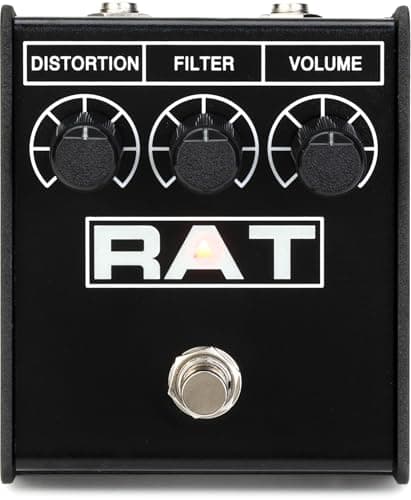 Pro Co RAT 2 Three controls, one of which runs backwards, in a steel box with a battery door you can open by hand. | A thick, midrange-heavy distortion that still works at low gain settings |
Rows link to the full write-up further down this page. Prices come from the live price layer only — where there is no live figure the button reads “Check price” rather than showing a remembered number.
03The backwards Filter knob, and why it is not a mistake
Every new RAT owner turns the Filter clockwise expecting brightness and gets mud. It is worth understanding what is actually happening, because it changes how you set the pedal.
A normal tone control on a distortion pedal is a treble emphasis: the pedal's unaltered output is darker than you want, and the knob adds high frequency back. The RAT's Filter is the other arrangement — the pedal's unaltered output is already bright and full, and the knob is a low-pass filter that progressively removes treble as you turn it up.
The practical consequence is that you set this pedal from the other direction. Start with Filter at minimum, which is the pedal at its most open, and add filtering until the harshness goes. On a bright amp you may end up at nine or ten o'clock; on a dark amp you may never leave minimum. Players who set it the way they set every other pedal spend their first week thinking the pedal is muffled.
Pro Co RAT 2
A thick, midrange-heavy distortion that still works at low gain settings
The numberDistortion, Filter, Volume. Filter removes treble as you turn it up. 9 V battery or supply (not included).
Pro Co publishes very little about this pedal, and what it does publish is mostly mechanical: Distortion, Filter and Volume controls, a steel enclosure, a battery compartment accessible without tools, and operation from a 9 V battery or a 9 V DC supply with the adapter sold separately.
The control worth the paragraph is Filter, which Pro Co describes as running backwards from a normal tone knob — turning it up removes treble. That is not a quirk to work around; it is a different design decision. A conventional tone control is a treble boost you dial in. The RAT's is a low-pass filter you dial in, which means the pedal's natural state at Filter fully counter-clockwise is bright and full, and you are subtracting from there.
The cons start with what is not published. Pro Co states no current draw and no impedance figures at all for the RAT 2 — our product entry carries that as the stated absence rather than a number from elsewhere, because the figures are not available from the maker. There is no power supply in the box. And there is no clean-boost side to this pedal: at low Distortion settings a RAT is still a distortion, not a transparent drive, so it will not do the job of an overdrive. The Filter control also confuses every new owner exactly once.
| Controls | Distortion, Filter, Volume |
|---|---|
| Filter control | Runs backwards from a normal tone knob — turning it up removes treble |
| Power | 9 V battery or a 9 V DC supply (adapter sold separately) |
| Enclosure | Steel, with the battery compartment accessible without tools |
| Electrical data | No current-draw or impedance figure is published for this pedal, so none is stated here. |
| What it does not do | No power supply included. There is no clean-boost side to it — at low Distortion the RAT is still a distortion, and the Filter control confuses everyone exactly once. |
Specs from Pro Co RAT 2 product page. We have not used this unit.
04Where it sits against the other classic hard-clipping pedals
This site's comparison pages do this in detail, and the short version is worth having here.
- Against a DS-1: the RAT is thicker and more mid-forward, the DS-1 brighter and more scooped, and the difference comes down to each pedal's single tone control working in opposite directions. BOSS DS-1 vs Pro Co RAT 2 covers it properly.
- Against an OCD: a genuinely close call and the comparison this site ranks best for. The OCD is the more amp-like of the two and has a second gain mode; the RAT is the more characterful. Fulltone OCD vs Pro Co RAT covers which for which player.
- Against a Big Muff: not really the same category. The Muff is a fuzz with a fixed mid scoop and enormous sustain; the RAT is a distortion with a mid emphasis. Big Muff vs RAT covers the stacking question too.
- Against a Blues Driver: the BD-2 is a low-gain overdrive that cleans up on the guitar volume knob, which the RAT does not do. RAT vs Blues Driver is the page.
05The steel box and the battery door
Two of the three things Pro Co publishes about this pedal are about the enclosure, which tells you something about where the design effort went.
A steel enclosure is heavier and more rigid than the folded aluminum most pedals use. On a board bolted to a case that difference is irrelevant; on a floor being stepped on in a venue it is the reason these pedals survive decades. The tool-free battery compartment is the kind of detail that sounds trivial in a review and matters enormously at the one gig where your supply fails — most compact pedals require a coin or a screwdriver and a flat surface.
What you do not get is a power supply, and because Pro Co publishes no current figure you cannot budget it precisely on a shared brick. In practice an analog distortion of this type draws very little, but 'in practice' is doing real work in that sentence and there is no published number behind it. Pedalboard power requirements explained covers how to handle a pedal with no published draw.
06Who should buy something else
Anyone who wants a transparent overdrive that leaves their amp's character intact. The RAT has a strong voice of its own at every setting, and at low Distortion it is a quieter version of that voice rather than a clean boost. Transparent overdrives compared is the page for that requirement.
Anyone who needs a pedal that cleans up when they roll their guitar volume down, which this does not do convincingly. And anyone who buys on published specification — if a pedal with no stated current draw and no stated impedances is uncomfortable, that discomfort is reasonable and the BOSS compacts publish all of it.
Everyone else is buying one of the few distortion pedals with a genuinely distinctive mid-forward voice, in a box that will outlive the guitar. Best distortion pedals sets it against the field.
Frequently asked questions
+ Is the Pro Co RAT 2 worth buying?
+ Why does the RAT's Filter knob work backwards?
+ How much current does a Pro Co RAT 2 draw?
+ Is the RAT 2 a distortion or an overdrive?
+ RAT 2 or BOSS DS-1?
+ Does the RAT 2 come with a power supply?
Sources
Related on Fret & Fuzz
BOSS DS-1 vs Pro Co RAT 2
Both clip hard. One control removes treble and one removes mids, and that is the whole difference in a band.
Top pick: Pro Co RAT 2
Fulltone OCD vs Pro Co RAT
Two pedals that are both further into distortion than their labels admit, and the backwards tone control that confuses everyone once.
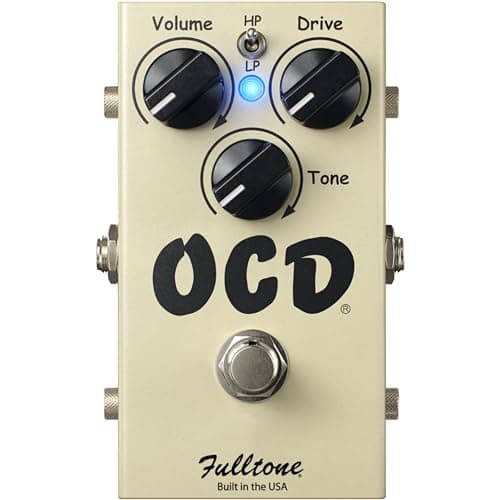
Top pick: Fulltone OCD Obsessive Compulsive Drive
#ad How we’re funded · price as of November 1, 2026
Big Muff vs RAT
Cascaded clipping versus one hard-clipping stage — sustain against articulation, and which survives a mix.
Top pick: Pro Co RAT 2
Best distortion pedals
Hard clipping is predictable; the tone control is where these pedals differ. Four distortions compared, plus one that is mislabelled.
Best Distortion pick: Pro Co RAT 2